
For the first time since the early 2000s, South Carolina will have at least one Democratic U.S. senator.
Read more Methanol tanker fire closes part of US 421 in Sampson County, residents evacuated
Dr. Annie Andrews, the Charleston Democrat, pediatrician and gun control advocate, won South Carolina’s U.S. Senate race, ousting U.S. Sen. Darline Graham, who was appointed in July to complete her late brother’s term.
Andrews became the first woman elected to the U.S. Senate from South Carolina.
The Associated Press called the race at 10:39 p.m.
“South Carolina, I think we just made history,” Andrews said as she took the stage.
In her speech, Andrews said she talked to Graham and thanked her for her love for South Carolina. Later in her speech, Andrews said she “was not handed a seat” and “did not read from a script,” referring to Graham.
Darline Graham said she called Andrews to congratulate her on the victory.
The last time a Democrat won a statewide election in South Carolina was in 2006 when Jim Rex was elected state superintendent of education. The last time a Democrat was elected to the U.S. Senate from South Carolina was when Fritz Hollings was reelected in 1998.
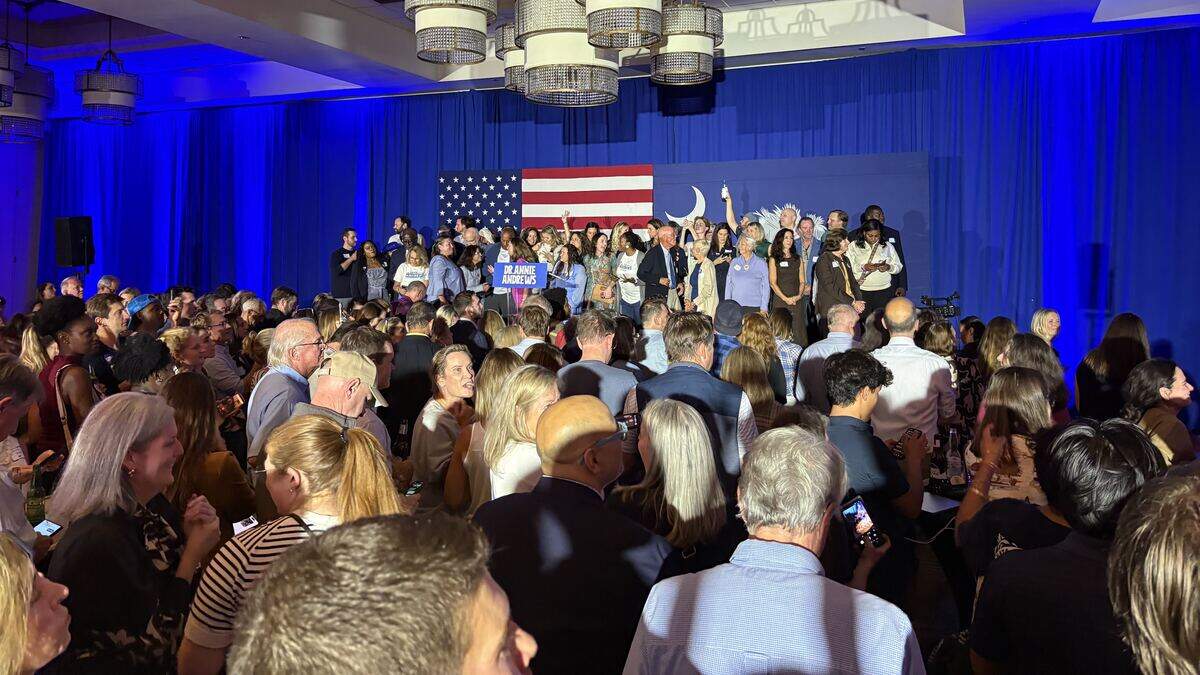
The vibe at Andrews’ party was ecstatic early as the results came in.
As the first results rolled in, people at the Charleston Marriott cheer as Democrat Dr. Annie Andrews took an early lead.
With MSNBC on in the background, public supporters of Andrews cheer anytime a Democrat won or was projected to win, most notably when North Carolina Democrat Roy Cooper flipped the Senate seat.
The Andrews victory in a state that is reliably Republican in statewide elections comes amid high disapproval nationwide for the GOP and President Donald Trump. The party that controls the White House traditionally sees losses in midterm elections.
Disapproval of Trump comes amid high gas prices because of the war with Iran and as people worry about affordability. His approval rating is underwater in a state he won three times. Only 42% of South Carolinians approve of the president, while 55% disapprove, according to a New York Times/Sienna Poll.
Andrews had more resources for her campaign than Darline Graham.
Andrews raised $24.2 million for her campaign and helped energize the party. She was aggressive with her own television advertising and had billboards displayed in the Upstate, an area that is dominated by conservative voters.
Graham trailed in fundraising and had to rely on outside groups, including the National Republican Senatorial Committee and Senate Leadership Fund, to advertise on television to support her campaign or attack Andrews.
According to FEC reports, Darline Graham only raised $1.9 million during the cycle.
“I cannot begin to tell you how proud I am to have been our party’s nominee and how hard our team fought,”
Read more NCHSAA announces 2026 boys NC high school soccer playoff bracket
The Graham campaign sought to portray Andrews as radical, while people questioned during the race if Graham was qualified for the office.
According to CBS News exit polling, 63% of voters did not think Darline Graham had the experience to be a U.S. senator, and only 51% of voters thought Andrews was too extreme.
“The lack of enthusiasm for President Trump, (Graham’s) lack of experience campaigning, but one thing to not discount: Annie Andrews is a darn good candidate,” said Scott Huffmon, a political science professor at Winthrop University. “She has done a phenomenal job fundraising. She’s done a phenomenal job with message discipline.”
Republican Gov. Henry McMaster, who is leaving office in January, dismissed the notion that the reliably red state was turning purple despite Andrews’ victory.
“I would say it would be an indicator that we have more people voting in that direction than we used to, but I don’t think that would be enough of a signal that the state has changed because I don’t think it may have changed a little bit, but (it) goes up and down. But this is basically a conservative state,” McMaster said.
GOP voters and donors were reluctant to support Darline Graham because she was relatively unknown until her appointment to the U.S. Senate. Graham trailed in fundraising and had to rely on outside super PACs to advertise on television to support her campaign or attack Andrews.
Andrews spoke last week in Columbia about Graham’s support from outside groups and how Trump came down to South Carolina twice in two weeks to campaign.
“I think it speaks volumes about the weakness of my opponent that she continues to have her campaign be rescued by powerful people from Washington D.C.,” Andrews told reporters Tuesday. “For me, this campaign is about South Carolina, and I will always put South Carolina first.”
According to Ad Impact, $101.1 million was spent on television advertising in South Carolina’s Senate race.
It’s also the third time this year South Carolina went against Trump’s wishes.
The state Senate rejected a White House push to undertake middecade redistricting. Voters also opted against his first choice for South Carolina governor. Lt. Gov. Pamela Evette, who was endorsed by Trump in May, finished first in the primary, but handily lost the runoff to Attorney General Alan Wilson. Shortly before the runoff, Trump hedged his bet and issued a dual-endorsement in the South Carolina governor’s race.
The State’s Joseph Bustos reported from Columbia. The Island Packet’s Madison Roth reported from Charleston.
This story was originally published November 3, 2026 at 10:42 PM with the headline “For the first time since 1998, South Carolina elects a Democratic U.S. senator.”
Read more Popular Wake County preserve along the Neuse River gets a little bigger