
AI-generated summary reviewed by our newsroom.
Data centers have been on the tip of everyone’s tongues lately.
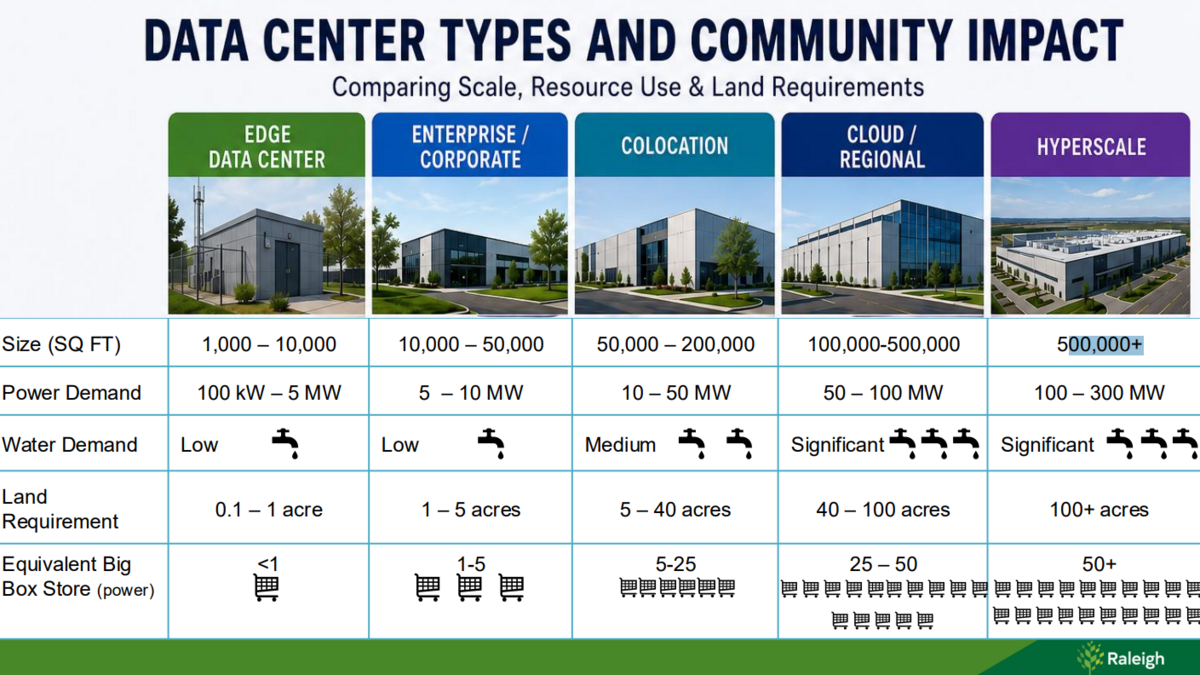
The controversy circling them is centered around their environmental impact and potential economic benefits to surrounding communities. As artificial intelligence use increases, large amounts of water and electricity are needed to power and cool the servers running within these often large buildings.
Read more ‘Black buildup’ and ‘pink slime’ at Durham chain restaurant: latest inspections
In North Carolina, the conversation about these facilities play out in town halls and county commissioners meetings as residents have pushed for their communities to be left data center-free.
A poll conducted by Elon University found that 44% of North Carolina residents would oppose a data center being constructed in their area and 24% would support the economic newcomers. The poll revealed that opposition exists across party lines, race, age, income and education while endorsements can be found in similar demographics.
The News & Observer previously reported that Charlotte, along with dozens of other local communities, hit pause on the data center boom. Many realized that their ordinances have no infrastructure for the large amounts of noise, energy usage, water demand and heat islands that these developments bring.
Natelli Investments sought to build a 300-megawatt center earlier this year in Apex before halting due to resident pushback and town zoning laws.
“No state has excess water. They don’t look for that, they just look for land,” Rania Masri, co-director and director of organizing communications and policy for North Carolina Environmental Justice Network said. “That puts at risk rural communities in North Carolina, but let us not think that it is only rural communities in North Carolina that are at risk.”
Marsi noted almost every county in the state is experiencing drought; “In the midst of this, should we be welcoming large water users to come into our state?”
The Environmental and Energy Study Institute reported that large data centers can consume up to 5 million gallons of water per day. The usage is equivalent to the water use of a town populated by 10,000 to 50,000 people. (Raleigh’s 2026 population sits around 514,000.; Charlotte’s around 982,000.)
Read more NC lawmakers again pledge money to help private jet company expand in Eastern NC
“Water does not know county borders, water does not know city borders. Water does not respect political boundaries,” Masri said. “We’re talking about the cost that will impact us all, both directly and indirectly.”
Data center supporters appreciate the possibility for new jobs and economic success that these developments can bring to an area. North Carolina Connects credits data centers with employing more than 25,000 people in 2024 and generating more than $1.39 billion in state and local tax revenue.
In May, Amazon broke ground on a $10 billion data center in Richmond County between Raleigh and Charlotte. “This investment will position North Carolina as a hub for cutting-edge technology, create hundreds of high-skilled jobs, and drive significant economic growth,” David Zapolsky, Amazon’s chief global affairs and legal officer, said in a statement.
Currently, North Carolina provides sales and use tax exemptions for data centers. In the freshly approved budget, one of these exemptions was removed, meaning data centers have to pay taxes on their electricity generating some state revenue. The remaining tax exemptions could collect millions for state usage.
Masri challenges data centers’ claim of local economic success. “The main jobs that AI data centers do bring are construction jobs, and typically those are workers that move with the data center. They’re not local,” Masri said.
There are multiple ways to get informed on this topic. Clean Water North Carolina and North Carolina Environmental Justice Network connect people to organizing resources depending on interest. For a more direct approach, Masri invites people to reach out to their county leaders to be heard.
“I think it’s also fundamental that we raise this as a critical issue in the midterm elections,” Masri said. “We need to make sure that those people that we give our vote to represent our best interest, and right now the development of AI data centers is a midterm election issue.”
Read more Duke Energy ends wind lease off NC coast. Lawmaker calls it a Trump ‘pattern’
The News & Observer’s Brian Gordon contributed to this report.