
AI-generated summary reviewed by our newsroom.
The future of North Carolina’s booming hemp industry could be decided by lawmakers this week.
Read more Duke basketball player was ‘ahead of his time’ promoting change in college sports
But that won’t happen without pressure from both sides. Tuesday is shaping up to be a big advocacy day. Hemp business owners and employees are expected to rally at the legislature, calling for a bill with regulations on hemp not to pass the House and arguing it would amount to a complete ban on hemp products.
The Senate has already passed the hemp regulations bill. If the House passes it too, it would still need Democratic Gov. Josh Stein’s signature to become law, or he could veto it.
“We’re actually trying to make it bigger than the shrimp debacle,” said Melissa Johnston, a leader in the hemp business advocacy efforts and Vice President of Strategic Development at Tryon Distributing, a beer and fine wine distributor that sells hemp beverages.
Johnston was referring to large protests at the legislature in 2025 sparked by a failed attempt by lawmakers to ban inshore trawling in North Carolina’s sounds.
“It feels more like a ban bill disguised as a regulation bill,” Johnston said, describing the hemp bill as “essentially saying like, hey, we’re not going to outlaw alcohol, but you just can’t have a beer with anything more than 0.4 percent” alcohol by volume. She said many in the hemp industry had called for “sensible” regulation bills across the years but this version “seemingly popped out of nowhere.”
Tryon Distribution and Johnston launched the “Regulate, Don’t Ruin” campaign, which seeks to inform consumers about the impending federal and state bans and encourage them to reach out to lawmakers. The campaign also shares the stories of those who use hemp products and how they’ve affected their lives, such as veterans using the products to sleep, and women managing menopause symptoms, Johnston said. She’s also heavily involved with the newly formed NC Hemp Businesses for Responsible Regulation, which grew out of a letter-signing campaign against the hemp bill that has attracted more than 100 signatures representing various companies.
Meanwhile, various law enforcement agencies are holding a press conference Tuesday morning in support of the legislation.
“Sheriffs in particular are concerned about the ability for children to have access to intoxicating material,” that is “often sold in a gas station or a vape or tobacco shop, and it is packaged in a way that is enticing to children and when tested by law enforcement is often at a very intoxicating level,” said Lauren Earnhardt, deputy executive vice president of the North Carolina Sheriffs’ Association.
The legislation, House Bill 328,would prohibit hemp use by anyone under 21 and mirrors a new federal definition of hemp that is set to take effect Nov. 12.
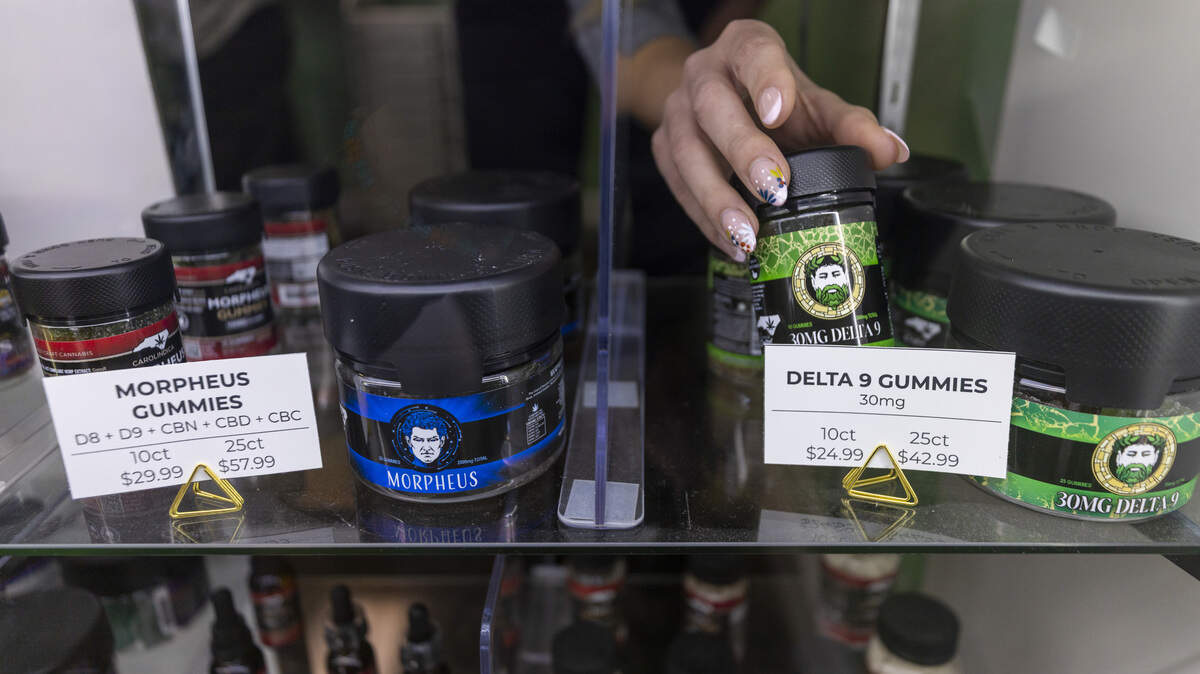
Hemp comes from the cannabis plant, like marijuana. But unlike it, it is not only legal but also has no age restrictions on use — and is largely unregulated.
Tetrahydrocannabinol is the psychoactive cannabinoid in the cannabis plant, and what separates legal hemp from illegal marijuana is the concentration of delta-9 THC — the specific compound responsible for the classic “high.” Under current federal law, hemp must contain 0.3% or less delta-9 THC by dry weight. But delta-9 isn’t the only form of THC — other types, like delta-8, are not currently counted toward that limit. The new definition would change that by measuring total THC. Under the bill, hemp products could contain no more than 0.3% total THC, or 0.4 mg of total THC per container.
The legislation also would ban synthetic kratom products and restrict the use of regular kratom products to those 21 and over. It would also make xylazine a Schedule III controlled substance. Drugs in that schedule have a currently accepted medical use and less risk for abuse compared to other more restricted drugs. Xylazine is not currently a scheduled drug in the state.
Stein on X on Monday said that “tomorrow the House is considering a bill that aims to eliminate the Wild West that is North Carolina’s THC market. For some reason, the bill also legalizes kratom, an opioid-like substance sometimes called gas station heroin.”
And while the state bills mirror the federal impending ban, the federal government itself has signaled it may revise or delay the standard.
The legislation is coming in the form of a conference report — a type of legislation that follows after the two chambers disagree on an initial bill and appoint a small group of lawmakers to negotiate a compromise. That type of legislation cannot be amended on the floor.
For years, lawmakers in the GOP-led legislature have struggled to figure out what to do with the industry — which saw explosive growth after the federal government legalized hemp in 2018 via the Farm Bill.
Legislation over the years has included various proposals — some more limited, some more expansive. But largely all have included age restrictions.
Democrats in the state legislature have also largely supported some form of marijuana legalization. They’ve sponsored bills and voted in favor of Republican-drafted proposals that ultimately failed. Stein also created a council to study and recommend a comprehensive, statewide approach to cannabis policy. That council recommended North Carolina establish a legal, regulated marijuana and hemp market for adults.
As for this year’s bill, the compromise version came out in early July, on a day dominated by final votes on the state budget as the legislature wrapped up its work for the month. Hemp legislation was added to the Senate calendar and passed in that chamber just a couple of hours later with bipartisan support, 37-6. All votes against were Democrats.
In its original form, HB 328 would have required public schools to adopt policies prohibiting hemp-derived consumable products in school buildings, on school grounds and at school-sponsored events. It also would have expanded the state’s definition of tobacco products to include vapor products, making them subject to existing laws restricting tobacco use in schools. Last June, the Senate rewrote the bill, expanding it into a measure that would have effectively banned most hemp products currently on the market.
Read more House committee recommends sanctions for Rep. Edwards. Read the report, his response
The House rejected those changes on April 21, the first day back in this year’s short session. On June 23, the Senate and House appointed a small group of lawmakers to attempt to negotiate a compromise.
Earnhardt told The N&O that the Sheriffs’ Association has supported hemp legislation versions in the past, but “they’ve gotten very little to no traction at the General Assembly,” and this session, “there hasn’t been anything that’s moved about hemp or about this topic except for this bill.”
She said the association has asked for similar legislation in the past, though it did not request this specific version, and has particularly wanted to keep these products out of kids’ hands. She said they were not aware of this particular bill version until it came out as a conference report.
“When all law enforcement is in agreement on an issue — that even at the state level, local level, when we all agree on a public safety issue — I think people should pay attention and take notice,” she said.
Tuesday’s press conference is helmed by Rep. Reece Pyrtle, a Rockingham County Republican and a retired police chief, along with law enforcement leaders including from the NC Conference of District Attorneys, NC Association of Chiefs of Police, NC Police Executives Association, NC Alcohol Law Enforcement Division, NC State Bureau of Investigation, and NC State Highway Patrol. Notification of the press conference was sent out via email from House Speaker Destin Hall’s office. Hall controls what bills come to the floor for a vote.
In a letter first reported by WUNC News and shared by Earnhardt with The N&O, various law enforcement agencies called for passage of the legislation, saying it was a “high priority.”
“Do not be fooled by those attempting to tell you that this conference report is bad or contains some hidden trick because it appeared ‘all of the sudden’ at the end of session. That is not true,” the letter says. “Let us be clear, failing to adopt this conference report means that anyone, no matter their age, will continue to be able to buy intoxicating THC products from any retailer that wishes to sell them without legal consequence in North Carolina.”
“The only people and businesses who would oppose this conference report are those who are profiting from, and promoting a business model that thrives on, selling intoxicating substances to North Carolina’s children,” it says.
That’s not true for Lauren Miller, co-founder of Wims, a North Carolina hemp beverage company.
Miller said her business ensures its products are “safe and labeled and tested.” The company, started by her and her father on their family farm in Summerfield, has grown in two years into a nationally recognized brand. It now employs more than 15 people at the farm and manufactures its products at a facility in Roxboro, said Miller.
“This ban would destroy us overnight — not only our business but also our manufacturer in Roxboro,” Miller said. “You have a lot of very responsible operators in North Carolina, and there are some bad actors that need to be regulated out. A ban would actually destroy all the responsible businesses and create room in a black market for the less responsible operators that need to be regulated.”
For Miller, the ban would mean firing all 15 employees at the Summerfield farm. And should the federal government eventually implement a fix or exemption, she said, the business would relocate to another state.
Miller said the bill could also effectively kill most CBD products, she said.
CBD, short for cannabidiol, is another compound found in the hemp plant. Unlike THC, it doesn’t get you high and it’s commonly sold in oils, gummies, and lotions marketed for things like pain relief or anxiety. The problem, Miller said, is that many CBD products are made using the whole hemp plant rather than just purified CBD and can end up with trace amounts of THC mixed in.
Miller said the manufacturing partner in Roxboro produces both full-spectrum and CBD-isolate products, but would still be wiped out under the bill because demand for CBD-isolate products alone isn’t enough to sustain the facility.
A ban would also lead to layoffs at Johnston’s company, which has hired a sales team around the growing hemp industry. Local brewery owners have also started making hemp beverages to help keep their doors open amid rising hospitality-industry costs, she said.
The call to refrain from taking up the hemp bill has drawn support beyond the hemp industry itself, including from the North Carolina Restaurant and Lodging Association, the North Carolina Brewers Guild and the Law Enforcement Action Partnership, a national organization of current and former law enforcement professionals.
That nonprofit group sent a letter to Hall saying it agreed with the need for a minimum purchase age for hemp products but disagreed with bundling it with a broader ban. It called for using another bill as a vehicle — such as Senate Bill 328, which includes a hemp age restriction added to the bill, and passed the House nearly unanimously more than a year ago but stalled in the Senate.
Hall said in early July after the House left without taking up the conference report that he personally supported “cracking down on these substances that are sold in gas stations,” noting some products are harmful to anyone while others pose risks specifically to people under 21.
“You strike the right balance, but I’d rather err on the side of caution in terms of getting those things out of the marketplace, and I think our caucus generally agrees with that position as well. They just need some time to study,” the bill.
Read more UNC basketball eyes freshly eligible bigs for Michael Malone’s roster. The latest
“If the caucus wants to do it, it’ll get a vote,” Hall told reporters.