
AI-generated summary reviewed by our newsroom.
Waitlists. Late-night stress. Failed class enrollments. Concerned parents. Bad schedules. Glitchy technology. Overworked instructors.
Read more Charge dropped against ex-Chapel Hill cop accused of plotting New Orleans mass shooting
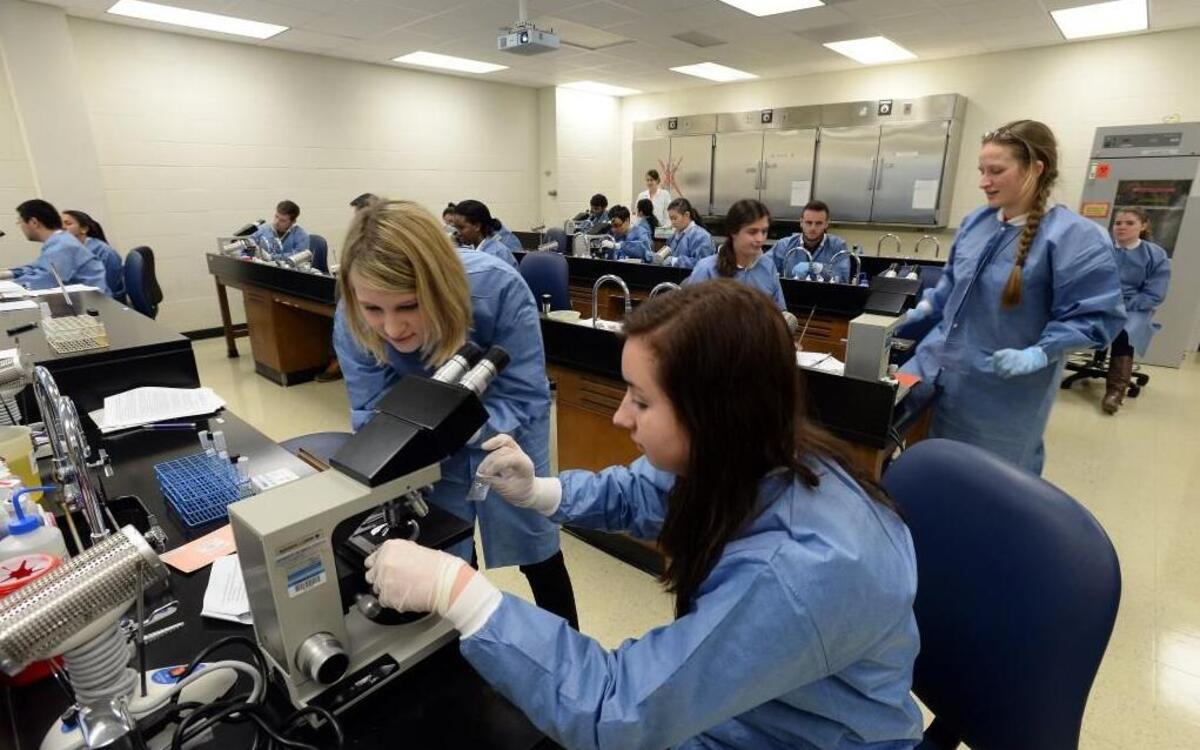
These are some of the problems that plague course registration at UNC-Chapel Hill — particularly for students who want, or need, to take chemistry and biology labs and other popular STEM classes.
“It’s a very intense part of going to school at Chapel Hill,” said Arianna Smith-Barnes, a second-year nursing student. For nursing majors, there are a number of prerequisites a student must complete as an underclassman before officially applying for the major — including high-demand courses like microbiology and anatomy.
Each year, it’s a struggle to figure out how to get all her required courses done on time, Smith-Barnes said. The experience, for her, is nerve-wracking and emotionally draining.
“You have to have backups for basically every single class because you most likely aren’t going to get it the first time,” she said. “It’s very competitive to get into classes. I have friends who post the classes they want to register for on their Instagram stories, and it’s all: failed, failed, failed.”
It’s not unusual for a large public university to struggle in this department. There are more than 22,000 undergraduates at Chapel Hill, and a limited number of seats in classes. But UNC is chasing record student enrollment, meaning the problem is growing more pressing. The school hopes to add 5,000 students by 2034.
At a recent board of trustees meeting, its university affairs committee engaged in a lengthy conversation about registration struggles — much to the delight of student body president Devin Duncan, who has a seat on the board.
It’s not typically the kind of issue that gets a lot of airtime at trustees’ meetings, he said.
“I was so happy that conversation took place because that’s what the board should be focused on: student experience and how our students are experiencing our campus,” Duncan told The News & Observer. “Sometimes I think that we don’t have enough emphasis on the student experience, and so having that conversation I thought was special.”
Many trustees have heard complaints from parents about registration. They want clearer data on how many students aren’t getting into the classes they need to graduate on time — as well as a plan and a timeline to fix the problem.
The data issue is tricky, according to Eric Hastie, an associate professor of biology at UNC tasked with easing some of the enrollment demand that afflicts his department. Waitlist numbers don’t capture true demand, because students register for multiple sections of the same class in anticipation that they’ll get denied from at least one, or because one is more desirable.
In a biology lab class he’s teaching this semester, there are 720 seats and a waitlist of about 158 students, but that includes some students who may already be enrolled in a different section.
The biggest bottleneck in registration, according to Provost Magnus Egerstedt, is those lab courses.
“The two areas where there is the highest demand is our biology labs and our chemistry labs,” Egerstedt said. “As part of our enrollment growth strategy, we’re investing quite a lot in new labs in those particular areas. All the data shows that for the first two years, that is where the constraint is more than anything else.”
Chancellor Lee Roberts has said repeatedly that the university’s undergraduate majors were once split equally between social sciences, humanities and STEM. But now, about half of its majors are in STEM fields — science, technology, engineering and math.
Read more UNC Rex expands its hospital in Holly Springs to keep up with SW Wake growth
Smith-Barnes managed to get into a Chemistry II lecture this semester, but was denied from the lab section of the class, meaning she’ll have to split up the two over two different semesters. It’s much easier in terms of academic workload to take the lab and the lecture simultaneously, she said.
Hastie is focused on trying to solve the enrollment problems in the biology department — making some classes hybrid, or taught both in-person and online, to try to meet demand.
“I dream about it,” Hastie said of trying to solve the supply-demand equation.
His biggest advice to students is to try to relax. Even if a student doesn’t get the class they want, it doesn’t mean they’re doomed, Hastie said.
“Students don’t usually have that perspective yet because they’re so excited to get started. They see it as a competitive thing where their peers are starting and they’re not,” Hastie said. “But even if you can’t start biology this semester, you’ll probably start chemistry or something else. There’s so many pieces to finishing a degree. You don’t have to do them all at once. It actually can be beneficial to slow down.”
Duncan also mentioned that some of the constraint may be due to scheduling preferences rather than true scarcity.
“Some people claim that there are no classes simply because the classes they need are at 8 a.m. on Monday or 3:30 p.m. on Friday,” Duncan said.
He’s seen a lot of improvement in registration during his time at UNC, he said, including a revamped Connect Carolina, which is the platform students use to register.
Connect Carolina has undergone improvements in recent years, but for Smith-Barnes, “it was really hard to navigate that website, even when they directed us on how to do it. I was just completely lost. … I think 30 minutes until it finally let me hit enroll, and a lot of those classes had already gotten filled up while I was waiting, just because something was going on with Connect Carolina.”
Smith-Barnes has gotten help and reassurance from university advisers during the high-stress moments of registration. Duncan also expressed that those student services are extremely helpful.
Duncan is worried, however, that because the university is pursuing a $25 million cut to administrative costs — most of which will need to come from reducing the number of administrative jobs — that the effectiveness of those student services offices may be handicapped.
“How many admissions counselors will there be to pair with students now with this enrollment growth?” he asked. “How many student affairs professionals doing case management and helping students get connected to resources will there be for extra students? More students mean there’s going to be more pressure on our infrastructure.
“It’s good to figure out ways that you can optimize resources, but also you have to understand that more students means that there’s going to be more work on campus. Who’s taking on that load when you’re cutting people at the same time?”
Egerstedt recommends thinking of the cuts as more like a strategic reinvestment — a move to free up money to pour into labs, classrooms and faculty.
Read more Group launches ad campaign urging swing voters to support Michael Whatley