
AI-generated summary reviewed by our newsroom.
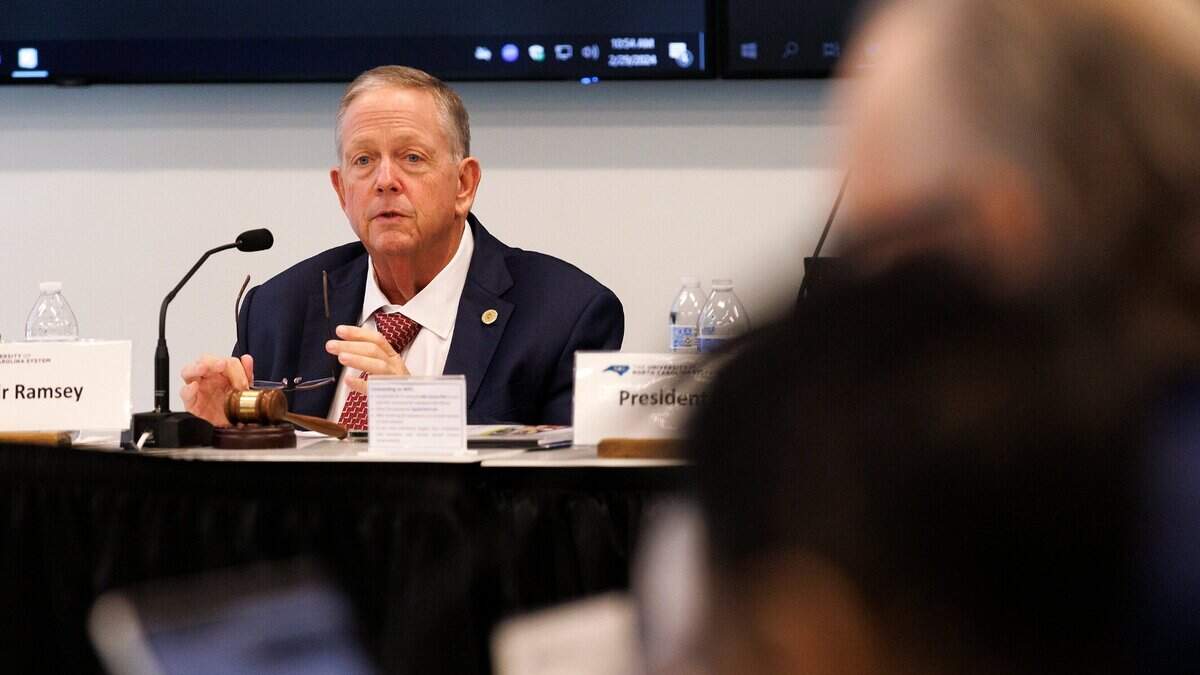
UNC Board of Governors member Randy Ramsey reported a financial interest in roughly 20 companies when he filed an ethics form in January. They include boat building, aviation and real estate.
Read more NC prosecutors deny Trump influence in Comey ‘86 47’ prosecution, defend threat case
But missing from the report is a prominent insurance business that has had big connections to state government officials, and the UNC System in particular. Ramsey did not report his position on the board of Sentinel Risk Advisors, an insurance brokerage and risk management firm with offices in Raleigh, Charlotte and Greensboro.
Sentinel’s founder and CEO is Jim Holmes, a former colleague of Ramsey’s on the UNC Board of Governors, which oversees the public university system. A second Board of Governors member, former state Sen. Joel Ford, worked for Sentinel, as did House Rules Chairman John Bell and a former House rules chairman, David Lewis.
Holmes left the Board of Governors in 2023, but continues to play a role in higher education as trustee of NC State University. Van Isley, a trustee at East Carolina University, is also a board member of Sentinel and has disclosed that role on statements of economic interest filed with the State Ethics Commission.
Ramsey did not report his board membership on statements of economic interest until this month after The News & Observer asked him, Holmes and the UNC System about the missing information. Neither he nor Holmes would say when Ramsey joined the board. Both said his lack of disclosure was an oversight.
Ramsey, a former Board of Governors chairman first appointed in 2017, did not respond to The N&O’s requests for an interview. He said in an emailed statement:
“I make a point of filing my Statement of Economic Interest early each January, and I try to err on the side of full disclosure. When I learned last week of an oversight, I decided to make it right by filing an update. I’ve now done so. The error involved ownership interest and board service through one of my investments.”
Ramsey, who is also a longtime appointee to the Centennial Authority that oversees PNC Arena, filed an updated disclosure statement last week that lists Sentinel as one of three companies in which his stock holdings have a market value of $10,000 or more. He also listed it as one of eight companies in which he earned more than $5,000 in 2025.
The statement covers the 2025 calendar year.
Rep. Marcia Morey, a Durham Democrat who has served on the House higher education committee, was skeptical of the response, given the public officials with connections to the company.
She said Ramsey should provide more information about when he joined the board and why he didn’t disclose it.
“The public demands full disclosure and it’s not OK to say now I’ve amended it so everything’s fine,” she said.
Brooks Fuller, the policy director for Common Cause North Carolina, a nonpartisan nonprofit government watchdog, also said Ramsey needs to fully explain his board service and why he failed to disclose.
“When someone who has a requirement to file a statement of economic interest discovers an error or an oversight, it is incumbent upon them to be radically transparent about their business dealings and be especially introspective about all that they are involved in, going back for as long as they’ve had to file such a form,” Fuller said.
Read more Florida fails to provide a path back to Congress for NC’s Madison Cawthorn
That’s especially true for a Board of Governors member, he said, because the university system is an economic driver for the state with many opportunities for businesses to profit.
Holmes, an NC State graduate who founded the company in 2012, declined to say when Ramsey joined the board. Sentinel is not required to disclose its board of directors since it is not a publicly traded company.
“You probably should just ask him,” he said of Ramsey. “I’m not here to comment on his disclosures.”
Isley declined comment, as did another board member, Paul Adkison. Isley began disclosing his seat on Sentinel’s board with his 2024 economic interest statement.
North Carolina law requires state lawmakers and appointees to state boards to file annual economic interest statements with the ethics commission to identify potential financial conflicts of interest. Such disclosures, for example, help protect the public from state officials using their positions to steer government contracts to companies they own or have a financial stake in.
When conflicts arise, officials are supposed to recuse themselves from voting. But the law does not require them to make public the reason for the recusal.
Holmes, for example, recused himself in December 2018 on a $123 million construction project at NC Central University to build three residence halls and a dining area, Board of Governors records show. Corvais was the developer, while Metcon was the general contractor and Provident Resources Group was the ground lessee. Vines Architecture and Cooper Carry were the architects.
Holmes did not respond to a reporter’s phone call or text about the recusal.
The forms state officials are required to fill out cite what can happen if they fail to disclose. A knowing failure to disclose is a misdemeanor offense, while knowingly providing false information is a felony.
Jameson Marks, the State Ethics Commission’s executive director, said in many cases an official filing a corrected report ends the issue. But the commission has the ability to look into cases in which there’s reason to suspect information was false or withheld.
The commission also investigates complaints, often filed by third parties, regarding possible violations. A state law that took effect in 2019, though, requires those filing complaints to be registered voters, Marks said.
State law prohibits Marks and other commission officials from discussing potential or active cases.
Read more How one Carolina Hurricane is using his day with the Stanley Cup for a good cause