
AI-generated summary reviewed by our newsroom.
Benjamin Hall isn’t going to blame the University of North Carolina football team’s abysmal second-half offensive output on the passing game.
Read more How Jackson Blake’s rapid rise with the Carolina Hurricanes made him a bargain
The numbers don’t suggest that Hall should take any fault at all, totalling a career high 130 yards rushing on just 18 attempts. He had rushes of 16, 11, 19, 11, 16 and 17 in the game. Meanwhile, his quarterback Billy Edwards Jr. completed just 8-of-22 passes after a 5-of-8 start to the game, totalling 135 yards through the air with an interception. His PFF passing grade was 42.7. But Hall supported him.
“Billy’s our guy,” Hall said about his quarterback. “I love Billy. I love the way he competes.”
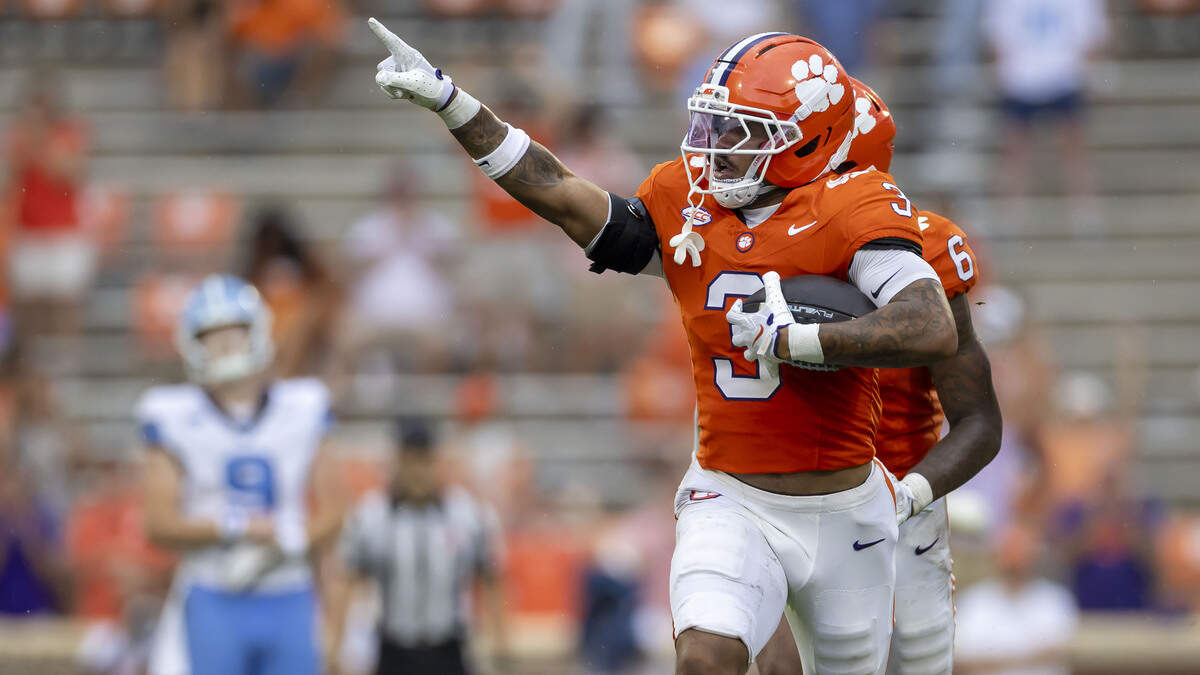
And he did take some fault, too, as the Tar Heels offense scored just twice on their final 10 drives in a 28-20 collapse against Clemson on Saturday at Memorial Stadium. He noted the one stat he didn’t contribute: a touchdown. There were numerous occasions throughout the game where the Tar Heels put themselves in position, and “have to get seven instead of three” with a field goal. Hall said Edwards put them in those situations. They proved earlier in the game they can finish those situations, even against Clemson. They just didn’t after the first two drives of the game.
So what went wrong?
“I don’t know,” Hall said. “Honestly, if I knew, maybe we would have fixed it.”
That’s how much of the game felt for the Tar Heels, and after the game, they were similarly short on answers. Immediately after their two opening touchdown drives, everything felt in freefall for UNC. But it didn’t seem to have any in-game response. Belichick was even asked about the moment he felt that contributed to the momentum shift after the game, which led to a similar result.
“The moment that contributed to what?” he asked a reporter asking a question about the momentum shift to him, seemingly not hearing its key word.
“The momentum,” the reporter repeated.
“Oh, ‘momentum?’” he replied, before delivering: “Yeah, I don’t know.”
In a lot of ways, it felt inexplicable. But while the numbers don’t look positive for North Carolina, the shift in the game wasn’t the result of it falling all over itself. Clemson did mix things up, creating some chaos for UNC’s offense. And perhaps, as Belichick alluded to after the game, it would have done that anyway.
Belichick said that the Tigers gave the Tar Heels a lot of different pressures, and showed odd fronts in the game, which means they didn’t have the traditional four defensive lineman. But Belichick said that’s “what they do.” UNC expected that from Clemson, no matter how difficult things looked for the home team defensively in the first half.
So the answer might lie in the Tigers ability to perform better containing Edwards in the pocket, forcing him to use his arm while under duress. Because in the first half — specifically on the first several drives — the seas parted on a few occasions for Edwards. He logged 11-yard and 17-yard runs, which are massive scampers for a player who entered Saturday with less than zero rushing yards on the season.
But even on Edwards’ leaping pass to Jordan Shipp after stepping up in the pocket on 3rd-and-6 at the 23, it seemed Edwards might have had a lane to the left to get the first down with his legs then, too. But the quarterback instead made a better read, and despite not throwing a perfect pass, put it in a good spot for Shipp to make a play.
Edwards looked sharp at that point, getting the ball out quickly to the flat on the left side of the field for a 15-yard protection. He seemed to read the pressure well there, but Edwards started to have a lot more trouble navigating it thereafter.
Read more Warren Buffett built a $1 trillion machine. Now what?
But that wasn’t the only thing: UNC showed it has some problems in the receiving game, too.
Tight end Jelani Thurman was a massive weapon in the Tar Heels’ first two games, and Edwards connected with him on a bootleg throw to the right — seemingly a favorite play of UNC and offensive coordinator Bobby Petrino so far — for 12 yards on his first completion. But Clemson was able to limit Thurman thereafter, as the tight end caught two of his next eight targets for six yards. On similar play to get the dynamic pass-catcher in space in the third quarter, Thurman was swallowed up after just a three-yard gain.
Without freshman wide receiver C.J. Sadler, who was out for the game after he was cited for speeding in an incident that led to the arrest of fellow freshman wide receiver Keeyun Chapman for a charge of carrying a concealed weapon, Edwards didn’t have many options in the receiving game outside of Shipp and Thurman. And Clemson seemed committed to ensuring one of those players didn’t have an outsized impact.
After limiting his options, Clemson then went for Edwards’ space. The room to run in front of him wasn’t available anymore in the second half, a result of the way in which the Tigers pressured him while still keeping rushers stationed hovering the line of scrimmage to keep him behind it and with little space to step up into, either. And the Tar Heels offensive line couldn’t deal with the pressure, no matter how they sent it.
It allowed 17 pressures total, per PFF, which is 12 more than their previous-worst total of five against TCU in Dublin. It was as disjointed as the offensive line has looked, with Aidan Banfield (49 snaps) and Cristian Alvarez (21 snaps) splitting time at right guard and allowing three pressures combined. Left guard Andrew Threatt allowed three pressures. Left tackle Jordan Hall had a particularly rough outing, allowing seven pressures, five hurries and a sack. Clemson right outside linebacker Will Heldt, who was lined up over Hall and Threatt’s side of the line, had eight pressures, five hurries and two sacks by himself.
A passing game should struggle when that’s its protection, and Edwards’ feet started to look more frantic in the pocket as the game wore on. And it led to some bad throws. On the first drive of the second half, he stepped up in the pocket similarly to how he created his best plays in the first two drives, but looked rushed as he overshot slot receiver Trech Kekahuna on a 3rd-and-4 play with 13:13 left in the third quarter. He tried to make a sidearm throw to wide receiver Mason Humphrey at the 8:07 mark of the third quarter, and almost threw an interception as the pass flew well behind Humphrey’s route. He just didn’t look comfortable.
And while the running game remained a solidly-consistent means of production for the offense, it didn’t convert in the end zone after running back Demon June’s game-opening three-yard score, as Hall mentioned. And the two-run sequence after the 2-hour, 28-minute weather delay showed the limitations of an offense that can’t rely on the pass.
“We missed an opportunity down there,” Belichick said of that sequence. “I’ll just leave it at that.”
The whole game was a missed opportunity. But UNC couldn’t separate because its offense couldn’t move. That was only compounded by the disaster that ended it: UNC going for Thurman deep on fourth-and-1 (after moving slowly and burning a lot of clock earlier in the drive, perhaps forcing some urgency) and Edwards overthrowing the ball and Edwards throwing the game-ending interception (where the intended receiver, Humphrey, seemed to stop short on his route as Edwards delivered the ball) after Clemson inexplicably scored a touchdown that gave North Carolina the ball back down one score.
UNC might not know what went wrong, but nothing went right.
“We’re just gonna go back to work and figure it out,” Hall said. “As we continue to do that, the score will keep getting higher and higher, and we’ll keep putting more points on the board. We’ll be alright.”
Read more Presley Gerber Opened Up About Addiction Treatment 6 Months Before Death