
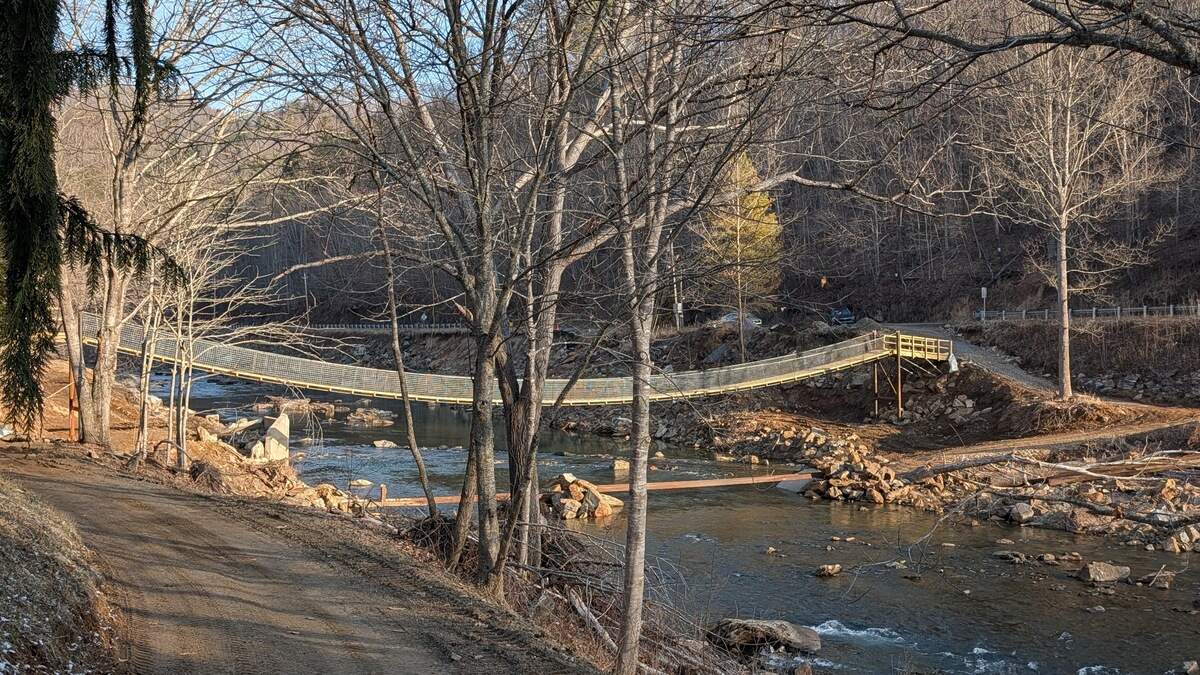
When Ted Baker needed an ambulance, first responders carried him on a stretcher across two steel beams spanning the Cane River because Hurricane Helene washed away the bridge to his home.
Read more Hurricanes sign Pyotr Kochetkov to extension, make other roster moves
Months earlier, Baker said, firefighters faced the same crossing problem when a neighbor’s house caught fire. Unable to drive to the Yancey County home, crews staged on the other side of the river, carried equipment across and pumped water from the river as they fought the blaze. Though the neighbors noticed the smoke early, the house burned down — something Baker believes could have been prevented if firefighters could drive across a bridge.
Baker, 76, said he has serious heart problems and was recently diagnosed with an aneurysm, making the lack of emergency vehicle access especially frightening.
“It took them forever to figure out how to get over to the house,” Baker said. “That’s like a constant worry. … I just don’t know when I’m gonna need emergency help.”
Nearly two years after Helene devastated western North Carolina, hundreds of households still lack the kind of road or bridge access that allows an ambulance or fire truck to reach their homes, according to state officials. North Carolina has committed more than $200 million to repairing privately owned roads, bridges and culverts damaged by the storm, and repairs accelerated this year. But thousands of damaged sites still have outstanding needs, and the state acknowledges there is not enough money to fix them all.
North Carolina Emergency Management identified 4,022 private road and bridge locations damaged by Helene. Its Private Road and Bridge Program hopes to address 371 of them — sites the state identified as lacking emergency responder access to permanent residential households.
Other sites have since been repaired by property owners, nonprofits or other groups, or withdrawn from consideration. Still, the state says more than 2,900 locations have remaining needs. NCEM has completed 148 projects, more than double the 63 completed as of the end of March. Those repairs restored emergency access to 854 households, compared with 364 in March.
But the agency estimates at least 727 households still lack emergency-services access while awaiting repairs through current program funding.
The program prioritizes private roads and bridges that are the sole access for emergency services to occupied homes, as well as routes serving multiple homes, businesses or recreational facilities.
Baker, his wife, and three nearby households are among those still waiting.
During the storm, Baker said the river rose 31 feet above normal. For several days after the storm, Baker and his wife were listed as missing. Three or four days after the river crested, a group of people came across in kayaks to check whether they were alive and get them taken off the list.
Though their home was not destroyed, the couple relocated because getting in and out was so difficult. But on one trip back to the property, Baker noticed a massive boulder sitting in the middle of the river and started imagining a way across.
He found two steel beams long enough to stretch from the bank to the boulder and from the boulder to the opposite side. Baker, who works with the donation-based Yancey County Long-Term Recovery Group, said he spent every cent raised through a GoFundMe on the beams and hired a tractor to put them in place.
The crossing is “sketchy at best,” Baker said, but it was enough to get them home. They hauled belongings back across the beams piece by piece, carrying what they could by hand over the river.
For about a year, that improvised crossing has been their way in and out. They still cannot drive across it, so they park roughly 1,000 feet away from their home and carry groceries in and garbage out by hand.
“The big thing is it got us home,” Baker said. “It just meant the world to us just to come back home.”
The wait is playing out across some of the counties hardest hit by Helene.
In Yancey County, about 35 miles northwest of Asheville, officials said 356 damaged private roads, bridges and culverts are in the recovery program. As of this week, 114 projects are complete, 15 are being designed and one is under construction.
Read more Prince Harry Reveals How Meghan Markle Reacted to His Skydiving Challenge
In Buncombe County, Recovery Officer Kevin Madsen said private access repairs have come through a patchwork of state, nonprofit and philanthropic efforts, making it difficult for the county to put a definitive number on remaining needs.
Early in the recovery, he said, there was an emphasis on creating temporary access for ambulances and fire trucks where permanent repairs could not happen quickly.
But Madsen said available resources do not cover everything that remains.
“The current funding mechanisms and funding streams do not fully cover what some of the needs are out there,” he said.
State officials say the same.
Lawmakers appropriated $205 million for the private road and bridge program, although the newest $30 million has been transferred to the program as of this week, NCEM said. Of the $175 million currently available, $58.7 million has been spent.
That includes about $5.1 million used to partially reimburse 264 property owners who hired private contractors to make repairs themselves.
NCEM estimates the projects remaining within its currently funded program will cost more than $113 million. Repairing all remaining private road and bridge damage identified after Helene would cost more than $309 million, according to the agency.
“There is not enough funding to complete all private road and bridge project needs,” NCEM Chief of External Affairs Justin Graney said in written responses to The Observer.
Lawmakers also changed how the program operates this summer, directing NCEM to expedite repairs and giving the agency more flexibility in how it contracts for bridge construction. The legislation also called for private bridge standards that can use designs more appropriate for residential and agricultural crossings, including lower design loads and simpler foundations where appropriate. Another law gave NCEM additional flexibility for bridges estimated to cost $500,000 or less.
NCEM said it already identified design and project efficiencies that have reduced estimated costs by about 25%, including greater use of modular and standardized bridges instead of customized designs.
Baker’s replacement is not a small bridge. He said the project is expected to cost roughly $1 million. He applied for state help in early 2025 and said his bridge was initially supposed to move ahead before two other Cane River projects because his was the only one where residents lacked vehicle access.
Then, Baker said, an error in a contractor’s bid forced the project to be rebid, pushing construction back about two months while the other bridges moved ahead. His bridge is now expected to begin construction in November.
Baker said he once imagined finally driving across a new bridge to his home would be an emotional moment. After nearly two years, he sees it differently.
“At the beginning, I felt like if I ever get that bridge, I’m just gonna cry out of happiness or something,” he said. “But now, it’s just gonna be like, ‘finally.’”
This story was originally published September 26, 2026 at 5:30 AM with the headline “Hundreds still lack emergency access to their NC homes two years after Helene.”
Read more Kim Kardashian Packs on the PDA with Lewis Hamilton Under the Eiffel Tower