
AI-generated summary reviewed by our newsroom.
This story contains reporting about sexual assault, a topic that will be disturbing to some readers.
Read more How much rain could NC get from Hurricane Isaias? The latest forecast
Duke University is a private institution, and its campus is private property. That means the school’s administration can decide who they do and don’t invite onto the elite Durham campus.
And on Thursday, when student organizers gathered for a protest in response to the Cornell University gang rape case that’s rocked the nation in recent weeks, Duke decided it didn’t want to allow the news media to come onto campus to cover it.
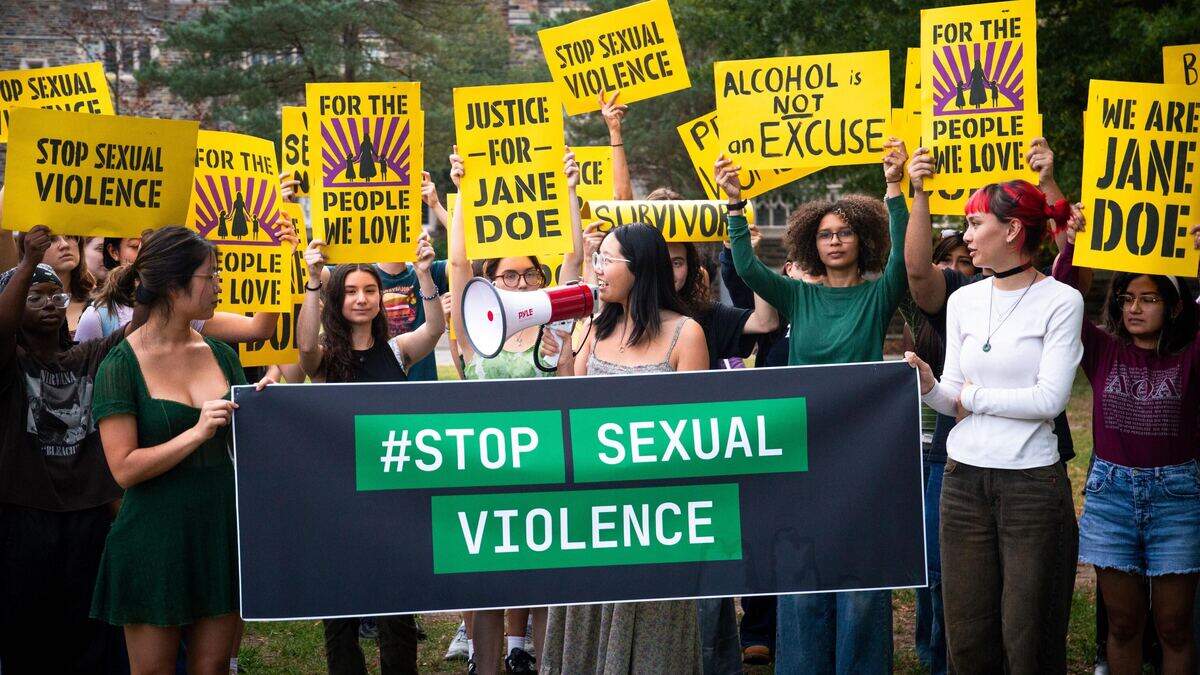
Duke students stood in solidarity with Jane Doe, the unnamed Cornell student who says she was raped by at least seven fraternity brothers over the course of one October night in 2024. It was part of a day of action on college campuses across the nation dubbed “#StopSexualViolence: From the Frat House to the White House.” In an Instagram post advertising the protest, student organizers wrote: “So many of us on this campus are Jane Does and love Jane Does.”
Students called on Duke “to confront rape culture, strengthen its prevention of gender-based violence, and meaningfully support survivors,” a press release about the rally reads.
The event was organized by student organizations Sunrise Duke and Duke Planned Parenthood Generation Action — not Duke’s administration.
Still, Duke controlled who from the public is permitted to witness it.
“This event is for the Duke community and we’re not opening it up to media,” Duke spokesperson Gregory Phillips told The News & Observer in an email on Tuesday.
But student organizer Artivista Karlin, a senior and leader of Sunrise Duke, said she and her fellow student organizers wanted media coverage.
“The community has the right to know what’s happening on Duke’s campus,” Karlin said. “Especially when it comes to an issue as salient as sexual violence. There’s going to be protests all across the country today against sexual violence and in solidarity with Jane Doe.
Read more Faith Hedgepeth timeline: Her life, the investigation, the man on trial for her murder
“It’s important for the Durham community to know what’s happening — and to know that students are not being silenced in the face of such a horrible tragedy.”
Sunrise Duke sent out a press release and made social media posts about the rally. Plans involved speeches, a march, an open mic, and a chance to take questions from The Duke Chronicle, the student newspaper. The N&O tuned into social media livestreams.
Student organizers had to get the rally approved by Duke’s administration, to comply with a policy introduced in 2024 that requires students to register protests at least two weeks before they occur or face disciplinary action. Students must give Duke the anticipated size of the protest, the anticipated noise levels, a protest plan, a site map, and a designated point of contact.
From there, Duke can approve or reject the protest.
Karlin says Duke’s policies are “very effective at preventing student organizing, preventing press from coming, and preventing change from happening.” Duke, she said, is more restrictive in its policies around free expression than other elite private institutions.
For example, at Cornell itself, thousands participated in a protest this week, including a seven-hour sit-in. The event was heavily covered by journalists, including those with the New York Times, NBC, the Washington Post, and the Associated Press.
At Duke, the only in-person coverage was to be provided by students from The Chronicle.
“Today’s rally was for members of the Duke community,” a university spokesperson said in a statement, “and we seek to maintain an environment in which students and others in our community can feel comfortable exercising their expressive rights, especially on sensitive topics.”
Read more MrBeast turns struggling Raleigh mall into viral playground with new video
This story was originally published October 8, 2026 at 4:28 PM.