
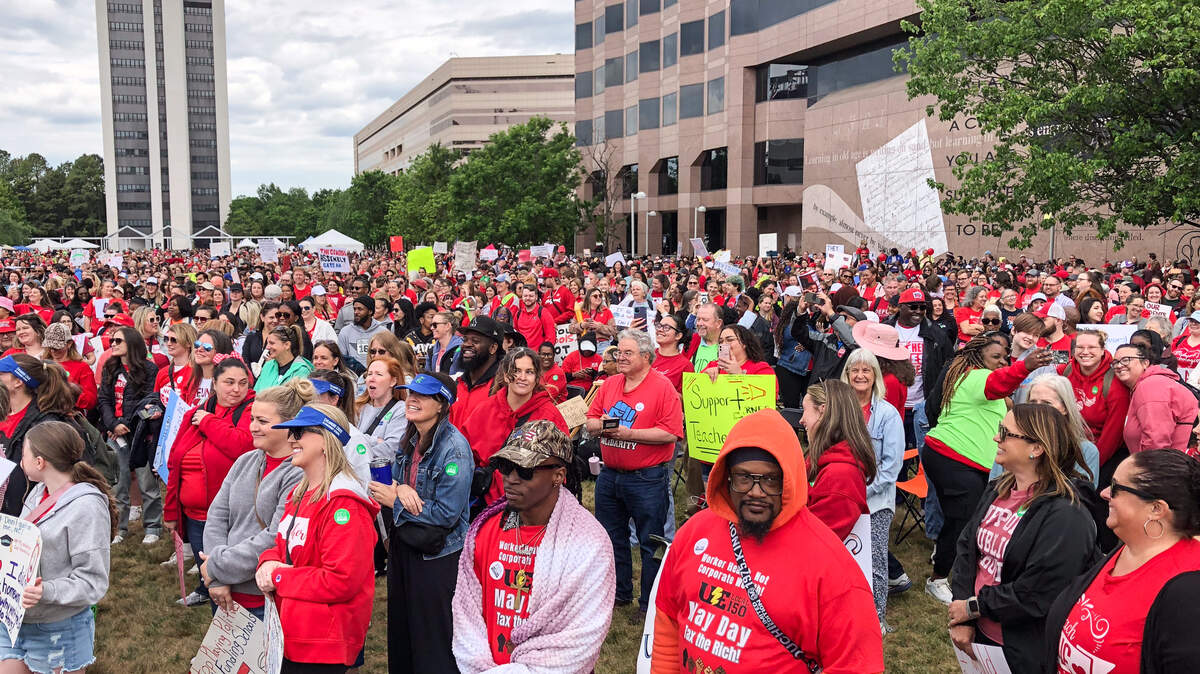
Some North Carolina educators say the state’s new budget leaves experienced teachers behind as NC lawmakers tout educator raises.
Read more Recalled Utz potato chips sold in NC upgraded to most serious risk level
After a yearlong wait for a new state budget, the North Carolina General Assembly finalized details on the $34 billion plan this week, including raises for thousands of state employees. Both chambers passed it on Thursday.
The plan comes with hefty raises for early career teachers in particular, bringing the state from nearly last in the southeast for beginning teacher pay to first.
But veteran educators stand to get much lower raises.
Mid-career teachers historically have not left the profession at the same rate as beginning educators, but some long-time Charlotte-Mecklenburg Schools teachers said that doesn’t mean they won’t, especially as state pay lags behind living costs.
“I thought I would be a career-long teacher, but realistically I don’t know how feasible that will be if this continues,” said Mark Cook, an English teacher at North Mecklenburg High School.
He just finished his 18th year in the district. His wife, also a CMS teacher, just finished her 17th.
“Salaries are so far behind the cost of living,” Cook said. “We’re told ‘thank you for your flexibility,’ but even things that are flexible can break.”
Teachers are set to get an average raise of 8% over two years, but that is heavily weighted toward early career teachers. Beginning teachers are looking at a state salary increase of around 17% during that time. Current base pay for beginning teachers is $41,000. The new base would be $48,000.
Meanwhile, teachers in their 15th year in the profession and beyond are looking at about a 5.5% increase. For example, teachers with more than 25 years of experience would have a base pay of $59,000 a year under the new budget, up from $55,950 this year.
The state is also investing an additional $32 million in expanding its Advanced Teaching Roles program, which allows districts to give additional state pay to highly effective teachers that take on additional responsibilities, such as teaching more students or coaching other staff. Teachers in the program can earn up to an additional $20,000 on top of their state salary.
Noncertified employees – staff like bus drivers, cafeteria workers and teaching assistants – will get a 3% raise.
Teachers and noncertified staff will also get one-time bonuses. Public school custodial and nutrition staff will get bonuses of $1,750 by Oct. 31. Teachers with 16 or more years of experience will get $1,000 bonuses, while teachers with fewer will get $500.
The state won’t give back pay for the 2025-26 school year.
Teachers most commonly leave North Carolina school districts before their 5th year of employment or after their 26th, state data show. The state loses teachers in the years between at a much lower rate.
So, it makes sense the state would prioritize raising pay for early career teachers, said Brenda Berg, president and CEO of public education advocacy nonprofit BEST NC.
Read more NC ranked No. 5 in US for ‘car-poor’ drivers. How much are their car payments?
“Starting pay is super important because that’s when people are making the decision to come into the profession,” Berg told The Charlotte Observer. “Our retention at the back end of the salary schedule hasn’t changed much in over a decade.”
She said the increase in early-career teacher pay is a big deal, since it will allow North Carolina to be more competitive for attracting and keeping new talent. She also commended the General Assembly for its investment in opportunities for teachers like the Advanced Teaching Roles investment and TeachReadyNC — where teachers can make up to $10,000 more for hosting an apprentice.
“If you combine the whole picture, even beyond the pay schedule, it’s a really good teacher pay increase,” Berg said.
More experienced educators will see around a 5.5% increase in pay under the new plan. But, since the last budget was passed in 2023, inflation has increased in the Southeast by an estimated 8.5%-9%, according to the U.S. Bureau of Labor Statistics.
Some local veteran teachers said it doesn’t do much to help with affordability.
“The legislature says it’s historic because it’s never given average 8% raises …but it’s never been a year late with a budget either,” Cook said. “It’s not about making an excessive amount. It’s about making a fair amount.”
Cook isn’t alone. The Observer heard from 11 other CMS teachers who shared the sentiment.
“I absolutely know experienced teachers that are thinking about leaving,” said Justin Hernandez, a social studies teacher at Palisades High School in south Charlotte. He’s taught in the district for 12 years.
“Teacher pay should reflect what it actually costs to live in the city,” he told The Observer. “With the rising cost of living, it’s just very hard to continue.”
CMS adds a county-funded supplement to teacher pay each year in order to make living costs more affordable and the district more competitive as an employer. Those supplements currently range from about $8,000 to $14,000 annually, and the district budget passed in May includes an average 5% supplement increase.
Others say the state raises for veteran teachers makes them feel like North Carolina doesn’t value their experience.
“It is incredibly disheartening to see decades of classroom experience rewarded with a fraction of (the raise) incoming teachers receive,” said Julie Randolph, an educator with 22 years of experience in CMS. “This makes seasoned teachers feel completely invisible.”
This story was originally published July 2, 2026 at 4:10 PM with the headline “Does NC legislature value teacher experience? Educators react to pay raises.”
Read more Ticketmaster responds to NC attorney general’s questions about Canes ticket sales