
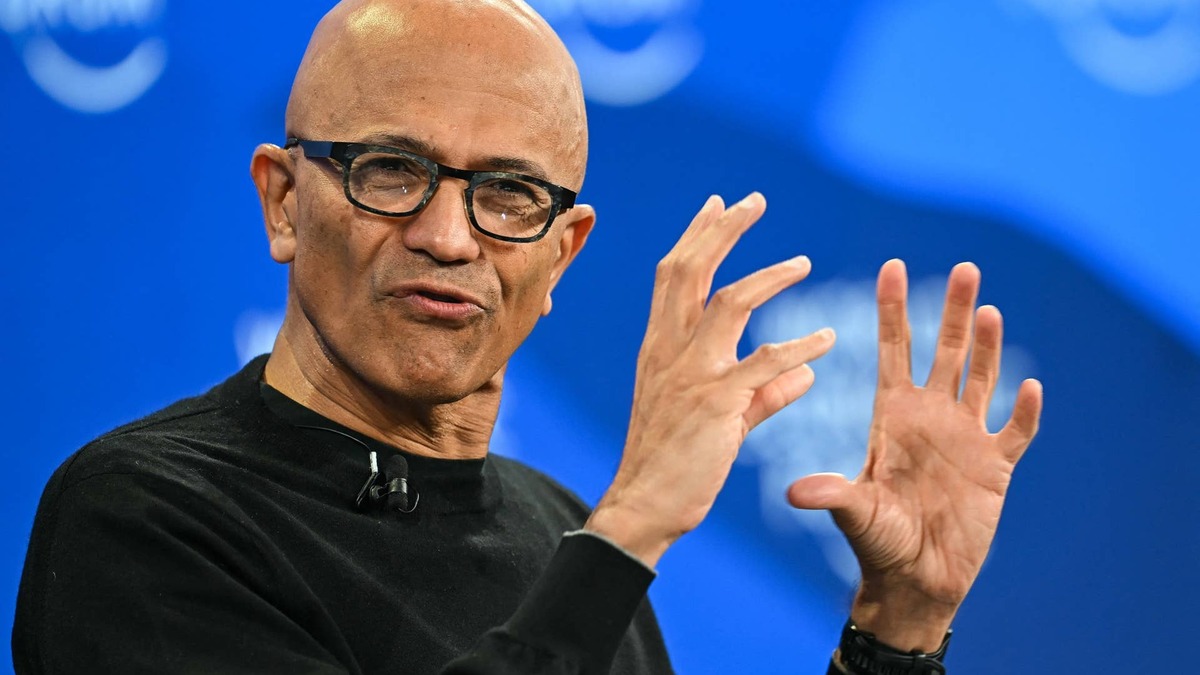
“When was the last time you had a creation tool that was so editorially controlled?” Microsoft (MSFT) CEO Satya Nadella quizzed engineers while taking shots at Anthropic’s much-talked-about Fable model, according to CNBC reporting.
Read more Cristian Romero Seemingly Snubs Donald Trump’s Handshake at World Cup Final
That remark was puzzling because Microsoft has hardly been an outsider to Anthropic’s tremendous come-from-behind story.
For some context, Microsoft has pledged up to $5 billion to the startup, integrates Anthropic models into Copilot and Foundry, and could collect billions in Azure revenue under Anthropic’s $30 billion cloud commitment.
Essentially, Nadella is challenging a partner that is a pretty big customer.
On a surface level, the dispute can look more like an argument over AI refusals, but there’s something a lot broader in play here.
Companies are willing to use cheaper models, and Microsoft is developing more of its own technology while executives question whether frontier labs should control access to the most capable systems.
In fact, I covered Nadella’s recent blog post, in which he talked about companies paying twice for AI, with buyers essentially giving up their knowledge to use a service they have already purchased.
In many ways, Nadella’s criticism reveals where Microsoft believes power in enterprise AI is shifting next.
Microsoft CEO Satya Nadella isn’t holding back on Anthropic’s restrictions on its most advanced Fable model, calling the system unusually constrained for a creative tool.
Nadella noted to Microsoft engineers working on Copilot that Fable can refuse requests that appear harmless. “It doesn’t make sense,” he added, according to CNBC.
More Tech:
For some perspective, Anthropic actually acknowledges that its safeguards might block some legitimate prompts.
After briefly suspending Fable to comply with a U.S. export-control directive, the company restored access on July 1 but also warned that the updated protections might flag a slightly higher share of harmless requests.
Certain queries, including those involving large-scale model development, could potentially be redirected to an older model.
However, Nadella’s argument extends beyond safety filters. He is increasingly questioning an AI economy dominated by a few frontier laboratories charging businesses for access to expensive computing.
“It can’t be that there are only two companies in the world with token capital, and everybody else is renting it,” Nadella said, as CNBC reported. “It makes no economic sense.”
“Claude Fable 5 includes robust safeguards for cybersecurity and biology,” according to Anthropic’s support page. “Many queries in these domains are automatically routed to Opus 4.8 if flagged by these safeguards. You won’t be charged Fable prices for rerouted requests.”
That fallback became doubly important after Fable 5 was suspended on June 12 under a U.S. export-control directive.
Later, on July 1, Anthropic restored access and deployed a stronger classifier to address a reported safeguard bypass. The company says the updated system blocks that technique in more than 99% of cases, with flagged requests sent to Opus 4.8.
These restrictions offer Anthropic a wider safety buffer against harmful cyber or biological use, but legitimate coding, debugging, and security work can be downgraded to an older model.
The big issue is that users can still receive an answer at a lower price but lose the capability for which they selected Fable. This explains Nadella’s frustration with its practical limits.
I did some digging, and what can be safely concluded is that the problem isn’t what Anthropic thinks; it’s that its safety system appears to be overly cautious.
Read more Patrick and Brittany Mahomes Color-Coordinate While Attending World Cup Final
For instance, The Verge tested the original June release of Fable 5; the model redirected multiple ordinary questions to Opus 4.8:
The publication said the mitochondria refusal was most likely to be an obvious false positive, but it’s also important to consider that the tests were done using the launch version.
However, post-redeployment stories point to an even more complicated boundary.
For example, I looked at a Reddit post apparently by a cancer researcher, who said that Fable downgraded even “Hi,” an R coding question, the weather, and World Cup viewing information because biological terms stored in the user’s memory were considered.
In commenting on that post, Reddit user shiftingsmith had an interesting observation.
“The saddest thing is that this is the best model ever created for autonomous scientific research; it was advertised with a video featuring butterflies, biology and science; and it was given to the public as a “freebie/test” version to get a taste of its power… And then restricted to hell.”
Another user in that specific post talked about how Fable downgraded a request to review whether responses to peer reviewers for a mycology paper were coherent. The exact prompt and context weren’t revealed, though.
Also, it should be noted that these accounts are self-reported, not independently reproduced.
These examples, though, point to more aggressive technical risk management, instead of political censorship.
Nevertheless, it’s unfair to say Nadella’s claims are baseless.
From the user’s perspective, Anthropic is deciding:
That is a form of product-level control, even if the claim is that it’s being driven by safety.
One of the more interesting things with Nadella’s criticism is that there’s clear contradiction.
Microsoft’s relationship with Anthropic is well documented, yet there’s ample reason to believe it wouldn’t want Anthropic, OpenAI, or any other major lab to become indispensable.
A single dominant model will likely lead to massive bargaining power over pricing, access, and product rules.
At the same time, it’s likely to bump costs and restrict specific use cases or result in competing applications that weaken Microsoft’s relationship with its customers.
Another big risk is that Microsoft becomes nothing more than an infrastructure provider behind someone else’s platform.
So a fragmented market works a lot better for Microsoft.
Foundry can offer thousands of models, while Copilot routes each task to the option that best balances capability, cost, and safety.
Routine work can run on cheaper models, while the more demanding tasks are sent to frontier systems. That flexibility will lower Microsoft’s costs and reduce its dependence on any one supplier.
What’s more important is that the model becomes replaceable while Microsoft retains the valuable layers around it: Azure computing, corporate data, security, governance, software distribution, and the customer relationship.
Related: Bank of America revamps Tesla forecast before earnings
The Arena Media Brands, LLC THESTREET is a registered trademark of TheStreet, Inc.
Read more Cincinnati Bengals’ Dalton Risner and Wife Whitney Announce Pregnancy Loss
This story was originally published July 20, 2026 at 2:03 AM.