
AI-generated summary reviewed by our newsroom.
In late April, the North Carolina departments of Labor and Justice warned residents about an uptick in employment scams, where fraudsters impersonate recruiters, conduct fake interviews and steal money or personal information from job seekers.
Read more Why Raleigh can’t easily regulate Glenwood South nightlife district
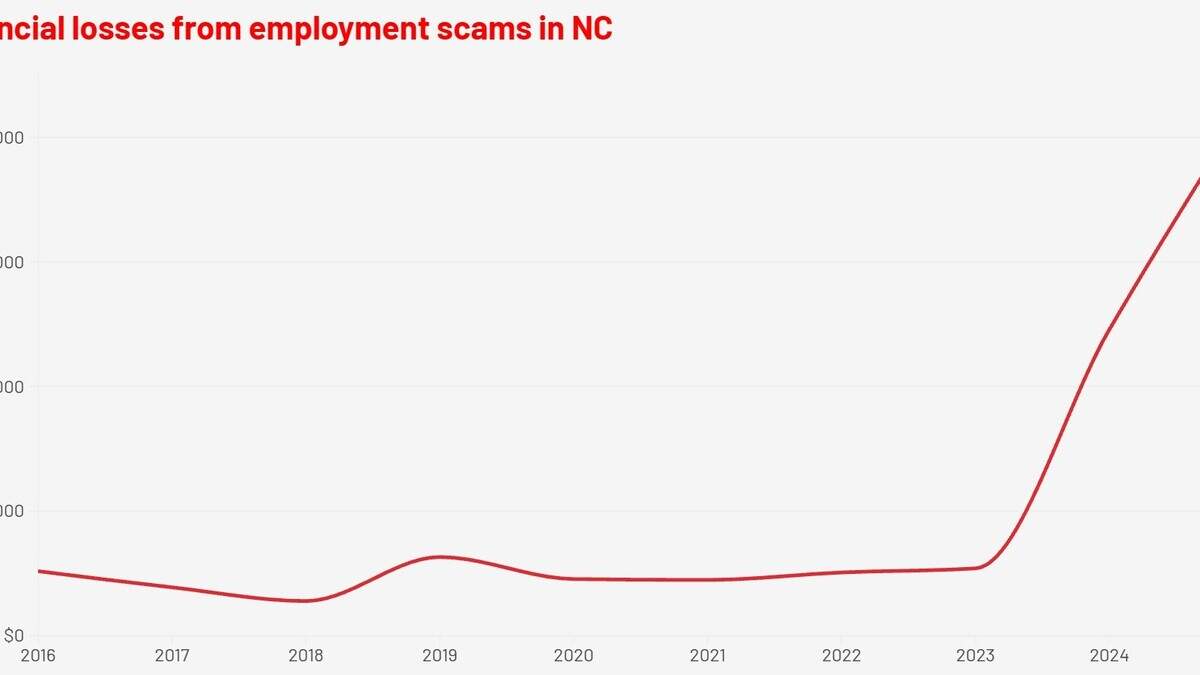
But the uptick isn’t new. For years, the number of North Carolina residents targeted by these scams, and the amount of money they’ve lost as a result of them, has been rising.
According to the FBI’s Internet Crime Complaint Center, 700 North Carolinians were targeted by cyber-enabled employment scams in 2025. That’s a miniscule portion of the state’s total population, estimated by the U.S. Census at more than 11 million last year.
But that 0.006% of the state lost more than $8.4 million dollars as a result of cyber-enabled employment crimes, according to the FBI.
For comparison, in 2016, about 470 North Carolina residents were targeted by these scams, and they lost much less — about $1 million.
These scams go under- or unreported for several reasons, Reid Davis, the FBI special agent in charge for North Carolina, told The News & Observer in a phone interview. Crimes may be reported to a non-federal law enforcement agency, for example, or some people may be too embarrassed to report the scams.
“Those amounts, as eye-popping as they are, are a small fraction of the actual fraud being committed,” Davis said.
Regardless of the monetary loss by any one person, employment fraudsters target vulnerable individuals who are trying to generate income.
“What little funds they do have being taken from them has a much more drastic impact on their financial situation than a large company losing money from cyber-enabled fraud and things like that,” Davis said.
Most cyber-enabled employment crimes, which involve email, text, online employment platforms or social media, are done for one of three purposes, Shelley Lynch, public affairs officer for the FBI’s Charlotte office, told The News & Observer in an email.
Scammers may try to:
In the first scam, fraudsters pose as employers and add money — usually from someone who has been scammed or a compromised account — to a person’s bank account, often using a peer-to-peer payment application. Then people are instructed to withdraw money, convert it into cash, gift cards or cryptocurrency, and transfer it again to earn a small commission.
They can face legal consequences and have their accounts closed and funds seized — salt in the wound for people who have already been targeted by a fraudster.
In the second scam, people who help fraudsters steal personal information are asked to collect documents from “customers,” receive and forward files, verify accounts by logging into portals or handling one-time codes, open accounts or submit applications, and share data.
In the third scam, which constitutes human trafficking, people are hired for a job and then asked to travel internationally, with the recruiter paying for flights or a visa.
On arriving in the new country, their passports are taken, and they are told they have to repay travel costs. And the task they’re asked to do may be messaging other targets of scams.
Cryptocurrency also plays a role in some employment scams. The FBI’s annual reports don’t show exactly how many North Carolinians were targeted specifically by employment scams involving cryptocurrency — as opposed to romance or non-delivery scams, for example. But last year, more than 4,300 people in North Carolina were targeted by scams involving cryptocurrency or cryptocurrency wallets.
“Whenever you’re dealing in any type of cryptocurrency, the risk is just higher that if you’ve been defrauded in some way, it drastically reduces the ability of law enforcement to return your funds — seize them and return them,” Davis said.
Read more NC family pulls $1 million scholarship over anti-DEI policy. Here’s what to know
In employment scams involving cryptocurrency, fraudsters pose as employees of companies and recruit someone to do a fully remote job completing routine, click-based tasks to help improve a company’s reputation or efficiency, according to the FBI.
Every stage of the scam happens digitally. Communication occurs over social media or a private messaging platform, and people targeted by the scam are asked to deposit cryptocurrency or money transfers to a platform to perform work, usually on a daily basis.
Scammers claim that the more money people deposit, the more they’ll make, and they allow people to withdraw proceeds or collect bonuses.
But they pressure people to deposit ever-larger sums, and at some point, people are unable to withdraw their money. When they’re unable to meet the deposit requirements, their account is frozen, and scammers take what’s in the account.
Artificial intelligence has helped scammers make themselves more believable, Davis said. Fraudsters can use photos and AI tools to assume the identity of a real company employee or executive on video calls.
But there are ways to test whether a person is who they appear to be, Davis said. You can ask them to look left and right, up and down, to get a complete view of their profile. Often, scammers will use a photo from the web, and when they move around so much, the picture may be spotty, as the AI tries to fill in holes.
If you have doubts about the person’s real identity, you can also ask them to email you on the spot from a certain account, or show something in their background that would suggest they are in the company’s office.
“Don’t ever be afraid to take extra steps, precautionary steps, when you’re dealing with someone virtually that you’ve never dealt with before,” Davis said.
Between 2016 and 2023, the number of North Carolina residents targeted by cyber-enabled employment crimes stayed relatively flat, between a low of 374 in 2021 and a high of 467 in 2016.
The financial losses resulting from those crimes during that period ranged from a low of $555,800 in 2018 to around $1.26 million in 2019.
But since 2021, the number of North Carolinians targeted by cyber-enabled employment scams has been steadily on the rise, nearly doubling from 374 in 2021 to 700 last year.
The money lost to these crimes has increased even faster. It was more than nine times higher last year than in 2021.
College students searching for jobs and internships might have more resources than others when it comes to avoiding employment fraud.
At Duke University, for example, staff at the career center discuss signs of employment scams with students. And the center screens employers who post job and internship opportunities on Handshake, a Duke spokesperson told The N&O in an email. The platform reviews and flags suspicious activity and can suspend employers, if needed.
The FBI also offers tips people looking for jobs can use to help protect themselves against employment scams:
“The No. 1 rule is, in any of our frauds across any sector that we work in law enforcement, is if something sounds too good to be true, it probably is,” Davis said.
Read more Heidi Montag Reveals Challenge of Balancing Motherhood With Pop Comeback