
AI-generated summary reviewed by our newsroom.
Amazon is vying to build a new data center in Richmond County, but faces pushback from residents worried about the effects its proposed diesel generators on local air quality.
Read more UNC football GM Michael Lombardi retains lawyer, issues statement. What we know
Residents are raising concerns that the data center’s power sources could drive up levels of air pollutants linked to cancer and other respiratory diseases in a town that’s already home to several other major air polluters.
“We are not opposed to progress,” said Rev. G. Rebecca Warren, a pastor at Wayman Chapel, which sits half a mile from the future data center campus. “However, we believe progress should never come at the expense of the health, safety, and quality of life of the people who already call this community home.”
At a crowded hearing in Rockingham on Thursday, Warren and around 150 people came to weigh in on Duke Energy and Amazon’s applications for two separate air quality permits. North Carolina’s Department of Environmental Quality will likely decide within the next month whether to grant the companies these permits, which would allow them to build diesel generators for the data center.
County and state officials — including Gov. Josh Stein — have publicly supported the project since the deal with Amazon was announced last summer. The project, a $10 billion investment, is projected to create 500 new jobs while it’s being built. In Richmond County, over 90 miles southwest of Raleigh, such a deal is alluring for a region where nearly a quarter of the population lives below the poverty line.
Duke Energy, too, maintains that the emissions from the project will “remain below the strict permit requirements set to keep the public and surrounding environment safe,” company spokesperson Bill Norton told the N&O.
Many residents aren’t convinced. The town of Hamlet, where the data center will be built, is already home to a factory run by wood pellet manufacturer Enviva, which is also a state-sanctioned major polluter. A report by Amazon found that Hamlet is “within the two least healthy ranges in the state” for health and well-being, and the town of about 6,000 people has rates of cancer and opioid addiction above the state average.
Residents are hoping the state will deny Duke and Amazon’s permits — or at least ask them for more data on how their project will impact local air quality.
“This is just not a data center, this is an industrial power project,” said Shaun Ingram, co-founder of the Richmond County Coalition for Justice and Black Empowerment, a local activist group. “We were sold a story about industrial jobs and progress. But now we are looking at air permits, generators, turbines, emissions, noise, water demand and risk to communities that are already overburdened.”
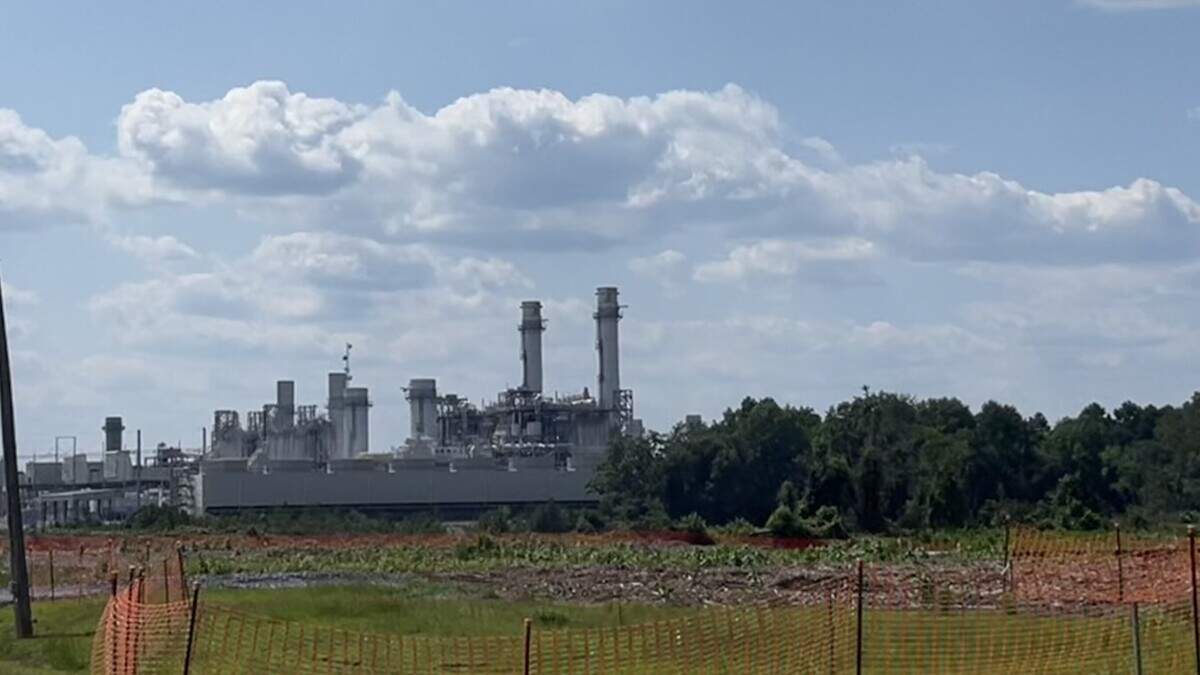
Amazon is planning to build the data center on a property next to an existing Duke Energy plant in Hamlet. That plant is home to a natural gas turbine that can generate up to 2,200 megawatts of electricity, enough to power at least 1.3 million households.
The turbine, too, is permitted as a major air polluter.
Once complete, the data center will draw its energy from the same electric grid that provides power to everyday North Carolina households and businesses. Duke is also proposing to build an additional 240 megawatts of power generation at its turbine site.
However, Amazon’s data center will need infrastructure to connect it to the electric grid, which likely won’t be complete until after the center is already up and running. So Duke applied for an air quality permit to build 57 diesel generators next to the data center, which will power the project for less than a year.
Those temporary diesel generators will be paid for by Amazon, not by Duke Energy customers, said Norton, the company’s spokesperson.
Amazon’s air quality permit, which is separate from Duke’s, seeks to build a total of 594 diesel generators along with the data center. The generators will act as an emergency source of power, running only during testing or power outages.
Yet during those emergencies, Amazon says it’s critical to have enough power to support the services that the data center will provide. The company’s data centers power not just artificial intelligence, but also “hospitals, first responders, energy systems, and national security agencies,” according to a blog post that a company spokesperson referred to The News & Observer.
The project comes as Duke Energy and other utilities across the nation are racing to build out enough electricity to provide power to the data center industry. Data centers often need massive amounts of energy. Amazon’s backup diesel generators, for instance, will have the capacity to produce 1600 megawatts of electricity — enough to power a city twice the size of Raleigh.
At Thursday’s hearing, residents hammered Duke and Amazon for splitting their air quality permit applications into two, when the diesel generators are all tied to the same project.
Read more Federal judge’s NCAA eligibility ruling sends shockwaves through college sports
“[Particulate matter] doesn’t care which company produces them,” said Denise Cozart, a Richmond County resident who spoke at Thursday’s hearing. “Residents within a 10-mile radius breathe the combined total.”
Duke and Amazon’s applications say they’ll each be emitting levels of air pollutants below a certain threshold. If they were above the threshold, they’d have to conduct more in-depth modeling to see how air pollutants would affect the surrounding area.
The state maintains that because Duke’s generators are on a different property than Amazon’s, they should be reviewed separately.
According to Russell Braswell, a permit engineer with the DEQ, Duke Energy is facing stricter requirements for how many air pollutants its diesel generators can emit because its permit application is separate from Amazon’s.
Both companies also say they’re taking measures to filter out as many air pollutants as possible, though neither Duke nor Amazon answered The N&O’s questions about how they decided on diesel generators for the project.
Jennifer Richmond-Bryant, an associate professor at North Carolina State University, said splitting the applications in two “conceals the magnitude” of pollution that could come from the entire project.
Richmond-Bryant said she analyzed each company’s permit application and found that altogether, the combined 600-plus diesel generators that Duke and Amazon want to build may drastically increase how many air pollutants are coming from Duke’s existing natural gas turbine site.
The total amount of hazardous air pollutants will increase by 28% compared to how many pollutants were coming from the Duke turbine site in 2024, her analysis found. Emissions from other pollutants could see larger increases, she said, and the level of volatile organic compounds coming from the site may increase by over 400%.
Yet an increase in pollutants may be difficult to track. The closest government-run air quality monitor sits nearly 30 miles away from Hamlet.
Richmond-Bryant also helped Ingram and other local residents place low-cost air quality monitors around the county. The monitors are already showing poor air quality in the Hamlet area, she said.
“In my mind, that would raise the question about whether a federal equivalence monitor [is needed],” Richmond-Bryant said. “That gives us some information to say, hey, maybe this is an area you need to check out, you being DEQ, with better equipment.”
Now, a decision on the air quality permits is likely to come in the next four to six weeks — unless the state decides to go back to either Duke or Amazon and ask them for more data, said Shawn Taylor, a spokesperson for the DEQ’s Division of Air Quality.
Asking an applicant for more data isn’t routine, but it happens “occasionally,” Taylor said. In this case, the state would want to move as fast as possible if they did need more modeling from either company, he said.
This story is available free to all readers thanks to financial support from the Hartfield Foundation and Green South Foundation, in partnership with Journalism Funding Partners, as part of an independent journalism fellowship program. The N&O maintains full editorial control of the work. If you would like to help support local journalism, please consider a digital subscription, which you can get here.
This story was originally published July 31, 2026 at 2:16 PM.
CORRECTION: This story has been updated to reflect that the data center will not be fully gas-powered. The story also clarifies that Duke isn’t yet building an additional 240 megawatts of power generation at its turbine site but is proposing to.
Read more 80 mph tornado snapped, uprooted trees in “rugged” NC mountain terrain, NWS says