
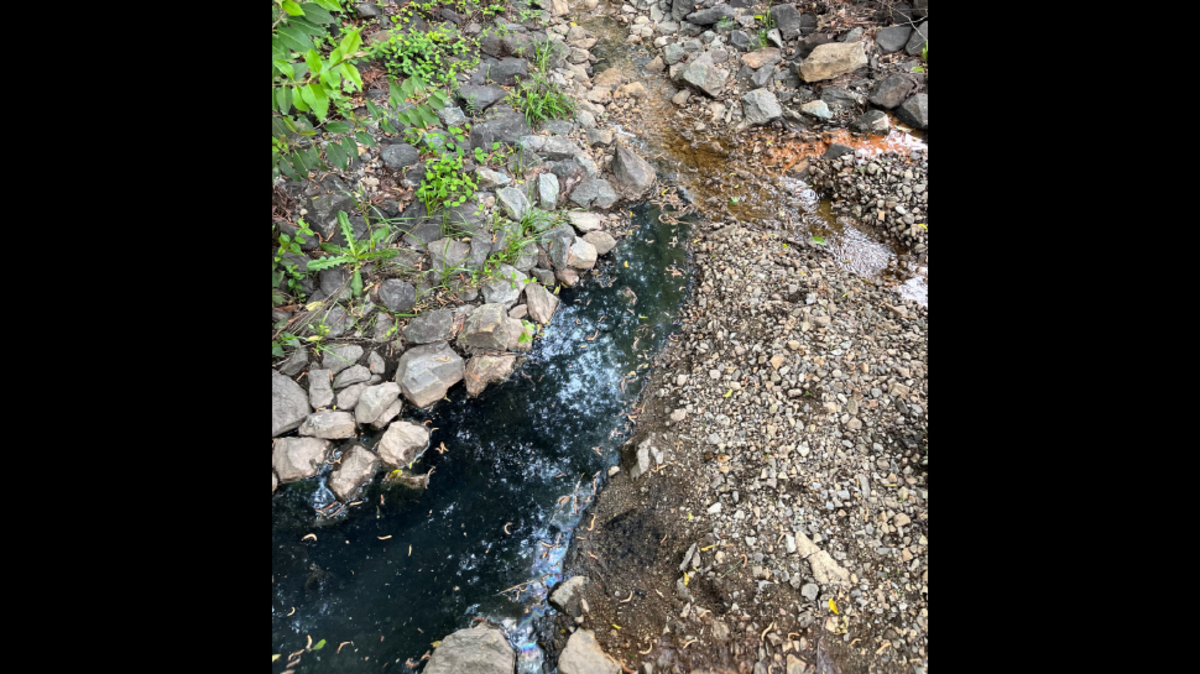
A Durham-based chemical company that has been leaking black sludge into city waterways now will be legally required to make a plan for tracking, cleaning up and preventing pollution.
Read more Durham may bring back ‘violence interrupters’ to reduce shootings, homicides.
Yet many of those requirements, laid out in a Tuesday court order, are things that state officials have already asked Brenntag, the company, to do.
North Carolina sued Brenntag in June, alleging that it had been illegally leaking pollutants from its East Durham facility. According to the lawsuit, recent testing has found that the company leaked “black water” and several toxic chemicals into a Durham stream. The stream flows through Burton Park, into Third Fork Creek and eventually to Jordan Lake, the drinking water source for the city of Durham.
On Tuesday, the N.C. Attorney General’s office and the N.C. Department of Justice announced they had secured a court order against Brenntag. While the order isn’t a final decision in the case, it’s intended to temporarily stop Brenntag from releasing pollutants while the lawsuit continues.
“Protecting the health of our community and the integrity of Durham’s waterways is one of our top priorities,” Durham Mayor Leonardo Williams said in a Tuesday press release. “City staff have been diligently working for several years to address contamination linked to the Brenntag site, and we will continue taking action to safeguard our waterways.”
The order requires Brenntag to submit a report to the N.C. Department of Environmental Quality by Aug. 17 detailing how these chemical leaks happened, and how they may have impacted human health. By Sept. 1, the company must submit another detailed plan, outlining how it will stop future leaks.
Brenntag must also reimburse the city of Durham for the amount it spent putting up signs around Third Fork Creek warning residents of water contamination. The company will start maintaining an existing construction fence in Burton Park, which blocks off the now-contaminated stream.
The Attorney General’s office reports that Brenntag already has agreed to the order, and Attorney General Jeff Jackson specifically thanked the company for “coming to the table” on this case.
The company declined to comment about the court order, telling The News & Observer it does not speak about pending litigation.
However, the court order states that Brenntag already has failed to meet deadlines for submitting these reports to DEQ.
State authorities first asked the company in January to turn in reports of how the leaks happened, along with a plan for cleanup. Brenntag requested an extension until the spring — but the extended deadlines came and went without the company filing any of the reports, according to the court order.
Read more Officials say teen ‘abandoned’ at CLT is actually 18, has been reunited with family
As recently as May 5, the city of Durham reported that Brenntag had recently discharged more polluted water, and didn’t provide any testing of the “black material” that was found in the water.
Aidil Ortiz, a community organizer who lives a few blocks away from Brenntag’s facility, said that residents in East Durham had been “excited” to hear of the lawsuit. But reading through Tuesday’s court order, she was left wondering “what is new.”
“These assessments, reports, monitoring are all things that [Brenntag] should’ve already been doing,” Ortiz said. “Why do we take their word that they will do it now?”
DEQ first started investigating Brenntag’s facility in 2025, and found that the company was storing various chemicals inside of tanks, some of which were “leaking or otherwise compromised,” Tuesday’s news release said.
Samples taken downstream of the facility revealed a drop in dissolved oxygen levels below the state’s legal standard of 4.0 mg/L, creating conditions hazardous to aquatic life, according to the court order.
For the city of Durham, the situation has lasted much longer. Durham has repeatedly found illegal chemical discharges coming from Brenntag’s Pettigrew Avenue site since 2022.
To date, the city has fined the company at least $157,000, said Michelle Woolfolk, the city’s manager of stormwater quality, during a May city council presentation. Many of those fines have gone unpaid.
After Tuesday’s court order, Woolfolk said in a statement that city officials “expect Brenntag to finally comply with its legal and social obligations” to stop its illegal discharges.
“The city has been out a lot of money to pay for consultants, to gather more data,” Ortiz said. “So the price tag [of the lawsuit] has to match … what it costs us, you know, because we’re paying it. We’re subsidizing the damage.”
This story is available free to all readers thanks to financial support from the Hartfield Foundation and Green South Foundation, in partnership with Journalism Funding Partners, as part of an independent journalism fellowship program. The N&O maintains full editorial control of the work. If you would like to help support local journalism, please consider a digital subscription, which you can get here.
Read more After two years of relying on offense, NC State defense looks to reemerge