
AI-generated summary reviewed by our newsroom.
South of Raleigh, where Johnston County’s subdivisions creep into former farmland, Swift Creek looks like an ordinary stream — slow, brown-green, unremarkable. But it is remarkable in one way: It is home to the Neuse River waterdog, a fully aquatic salamander found nowhere else on Earth beyond a narrow stretch of North Carolina’s Neuse and Tar River basins.
Read more Police Reveal More Details About Hayden Panettiere’s Tragic Death at 36
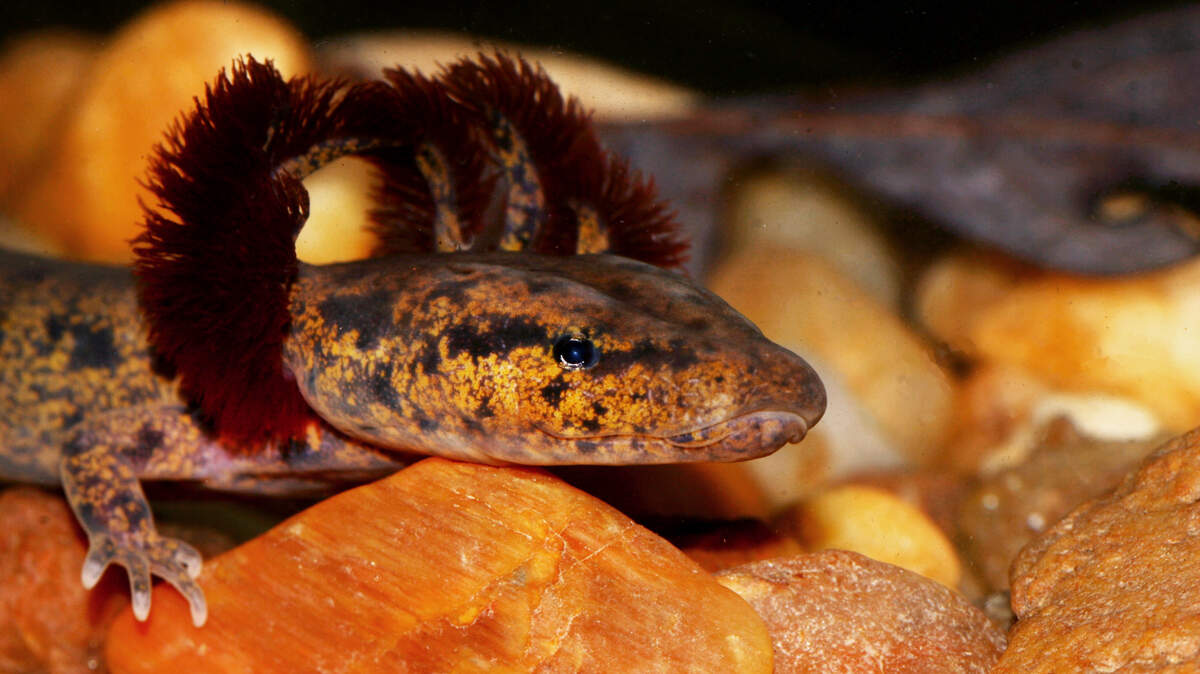
The Neuse River waterdog (Necturus lewisi) grows up to a foot long and sports a reddish-brown body dappled with blue-black spots, but its most striking feature is a pair of feathery, blood-red external gills that flutter like a set of underwater feather boas.
The waterdogs were listed as federally threatened in 2021. Living for decades, some of these waterdogs are older than the subdivisions threatening their existence.
On the surface, Raleigh’s waterdog seems to be holding on. Underneath, the picture is far more precarious.
Most people in the Triangle have unsurprisingly never heard of the Neuse River waterdog, according to Aubrey Green, a wildlife diversity biologist with the N.C. Wildlife Resources Commission. Waterdogs are most active in the dead of winter to avoid warm-weather predators like largemouth bass and the invasive flathead catfish.
“Nobody is seeing them,” Green said. “People aren’t going to be snorkeling in those rivers in winter.”
Streams and rivers often freeze thick enough that researchers have to break through ice to check their traps, work Green called “laughably challenging.”
This challenge leads Jeff Hall, statewide herpetologist for the Wildlife Resources Commission, to seize every run-in with a stranger.
“Spending just five minutes with a private citizen, they’ll say, ‘Wow, I never heard of that salamander before… Oh wow, it only lives in North Carolina. That’s amazing,’” Hall said.
An animal only found in one place is known as endemic. That endemism was key for Eric Teitsworth, a biologist who spent years studying the species.
“People are more likely to care if you can get them to understand: this is special to us. You don’t find this anywhere else,” Teitsworth said.
The short answer? Sedimentation.
Dr. Krishna Pacifici, a quantitative ecologist at NC State, spent five years helping Teitsworth track why the waterdog is disappearing. All roads led to sedimentation.
Land development changes how water moves across the landscape. More pavement means less absorption and faster and dirtier runoff into streams. Teitsworth described watching streambeds shift in real time from clean gravel and cobble to bottoms thick with silt and muck.
Female waterdogs don’t breed until they’re around 6 years old, and they lay their eggs just once a year, tucked under rocks and logs. Bury those in mud, and the juveniles that would hide there have nowhere to go.
The scale of loss is already significant. Surveys from the 1980s established a baseline for where waterdogs lived. When the state resurveyed those same sites three decades later, the species had vanished from 35% of its former range, especially around the urbanized areas near Raleigh.
An additional quarter of the streams were found to be in poor enough condition that long-term survival there is doubtful.
Streams with a moderate amount of development still turn up adult waterdogs, but almost no juveniles. Because the species lives for decades, an adult waterdog can persist for years, even in a stream that’s already stopped producing the next generation.
Read more King Mack made two stops before NC State. Victory Day is like no other event
“You have a few really long-lived adults that are still surviving in really poor conditions, but they’re not reproducing,” Pacifici said. “There’s not going to be a viable population there in the future.”
A stream can look occupied and be, functionally, a hospice.
Teitsworth stressed how the waterdog’s fate is intertwined with Triangle residents.
“The things harming the Neuse River waterdog are harming them, too,” Teitsworth said. “They’re harming the river’s health itself, the river that they want their kids to swim in, the same watershed that contains their drinking water.”
North Carolina is roughly 80% privately owned, including along streams and rivers waterdogs depend on — a major obstacle, said Katie Maddox, working lands coordinator for the Amphibian and Reptile Conservancy (ARC).
ARC is offering free site visits and conservation plans at no cost for landowners to solve that issue.
“You don’t have to sign a dotted line,” Maddox said. “You don’t have to give us anything except invite us out.”
Maddox urges residents to keep vegetation along stream banks to absorb runoff and cut back on lawn herbicides and pesticides while emphasizing the need for action, warning that waiting could be fatal.
“We can wait until we have all of the answers and know every single little thing about every individual,” Maddox said. “If we wait until then … there’s not going to be enough of them left.”
Meanwhile, Hall and Green point to something more structural as the missing piece: consistent regulation.
“You need regulation that forces everybody to do the right thing to protect the water,” Green said. “It’s got to be regulation.”
It would be easy to file the waterdog away as a curiosity — a strange, gilled salamander most people will never see. There’s no single fix on the table, and while captive breeding has been floated, Hall is wary of treating it as a shortcut.
“The key is to mitigate the reasons that they disappeared from a particular system in the first place,” Hall said. “Otherwise, it’s essentially like pouring water into a bucket that has holes in the bottom.”
For Pacifici, the stakes couldn’t be clearer.
“To say that they’re not found anywhere else in the world is a pretty powerful statement,” Pacifici said. “Once they’re gone, they’re gone forever.”
On Swift Creek south of Raleigh, the subdivisions keep coming. Somewhere in the silt below, a waterdog might be moving through the water, gills fanned out, unseen.
That stream may never produce a generation young enough to replace it. That depends on what happens to the land around it, decided by people who, for the most part, have never known it was there at all.
Read more Why are Duke Energy bills so high for Triangle residents right now?
For a private land consultation, contact: [email protected].
This story was originally published August 17, 2026 at 6:30 AM.