
AI-generated summary reviewed by our newsroom.
There was a time in the recent past when the North Carolina Republican Party, led by Chairman Michael Whatley, accused former Gov. Roy Cooper of sponsoring “draconian” crime bills.
Read more Carrboro police ask for help, investigating after finding a body off NC 54
Republicans criticized Cooper for taking away the ability of people serving life sentences to seek parole.
They chastised him for lowering the minimum amount of marijuana someone needed to have in their possession to be charged with a felony.
And they attacked Cooper for doubling minimum sentences.
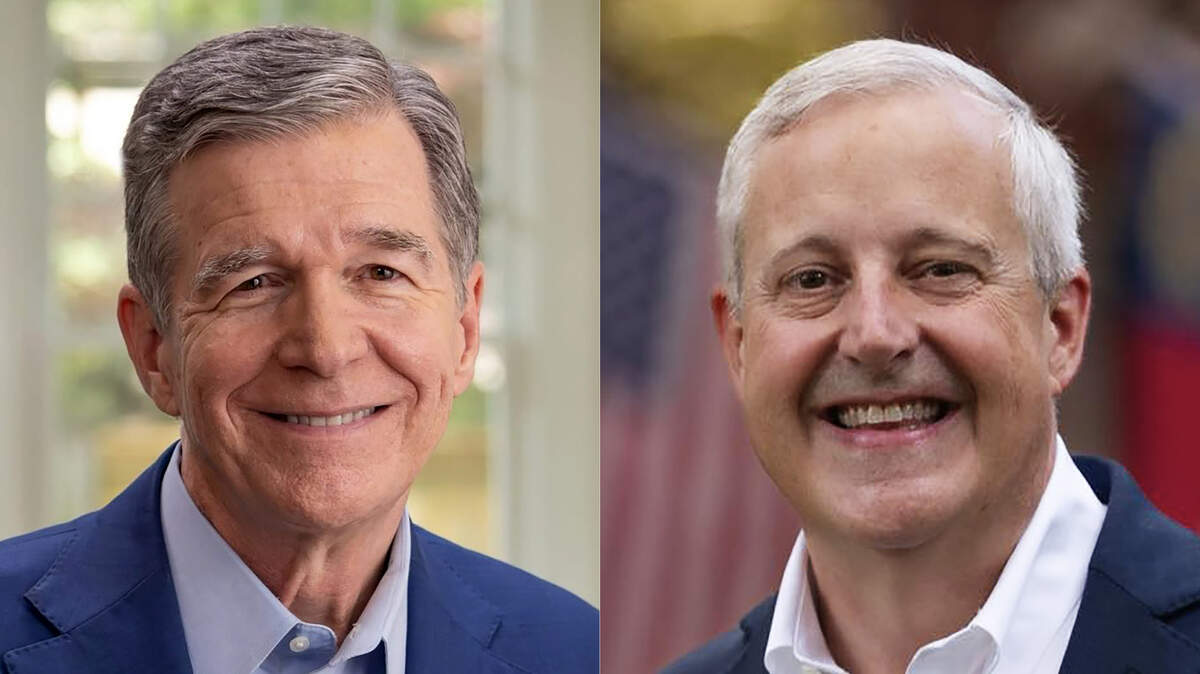
But now Cooper, a Democrat from Raleigh, is running against Whatley, a Republican from Gastonia, to succeed retiring Republican Thom Tillis in the U.S. Senate. And voters constantly hear how Cooper is “dangerously soft-on-crime” or has a “pro-crime agenda” as shown by a prison release during the COVID-19 pandemic.
It’s a very different message about Cooper’s record from the one just six years ago. And it puts Whatley in the position of having criticized Cooper for being both too hard and too soft on criminals.
Whatley’s campaign said it’s Cooper, not Whatley, who’s on “every side of the issue.”
“Ha,” said DJ Griffin, spokesman for Whatley, in a written statement. “This is laughable. Candidate Cooper is now saying he supports both mass incarceration for minor offenses and also mass early-release…”
On June 16, 2020, the North Carolina Republican Party sent out a news release celebrating President Donald Trump’s executive order that targeted the use of excessive force by police and created a database of “corrupt cops.”
It also highlighted North Carolina lawmakers’ passage, the same day, of the Second Chance Act, which makes it easier to have criminal records expunged. Republicans said in their 2020 news release that it “reduces unfair sentencing and helps people get a job once their sentence is over.”
“The successes President Trump has racked up on criminal justice reform in his first term stand in stark contrast to the decades Joe Biden has spent passing draconian legislation,” the NCGOP said in its 2020 news release. “Former Senator Joe Biden personally worked to pass the 1994 crime bill that led to much of the mass incarceration that the Trump criminal justice reform sought to address.”
At the time of the news release, Trump was running against Biden (the first time).
The news release then took aim at Cooper.
“Like Biden, Governor Roy Cooper spent the 1990s implementing draconian legislation that criminal justice advocates decry,” the GOP said. “This afternoon, the Republican State House and State Senate unanimously passed North Carolina’s Second Chance Act which undoes a number of laws that then state senator Cooper personally sponsored. During the 1990s, Cooper served in the State Senate as the Judiciary Committee Chairman and personally sponsored legislation to double mandatory minimums, increase the prison time for marijuana possession and eliminate parole board reviews.”
McClatchy reached out to the Whatley campaign asking if he stands by the 2020 news release, if he thought Cooper’s policies were too harsh and how Whatley would want Cooper to walk the line to not be too soft on crime.
“For decades, everyone Left, Right, and Center alike had realized the policies supported by Legislator Cooper in the 90s had not worked,” said Griffin. “So, President Trump sought and secured common sense sentencing reform with broad bipartisan support (87-12 in the US Senate) to undo the failed policies championed by Legislator Cooper.”
Cooper has worn many political hats while serving in elected office.
Over 40 years, he worked in the state House and Senate, then spent four terms as attorney general and two as governor.
The news release focused in on Cooper’s time in the state Senate and his work as chairman of the judiciary committee.
News clippings that time — 1991-2001 — show Cooper was known for his tough approach on crime.
Read more New idea emerges for elevated walkway connecting downtown Raleigh and Dix Park
In 1993, Cooper spoke to the Rocky Mount Telegram about structured sentencing, a plan passed that year to have judges use a grid to match the severity of a crime with a defendant’s past criminal history. Structured sentencing took effect in North Carolina in 1994.
He told the newspaper that he believed violent offenders were being released from prison too soon and structured sentencing would prevent that.
“It will not let them out on parole,” Cooper told the newspaper in 1993. “That is what structured sentence is all about.”
He would speak out against early parole again to the newspaper in January 1994, saying he hopes “the prison cap is lifted, so more criminals can serve the time they should serve.”
In February 1994, Cooper fought for first-degree murder offenders to either be executed or spend life in prison without the possibility of parole.
“Life doesn’t mean life in prison as it stands now,” Cooper said to The (Greensboro) News & Record then. “The person who commits first-degree murder ought to be off the streets of this state.”
In September 1994, the Rocky Mount Telegram quoted Cooper calling for “tougher, and more certain punishment for criminals.”
“If criminals are afraid of the criminal justice system, then it will deter them from crime,” Cooper told the newspaper. “Punishment is just one side of crime. We must prevent crime. It makes economic sense.’”
North Carolina still sentences defendants to death, but an execution hasn’t been carried out since 2006 because of legal fights over claims of racial bias and over the methods used to carry it out. There are 122 people on death row in North Carolina.
Cooper granted clemency to 15 people on death row before leaving the governor’s office at the end of 2024.
Since Cooper left office and began his run for U.S. Senate, Republicans have tried to rewrite the narrative on Cooper as soft on crime.
It began in August 2025, with the death of 23-year-old Ukrainian refugee Iryna Zarutska. DeCarlos Brown is accused of killing Zarutska on the light rail in Charlotte while he was out on bail from jail for misuse of the 911 system.
In February, Republicans leaked to Fox News a document sealed by a judge that showed Brown was included on a list of 3,500 people released from prison early due to a 2021 court settlement.
In 2020, several advocacy groups called on Cooper to release 18,000 prisoners, or more than half the state’s prison population, by executive order to stop the spread of COVID-19 in prisons. When he refused, those groups sued the state.
A judge sided with the advocacy groups, saying he would likely rule that the virus had made the conditions at the prisons unconstitutional. In response, state officials agreed to a settlement that called for the release of at least 3,500 prisoners who were near the end of their prison sentences.
Brown was among those included on the list, but his prison record shows he had already served his full sentence and was out of prison by the time the settlement was agreed to. That hasn’t prevented Republicans from repeatedly blaming Cooper for Zarutska’s death years later.
Read more A coastal Carolina restaurant is opening its first Cary location
Cooper faces off against Whatley in the general election on Nov. 3.
This story was originally published August 27, 2026 at 12:42 PM.