
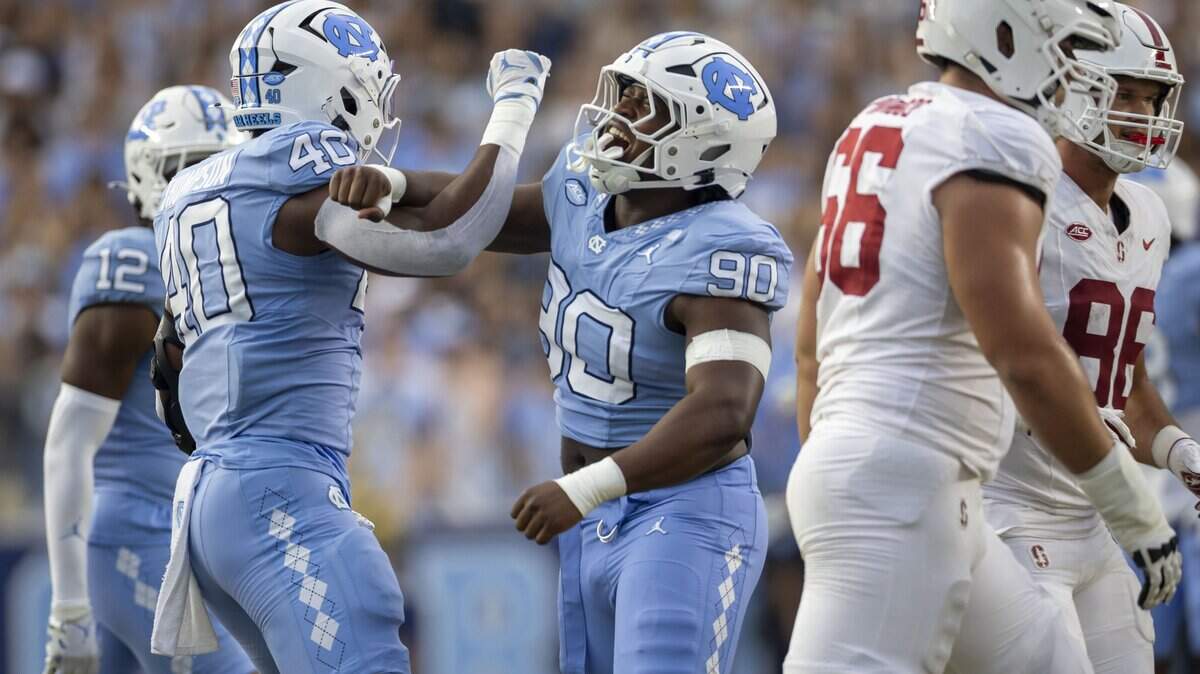
Xavier Lewis said last season was just the start. After joining the University of North Carolina football team as a preferred walk-on, Lewis’ first goal was to get on the field. The 6-foot, 250-pounder’s quickness earned him an opportunity as a situational pass-rusher on third downs. But things are different now — he’s an every-down player for UNC in his sophomore season.
Read more West Coast-inspired Raleigh restaurant will close its doors this month
“I just embrace the role,” Lewis said, “to come out and, you know, ball out.”
In a 15-10 win over TCU on Saturday at the Aviva Stadium in Dublin, Ireland, Lewis announced himself as one of North Carolina’s best defensive weapons and may very well have announced himself on the national stage, too.
He was its highest-rated defender, per PFF, earning a 82.4 overall defensive grade with five pressures, two sacks and 4.5 tackles for loss. It was evident that TCU’s offensive line, which Lewis noted after the game he expected would struggle against movement, didn’t have an answer for his’ speed and quickness at the line. He blew up a run play with about 2:30 left in the half, just two plays before TCU’s long-snapper airmailed a snap that ended up as the winning score on a safety to make it 12-10.
His most productive sequence, though, came on the TCU drive immediately after UNC added the field goal midway through the third quarter to make it 15-10, which was the last score of the game. He got his first sack, then a run stop around the line of scrimmage a few plays later. The very next play, he waited patiently on the rush and burst through when he saw an opening to force an intentional grounding by TCU’s Jaden Craig to end the drive.
That play in particular showed the pass-rushing prowess of several for UNC, as a great push by true freshman defensive lineman Trey Gidden set up a lane for Lewis to attack. In addition to Melkart Abou Jaoude’s team-leading 87.6 pass-rush grade, per PFF, Lewis provided a terror for TCU in every situation in all 54 of his snaps. The UNC defensive line looked great because of it.
“It was a great team effort from the defensive line,” Lewis said. “From guys like Leroy Jackson, Isaiah Johnson, Trey Giddens, they also had a great game as well. Like, it wasn’t just me. I had a little bit to do with it, but they helped me out a lot through their performance as well.”
Here’s what else stood out from rewatching the Tar Heels’ win.
There wasn’t much to the Tar Heels’ two turnovers, which were both fumbles by runners looking for extra yards. Slot receiver Trech Kekahuna, who fumbled with under a minute left in the first half as UNC was marching down the field in a two-minute drive following the TCU safety, spun off a tackler and didn’t see another Horned Frogs defender immediately ready to levy a hit from beside him.
Running back Benjamin Hall’s fumble with 5:39 remaining in the third quarter was similar, as he kept his legs churning on first contact and had the ball punched out when more TCU defenders jumped into the pile.
The common denominator? Each had just one arm on the football when they lost the ball. The ball security issues could have been costly. According to ESPN Insights on Twitter, FBS teams were 6-193 when scoring 15-or-fewer points and committing two-or-more turnovers. UNC snuck away with the win this time.
Time after time, UNC offensive coordinator Bobby Petrino tried setting up the same thing for his tight end, Jelani Thurman. A 6-foot-6 big target in the downfield passing game, led Tar Heels receivers with 94 receiving yards on four receptions. Yet despite catches of 20, 35, 14 and 25 yards, only one of them (a 35-yarder up the seam on the first drive) came down the field.
Petrino, rather, set up Thurman multiple times to just get the 250-pounder out in space. On the first play from scrimmage for the Tar Heels, Thurman was lined up to the right of the offensive line, chipped a defensive lineman, then ran horizontally into space, reeling in a short pitch-and-catch from quarterback Billy Edwards Jr. before running for a gain of 20. His two second-half catches were nearly identical plays. He was thrown the ball short and given the opportunity to get yards after the catch.
Read more Brooks Nader Says ‘Don’t F***’ With Sister Sarah Jane as Sibling Joins ‘DWTS’
Thurman had 72 yards after the catch, an average of 18 per reception per PFF, which was 53 more than any other UNC receiver. Edwards targeted and failed to connect with Thurman a few times over the top, trying to have Thurman make a play on a jump ball, but those quick passes kept him involved in the offense.
“Carolina just bringing me in,” Thurman said, “they just showed everybody how the tight end can work.”
Thurman wasn’t limited in his impact to the passing game, though. He had several key blocks to set up big run plays, too, and was on the field for 25 blocking snaps among his 55 snaps total. He even had the key block at the second-level on running back Jaylen McGill’s touchdown run in the first quarter and had a big block to the inside on another McGill run right before Kekahuna fumbled in the two-minute drill.
Thurman will be on the field a lot for North Carolina, and the win over TCU was a preview of how involved the Tar Heels would like him to be.
The most notable snap counts in North Carolina’s week zero win, per PFF, were likely the ones coming out of the running back room. Hall got the start and played 27 snaps, which was a near-split with McGill, who had 25 offensive snaps. But the most jarring snap count was running back Demon June’s, the Tar Heels’ leading returning rusher with 464 yards on 84 carries a season ago. On Saturday, June was on the field for just nine offensive snaps.
North Carolina clearly has sights on using him in the run game, though. Seven of his snaps were rushing plays, with June getting six of those carries for 25 yards — all in the game-sealing drive. He nearly secured the game-sealing first down, but the play was whistled dead when his forward momentum briefly stopped on his third effort to the marker.
June is a bruiser, and provides a different element compared to Hall and McGill. A poor rep where he whiffed on a block and got hit with an illegal block in the back penalty with just around 11:26 left in the half might have contributed to the low snap count, but he was by far the least involved of the three UNC running backs that were expected to get some playing time.
Left tackle Jacqawn McRoy, right tackle Jordan Hall, left guard Andrew Threatt, right guard Aidan Banfield and Edwards each played all 58 offensive snaps, per PFF. Wide receiver Jordan Shipp led all skill players with 56, followed by Thurman’s 55 and 39 for wide receiver Mason Humphrey. Cornerback Jaiden Patterson and linebacker Derek McDonald led the way with 72 defensive snaps. Leroy Jackson led defensive lineman with 58, but Lewis (54), Jaylen Harvey (54) and Abou Jaoude (53) all played 50-plus. Abou Jaoude briefly left for a little more than a drive with a hand injury, per the ESPN broadcast.
Lewis had the best defensive grade and Thurman (71.7) had UNC’s best offensive grade, per PFF.
Read more Student group welcomes ‘professors UNC doesn’t want you to hear from’
This story was originally published September 1, 2026 at 5:30 AM.