
AI-generated summary reviewed by our newsroom.
Raleigh lifted its water restrictions last month after rebounding from the state’s current drought, but how will it handle future droughts?
Read more What makes UNC football’s pass-rushing effective? Speed and depth
As the city grows, Raleigh leaders will have to decide how to meet increasing water demand. They could build another reservoir — an expensive proposition — or find another option.
But one NC State professor says the city does not need a new reservoir if it can be more efficient with the resources it already has.
The City Council will meet at the municipal building on West Hargett Street in an 11:30 a.m. work session Tuesday to discuss the city’s drought response plan and long-term water resources.
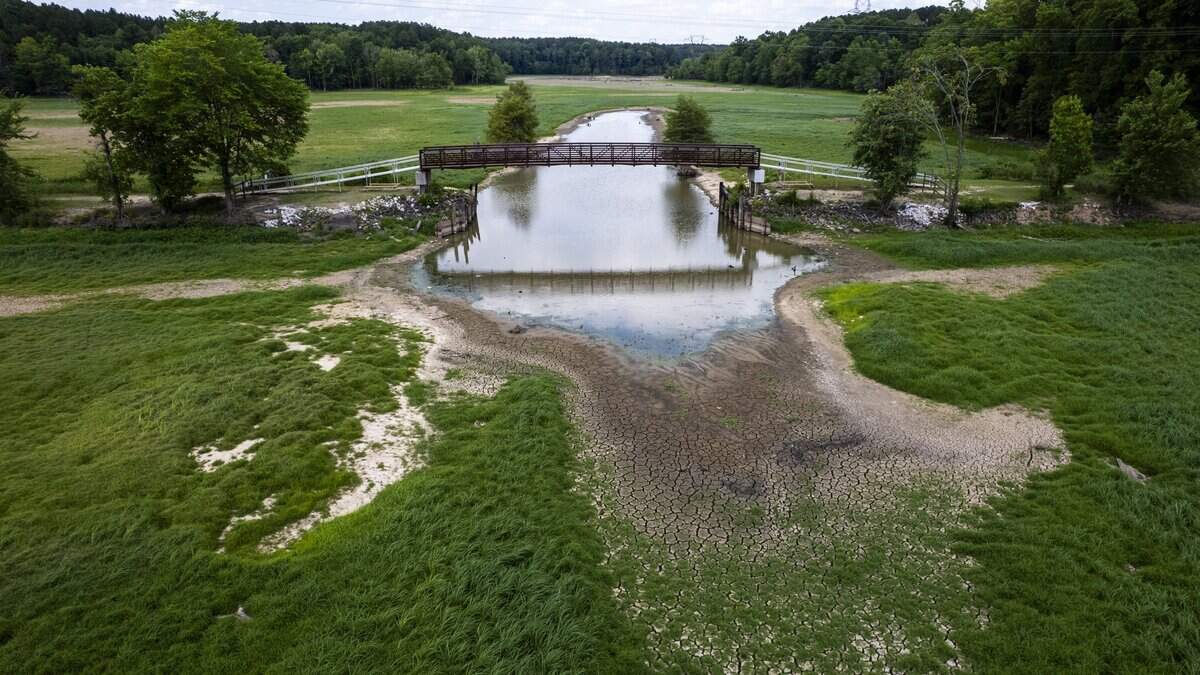
This year’s drought originated in August 2025, when the state started seeing below-expected rainfall. By March 31, all of North Carolina’s counties were in some stage of drought.
Raleigh implemented its stage 1 restrictions in April, which required residents to water their lawns only on certain days, alongside other restrictions.
The city made that decision, according to Assistant Raleigh Water Director Ed Buchan, because Falls Lake — its primary reservoir — was at 85% capacity.
The city’s water restriction system is triggered based on the reservoir’s water level, and Buchan said the lake had always been full in April, to his knowledge.
The restrictions proved ineffective, however, as many people didn’t obey them, he said.
The City Council voted during the summer to grant the city manager authority to enact stage 2 water restrictions — which would have prohibited most lawn irrigation — since the council was about to go on its summer break, and water demand remained high.
Late summer rainfall enabled the city to lift stage 1 restrictions, but questions remain on what the city may do to expand its water supply and revise its rules.
Buchan says water demand really hasn’t increased that much in the past two decades, but future growth will still require more water.
The city’s water demand in 2007 was 52 million gallons per day, he said. Now, it’s 60 million gallons, though the city is temporarily selling water to Fuquay-Varina, Johnston County and Franklin County while those areas plan to acquire more of their own water, Buchan said.
When those sales figures are subtracted, the city’s true demand now is only 57 million or 58 million gallons a day, he said, an increase of about 8% to 10% since 2007.
The city’s population has increased more than 23% in that same time, according to U.S. Census data, and that doesn’t include the other towns that use Raleigh’s water system.
“Point being, for the demand to only increase 4 or 5 million gallons over 19 years is pretty amazing,” Buchan wrote.
Changes to water usage patterns after the 2007-08 drought — among the worst in the city’s history, according to Buchan — have also helped reduce demand.
People are using more water-efficient toilets and appliances and a higher proportion of residents are moving into apartments and town homes with smaller or no lawns.
But Raleigh has also merged water systems with Wake Forest, Zebulon, Knightdale and others in Wake County. And it sells over a million gallons a day to Fuquay-Varina.
Those towns are experiencing significant growth alongside Raleigh, Buchan said. The population of towns in the Raleigh Water system is expected to more than double by 2070, according to data from Wake County.
“Overall, we have more than adequate water resources to meet our needs at least through 2045, but we are investigating what our next water resource options could be,” he wrote.
NC State University professor Sankar Arumugam, who studies government water management, said in an interview that new development especially seems to be less water intensive.
“If you think about water consumption as a whole, most of the consumption increase is in the summer for the yard and for grass,” he said. “With new [housing] development you can see lawns are getting smaller.”
Read more How Duke’s Walker Eget bounced back from ‘not good’ game to help Blue Devils win
And new development is also typically more dense with apartment buildings rather than single-family homes with lawns.
Raleigh Mayor Janet Cowell has said the greater region around Raleigh has to significantly increase its water supply over the next few decades to meet growth.
The two most likely options for the city, she wrote in her newsletter in July, are developing a new reservoir on the Little River to the northeast of Raleigh and constructing a new intake to draw water from the Neuse River, which feeds into Falls Lake.
But Arumugam said developing a new reservoir is “counter-productive.”
Reservoirs typically have a large surface area exposed to the sun, which means that more of the water evaporates because of heat.
That, combined with the water taken out of supply by the new reservoir, can cause less water to go downstream to other communities.
And building a new reservoir is expensive, he said.
In 2012, Raleigh contracted with a consultant to investigate building a reservoir on the Little River.
Then, it was estimated at more than $260 million, which would be over $380 million when adjusted for inflation today. That would have netted the city almost 14 million gallons of water per day.
The city ultimately decided not to move forward with the plan.
In 2019, it negotiated with the U.S. Army Corps. of Engineers — which manages the lake — to gain access to a higher proportion of Falls Lake’s water. The city had to pay $24 million for the rights to the water, adding 22 million gallons of water per day into the city’s supply.
Arumugam said the city could go back to the Corps and ask to raise the water level at Falls Lake, which would give the city access to more water.
The main mission of the Corps though, is to prevent flooding from places like Falls Lake from affecting the areas downstream of the Neuse River, which flows eastward out of the lake.
Arumugam says the lake, which has never overspilled its dam, can afford a “small increase” in its water level without affecting any downstream communities’ flood risk.
The short answer is yes, said Edward Woodley, the chief water manager for the U.S. Army Corps of Engineers‘ Wilmington District, in an interview with The N&O.
It’s been proposed before, Woodley said. But it would require an in-depth study to see how raising the lake level would affect flood control and the water supply in the entire area around the lake and Neuse River.
“If you take more water, it’s got to come from somewhere,” Woodley said.
That study would come with a cost, and if the water level were raised enough, it could require adding to the height of the Falls Lake dam, which would come with an even higher cost, Woodley said.
He couldn’t speculate as to how much the idea could cost, however.
City spokesperson Julia Milstead told The N&O the city is already working on expanding the water pools at its secondary water reservoirs at Lake Wheeler and Lake Benson by 2 feet each.
That will give the city another 2 million gallons per day when those projects are completed over the next five years, and it will cost the city about $30 million.
Buchan also told The N&O in early August that the city planned to reevaluate its drought restriction trigger system.
“The current system was developed in 2012, and while water demands haven’t increased very much since then, we do believe that will be changing moving forward,” he wrote. “We were able to absorb a lot of new residents and not increase water demand, but I think our demands will start creeping up year to year.”
One scenario he said the city is modelling is a combination of the current drought and the conditions of the 2007-08 drought.
“That is a true ‘worst case scenario’, so we need to understand how we can manage through something like that,” he wrote.
Arumugam suggested that some restrictions, like limiting when people can water their lawns, could be considered as permanent measures.
He said the city should be sustainable with its water resources all the time, rather than just during a drought.
Read more These 30 Cary and Morrisville schools are closing early due to water main break
This story was originally published September 14, 2026 at 11:19 AM.