
AI-generated summary reviewed by our newsroom.
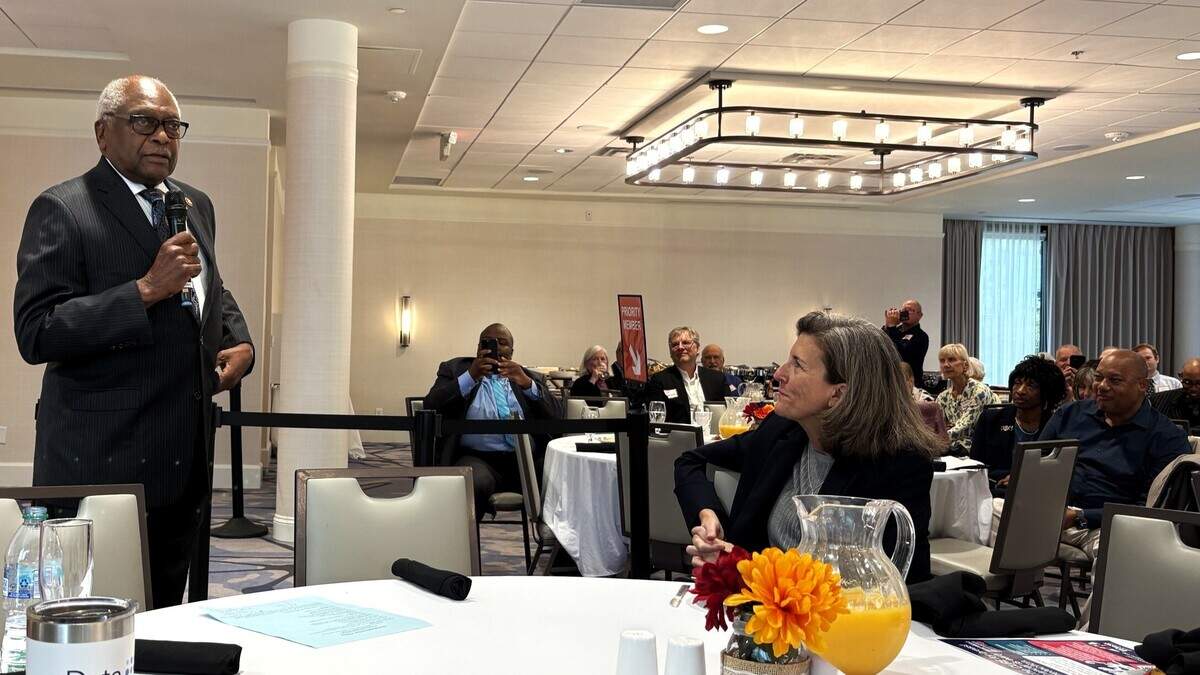
This year’s midterm election is the most consequential of our lifetimes, South Carolina U.S. Rep. James Clyburn told a roomful of Democratic leaders and supporters in Chapel Hill on Saturday.
Read more How a messy Week 5 affected the ACC’s ranked teams, top 25 hopefuls
But it’s “not quite true” that the nation hasn’t been here before, he said, recounting the 1876 presidential election between Democrat Samuel Tilden and Republican Rutherford B. Hayes.
Tilden won the popular vote, but fell one vote short of an Electoral College victory, while Hayes lacked 20 Electoral College votes, Clyburn said. Florida, Louisiana and South Carolina remained in contention, and a 15-man commission was eventually formed to nominate one man to the U.S. House.
The commission split 8-7 for Hayes in January 1877. Democrats abandoned threats to delay the process, and 30 days after he was sworn in as president, Hayes agreed to Southern Democrats’ demands to end Reconstruction — a pivotal decision overturning rights and opportunities that formerly enslaved Black Americans had gained following the Civil War.
The result was decades of Jim Crow laws, violence and oppression until the 1960s Civil Rights Movement pushed the government to pass new laws aimed at inclusion and equality.
“The consequence of one vote demonstrated how important it is to show up on Election Day,” Clyburn said at the Orange County Democratic Party’s annual Unity Breakfast.
“Don’t let that one vote be you. Don’t let that one vote be a sibling or parent or child or a friend or maybe just an acquaintance,” he said.
Born to an activist minister and a beautician in South Carolina, Clyburn graduated from high school in 1957 when his choices as a Black man were still limited. In 1992, he became the first Black man elected to Congress from South Carolina since 1897.
Now 85, he has twice served as majority House whip and also as chair of the Congressional Black Caucus and the House Democratic Caucus, among other roles. Last year, he published “The First Eight,” a book documenting the stories of South Carolina’s eight Black congressmen following the Civil War, the history of Jim Crow and Southern suppression of Black political power.
Clyburn, who remains the only Black House member from South Carolina, is pushing to expand the U.S. Supreme Court from nine to 13 members as he seeks another term in Congress, despite an attempt to redistrict him out of office earlier this year.
U.S. Rep. Valerie Foushee, an Orange County Democrat, said it has been an opportunity and a privilege to sit with Clyburn in the U.S. House.
“What I will tell you is that the opportunity to learn from this great patriot has been the highlight of me being a member of Congress,” Foushee said
Saturday’s event, which also featured brief remarks from Democratic Court of Appeals candidates John Arrowood, Toby Hampson and Christine Walczyk, came five days before in-person early voting starts Oct. 15. It also came as Democrats regained a narrow lead over Republicans in North Carolina voter registration.
Read more NASCAR Chase playoffs in Charlotte: Our predictions, how to watch, betting odds
There were 490 more Democratic voters as the registration window closed Friday for the Nov. 3 election, state elections law expert Gerry Cohen noted on social media. (Voters can still register during the in-person early voting period.) State Board of Elections data showed 2,331,133 Democrats to 2,330,643 Republicans.
But unaffiliated voters still outnumber both parties, adding 1,908 new registrations as of Friday, said Cohen, who is a member of the Wake County Board of Elections and a former Chapel Hill Town Council member.
Unaffiliated voter registrations have grown substantially over the last 20 years to reach 3,168,005 heading into the November election, data shows.
The change in party dominance comes less than a year after Republicans overtook Democrats ahead of the March primary races. State Board of Elections data in February showed about 2,000 more registered Republican voters than Democrats.
That was the first time in North Carolina’s history that Republicans outnumbered Democrats, The News & Observer reported.
State Sen. Jonah Garson, representing Orange, Person and Caswell counties, said he is glad to hear more people are joining the Democratic Party, and “heartened to see more young people making the choice.”
But he remained cautious about the news, noting the state’s longtime policy of letting unaffiliated voters participate in primaries was expected to grow the number of unaffiliated registrations. Negative partisanship still remains at an all-time high, he said.
“I think, if anything, the significance of Democratic registration increases has to do with folks wanting to assert themselves with the Democratic brand at a time when the Republican Party is such a cluster, and so the registration data has some significance, but it is just not nearly as significant as it would be in a state where it’s a closed primary system,” Garson said.
Clyburn agreed the Democratic Party still has work to do, despite an analysis he cited that he said showed the party with a 73% chance of taking back the Senate from Republicans in November and a 93% chance of taking back the House.
There’s also a lot of work ahead to make the country great by providing affordable and accessible health care, education, housing and energy, Clyburn said. Citing the “Triple A” of representation, he also urged Democrats to also make themselves accountable.
“No kings. Good, solid, representative democracy,” Clyburn said, referencing the words of Benjamin Franklin. “That’s what the republic is — a representative democracy — but it is always under threat, and what you and I have got to work on is making sure that we do the things that are necessary to protect this democracy from those threats.”
Read more Isaias left thousands in Carolinas without power. 8” of rain threatens mudslides