
AI-generated summary reviewed by our newsroom.
Editor’s note: This story contains discussions about suicide, a topic that will be disturbing to some readers.
Read more What Butterball must pay, change after firing NC worker with breast cancer
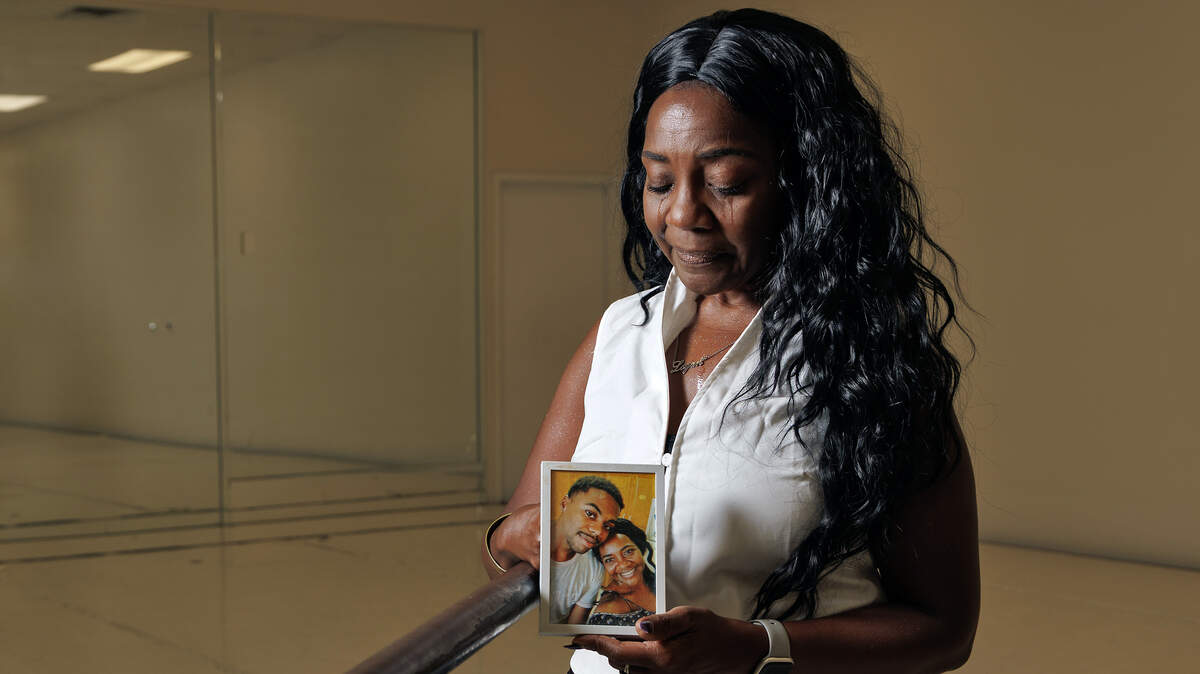
Lisa Beckwith keeps her phone on silent.
The sound of a ringing phone transports her back to fielding calls from doctors while her son Logan was in and out of psychiatric care throughout his 20s. Or those few calls from police, informing her that Logan had been arrested and taken into custody when his thoughts and actions became erratic during a manic episode.
In those days, Beckwith lived with fear that someone would take her son away from her, that they wouldn’t understand him or what he needed, that they’d mistreat or judge him.
But even now, more than two years after Logan died by suicide in 2024 at age 29, she leaves her ringer off.
Beckwith avoids reading about tragedies in the news. Even stories about accidents can be “traumatizing,” she said.
So when her cousin told her last month that a young Black man had been found dead in a parking lot in downtown Raleigh, hanging from a tree, her heart dropped.
Police were calling it a suicide, she was told. She stopped what she was doing and prayed.
She prayed because she knew what his mother was feeling, she said: the anguish of getting the call, the insistence that police must be wrong, the blur of grief that lay ahead.
“I don’t know her son, but I know her pain,” she said.
The suicide of the 32-year-old man — who has never been publicly identified — drew immediate anger and fear online. Community members and advocates pressed police on how and why they’d so quickly ruled out foul play, demanding authorities probe the case as a hate crime.
To Beckwith, a second-grade teacher in Durham, fears of the man’s death being an incident of racist violence are understandable.
“History has made us fearful of that,” she said.
But after Raleigh police confirmed to the public in August that surveillance video showed the man had acted alone and taken his own life, for her, one question remains: What now?
“Now that it was not a brutal act of one race [harming] another race, now what?” Beckwith asked. “Because yes, [suicide] happens to the Black community.”
There have been at least 10 reported Black hanging deaths across the U.S. in 2026.
One hanging death has been ruled a homicide after an autopsy, prompting 59 members of Congress — including Charlotte Democratic Rep. Alma Adams — to sign a letter Sep. 10 demanding the FBI and Department of Justice open an investigation into the deaths.
Many of these deaths were ruled suicides, angering critics who say the image of Black people hanging from trees echoes the lynchings of roughly 4,400 Black Americans in the U.S. between 1877 and 1950.
Victims’ families have also criticized some investigations for skipping steps. In Charlotte, police ruled the death of Juliana Nzita, a Black girl found hanging behind a church, a suicide. But they did not find her cell phone, have an autopsy done or contact the man who found her body, according to The Charlotte Observer’s investigation.
At the same time, Black Americans face rising suicide rates, especially among young Black people.
Black suicide rates in the U.S. rose over 25% between 2018 and 2023, according to the Centers for Disease Control and Prevention — going from about 7 deaths per 100,000 people in 2018 to 9 deaths per 100,000 people. Overall suicide rates for all races stayed roughly the same, at about 14 deaths per 100,000 people.
While Americans ages 10 to 24 saw a 10% decrease overall in suicide rates, Black people ages 10 to 24 saw a near 30% spike between 2018 and 2023.
Suicide rates among Black Americans are still below the national average. But data going back to the 1930s that showed a very low suicide rate among Black people has steadily increased in the past three decades, according to Sonyia Richardson, a professor of social work and psychiatry at UNC-Chapel Hill, who studies Black youth suicide interventions.
Researchers have posed several theories for the increase, Richardson said: the rise of technology and cyberbullying, racism and discrimination and access to firearms. One researcher from the 1930s predicted that as Black people were assimilated into broader U.S. culture and shed African communal values, suicide rates in the community would increase, Richardson said.
Sonyia Richardson
North Carolina has a five-year “Black Youth Suicide Prevention Action Plan,” which Richardson said is tailored to meet cultural needs through informal community supports. Black youth and their caregivers may avoid seeking formal, clinical interventions like a psychiatrist or therapist out of fear or mistrust. But trusted adults, like youth sports coaches, barbers or pastors, can help youth open up about suicide.
The state’s plan supports a 30-county network of 250 volunteers who are trained in talking about suicide and host community events, Richardson said.
“Suicide prevention is not always talking about death,” Richardson said. “Suicide prevention is, ‘How do we make life worth living?’”
Logan was in eighth grade when he fell in love with dance.
His family never saw it coming. Lisa and Levi Beckwith knew Logan as the quiet kid who preferred to be alone. He was a protector of his younger sister, Lydia, and his little brother, Levi III, an admirer of his big brother Lance.
But when he performed his first solo performance for his school’s talent show to “Halo” by Beyoncé, his favorite artist, his classmates went wild.
“The kids, everyone was screaming,” Beckwith said. “It was like they didn’t know his name [before], but then they knew his name.”
From then on, dance was Logan’s “freedom,” Beckwith said.
He loved ballet — the grace of it, the elegance, the art form. To him, it felt like floating. By the time he was 18, he was performing in the Carolina Ballet’s “The Nutcracker.”
But around that time, he was diagnosed with bipolar disorder.
One day, Logan left for dance class and didn’t come home.
Beckwith found him on the side of a road in Clayton — far from the family’s home at the time in Knightdale. He wasn’t wearing shoes. He didn’t know who his mom was.
Read more Raleigh curfew plan + Wake school lawsuit threatened: Wednesday’s top Triangle stories
“We get warnings with tornadoes,” Beckwith said. “We get warnings with hurricanes. But the way [the episodes] came in with his mental health, it was just like [that]. So strong, and then it stops. That’s what it would do. It would go, it would spin, and then it would halt. And that’s the mystery to me.”
Lisa Beckwith
By his early 20s, Logan was diagnosed with bipolar disorder, schizophrenia and depression. Later, doctors added anxiety and obsessive compulsive disorder to his list.
Logan’s life became crowded with prescriptions and appointments — cycling through more than 20 doctors between the ages of 18 to 29.
He was about 23 when he traveled to New York and was accepted into the Bolshoi Ballet Academy Summer Intensive — a rigorous summer program for advanced dancers, with a goal of being recommended for year-round admission at the competitive Bolshoi Ballet Academy in Russia.
But weeks into the program, he withdrew as his mental health worsened.
Months before his death, Logan sent his mom what she calls a “blueprint” for the future.
In an email, Logan outlined a plan to help other dancers: funding a scholarship to help aspiring performers, sending dance supplies to children in Africa and donating to African orphanages.
“It was just to make a difference, making people not have to struggle financially to dance,” Beckwith said.
Logan took his own life on Feb. 16, 2024.
After Logan’s death, Beckwith felt it was as though her son had left her with a child, his own legacy for the family to foster.
She erected the L.A.B. Foundation in her son’s honor — named for Logan’s initials. In August, the foundation awarded its first $500 scholarship to a young dancer.
“That’s the point,” Beckwith said. “Taking the blueprint my son left for me and sharing it with the universe.”
But more than two years after Logan’s death, Beckwith said she’s told only family members and close friends how he died, wanting him to be remembered for more than his illness or how he ended his life.
“It’s an act of death that’s traumatizing and hurtful, and just like any death it does leave you speechless, but it shouldn’t bring shame,” Beckwith said. “It shouldn’t make me feel like I can’t talk about it. It shouldn’t make me feel like I have to cover it up. I don’t want to feel like that.”
Beckwith remembers when the 32-year-old man was found dead in downtown Raleigh. Her cousin had told her the news and the discourse it sparked, including comments casting doubt that Black people commit suicide.
Hearing those comments “made it worse,” Beckwith said. “To think that because of the color of your skin, you won’t do an act like that?
“It gives it negative attention,” she said. “Suicide is negative energy — that’s the way it’s projected. But the ones left behind are not negative. We’re left to deal with your negative thoughts from society. We’re left to deal with that.”
Bettie Murchison has seen the stigma against suicide in families firsthand.
As a community organizer and the CEO of mental health organization Village for C.A.R.E., she’s watched families grapple with telling their story after losing a loved one to suicide. Some challenge the cause of death. Others stay silent for fear of judgment.
“There are questions of ‘How did you allow this to happen?’” Murchison said. “People point fingers and want to assign shame or blame. There is a reason that people don’t want to talk about it.”
But it reflects a “genuine” lack of understanding about the reality of suicides, Murchison said.
According to a study from the Journal of Black Psychology, suicidal behavior in the Black community historically has received little attention, due to a belief that few Black people committed suicide or experienced depression. Some of that belief stemmed from racist theories that Black people were too carefree or “psychologically unsophisticated” to feel sadness or depression, the study states.
“I give grace to people who say Black people don’t die by suicide,” Murchison said. “I give grace and say maybe they really don’t know. That was a catalyst for me that our work is still not done.”
Inside a small dance studio in North Raleigh, a cluster of girls in black leotards are walking on their toes for the first time.
With pointe shoes laced to their feet, they haphazardly balance on their toes, gripping the ballet barre. A dozen mothers in the lobby crane their necks to glimpse their own ballerina through a window.
One mother standing outside can barely contain her own excitement. “It’s their first day on pointe,” she says, beaming. “Mine keeps looking over like, ‘Mom, are you seeing this?’”
Beckwith stands toward the back of the lobby, taking it all in.
This studio was Logan’s safe haven. He came to dance when he was healthy, and he came when he was manic. Dance — and the people who helped foster it — were there for him regardless, Beckwith said.
A plaque in honor of Logan and the L.A.B. Foundation sits on the studio’s front desk. His memory isn’t far.
Whenever she sees a dancer, Beckwith says she can almost feel Logan smiling.
“Dance made Logan happy, and he wanted to make dancers happy,” she said.
A new ensemble of dancers scrambles onto the dance floor, this time barefoot. The lights go dim as the hushed group gets into position.
Beckwith stands in front of the window. A slow ballad fills the space. She smiles softly and watches.
If you are having thoughts of suicide or other mental health struggles, call or text 988 for a 24/7 hotline. Call 988-PEERS-NC for the North Carolina peers warmline to talk to someone with experience with substance abuse and mental health concerns.
Read more Inside Drew Lovelace’s transition from NC State men’s soccer to football