
AI-generated summary reviewed by our newsroom.
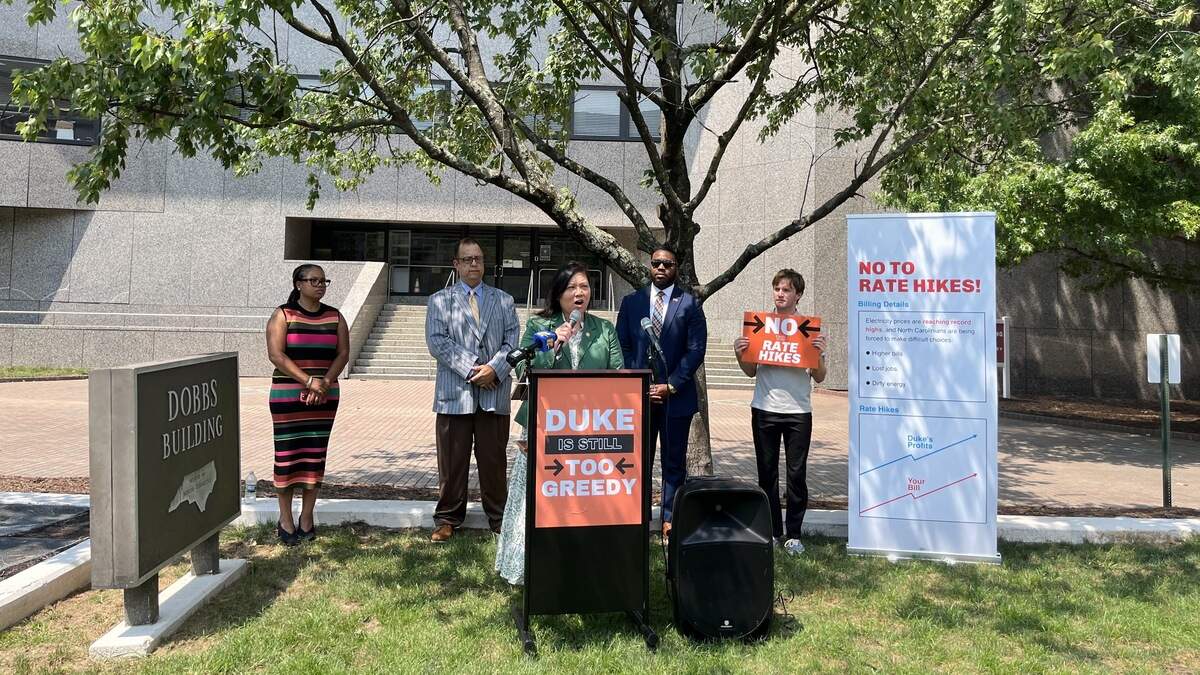
As Duke Energy Progress asked for higher electric rates at a Utilities Commission hearing on Tuesday, concerns about affordability grew louder just outside the hearing room.
Read more WCPSS coach found dead in Raleigh home. Police accuse her boyfriend of murder.
“Families are already stretched with their budgets, and some are facing the very real possibility of having their power disconnected,” said State Rep. Maria Cervania, a Democrat from Cary, at a news conference outside the hearing on Tuesday. “Yet Duke Energy came before the Utilities Commission asking for those same families to pay even more.”
Duke Energy Progress, which serves 1.6 million customers in eastern North Carolina and the Asheville area, is asking the Utilities Commission to let it raise electric bills by 6.8% across all customer categories, or 9.3% for residential customers, over the next two years.
For the average household, that will amount to a $9.62 increase on monthly bills starting Jan. 1, and another $5.89 increase starting in 2028.
At first, the utility wanted to raise rates by over 15%. But after months of backlash over high electricity bills — and weeks of negotiations with North Carolina’s utility watchdog group — Duke agreed last week to ask for a smaller rate increase, put in place new protections for customers, and slightly shrink its requested profit margin.
“We really need to balance ensuring a reliable system … while also taking into context affordability, and we believe that this [deal] provides that right balance,” said Kendal Bowman, Duke’s president of operations for North Carolina.
Despite the deal that’s been proposed, many state officials say it’s not enough. Attorney General Jeff Jackson is refusing to sign onto the deal, his office announced Wednesday.
“Duke brought down their rate increase … but that’s still too high for families and still more than the company needs to cover its investments,” Jackson said in a statement. “We’re not signing it.”
During this week’s hearing in Raleigh, the state’s five-member Utilities Commission is hearing arguments for and against the rate hike from Duke and other stakeholders. The commission will decide this fall whether to approve the new request as is, or to ask for different electric rates
‘Give and take’ with Duke
As the hearing kicked off Tuesday, Duke executives faced some pressure over their high profits and, as one utilities commission member put it, “dense” communication about their development plans.
Read more MAFS’ Jessica Castro Breaks Silence on Ex-Husband Ryan de Nino’s Death at 40
But at least inside the hearing room, they didn’t face quite the same vitriol as they did in last month’s rate hearings for Duke Energy Carolinas, the western counterpart to Duke Energy Progress.
Still, members of North Carolina’s Public Staff implied that striking a deal with Duke for a lower rate hike request was no easy task.
“The settlement [with Duke] was a process of give and take, but as we were going through … we were being observant of what the overall potential rate impacts would be,” said Patrick Fahey, a regulatory analyst for Public Staff.
Though the new rate increase is still sizable, the deal also requires Duke to refund money to customers in several ways. For instance, the utility will begin refunding customers $120 million that it received in clean energy tax credits — a benefit that Fahey said he saw as “an opportunity to provide immediate rate relief,” even as Public Staff was “exhausting” its options.
Jackson did credit Public Staff for pushing Duke to make compromises, including putting $10 million toward energy assistance funds for low-income customers.
Duke executives maintained that the rate hikes they requested are “required” in order to keep up with market pressures.
Duke Energy Progress had initially asked for a 10.95% return on equity — in other words, the amount of shareholder profit they’re legally allowed to make from building new infrastructure. The return on equity makes up about one-fifth of residential customers’ bills.
Brent Guyton, Duke’s director of asset management, said market data actually suggested that Duke needed an 11.3% return on equity. In the deal they reached with Public Staff, Duke agreed to lower their requested return on equity to 9.8%.
The average electric utility’s return on equity was around 9.7% as of 2024.
This story is available free to all readers thanks to financial support from the Hartfield Foundation and Green South Foundation, in partnership with Journalism Funding Partners, as part of an independent journalism fellowship program. The N&O maintains full editorial control of the work. If you would like to help support local journalism, please consider a digital subscription, which you can get here.
Read more 12-ton school project & a famous landmark re-opens — Today in Triangle history
This story was originally published August 13, 2026 at 1:35 PM.