
AI-generated summary reviewed by our newsroom.
Pads and helmets? Check. Uniforms, shoes and gloves? Check. iPads for in-game film review? Check. Footballs? Check.
Read more Duke prof with Epstein ties and research retractions runs for office in Israel
N.C. State football’s Tuffy-shaped waffle maker? Also, check.
Jaelyn Shipman, the Wolfpack’s director of football nutrition, boarded the team bus cradling the kitchen appliance, one of multiple examples of her often overlooked contributions to the team’s daily routine. If eating a breakfast pastry in the shape of N.C. State’s mascot encourages them to eat, she’s going to do it.
Nutrition itself is an often overlooked and underappreciated aspect of athletic training, but it keeps players healthy and in the game as much as possible.
“(Shipman) is really hands-on; takes it very personal. She’s engaging,” N.C. State head coach Dave Doeren said. “She has great command and presence. Players respect her. She doesn’t take any nonsense from anybody, but she does it in a motherly way. Tough love comes out of her quite a bit, and we’re thankful she’s here. She’s doing a great job.”
N.C. State football players — nearly across the board — boasted positive weight changes this offseason, losing fat and adding muscle.
Defensive lineman AJ Prim jumped from 287 pounds to 300 pounds. Tight end Vander Ploog weighed 220 pounds when he transferred from Oregon. He’s listed at 250. CJ Bailey was 185 pounds as a high school senior. He’s up to 218.
Most people recognize the strength and conditioning staff’s work, but they don’t always remember the nutrition staff. Those efforts extend beyond the field or weight room.
Shipman is in her first year at N.C. State. She made previous stops at Charlotte and Wake Forest, and graduated from Clemson.
She ensures players are fueled and hydrated before, during and after all activities. This includes weight training, practice, games or day-to-day activities. She develops plans to help players lose, gain or maintain weight, educating them on eating and drinking the right items at the right times to meet their goals.
“You’re gonna have your process in the weight room. It looks different from place to place, but, overall, you’re kind of doing the same types of things with your coaches,” Shipman said. “The way that (players) buy into nutrition is a separator.”
Players who learn their bodies and prioritize nutrition incur fewer preventable soft tissue injuries, are less likely to need drastic measures in their weight loss and weight gain, and often recover faster when injuries do occur.
Shipman emphasized the importance of having relationships with each player, ensuring they remember she’s part of the team. She’s not catching passes or blocking, but the nutrition staff will do whatever it can to put them in the best position.
“I don’t feel responsible for wins and losses,” Shipman said. “But I do feel responsible if there’s a guy that ends up having major issues (like) cramping, or they are just sluggish and under-fueled.”
When players step off the field at Dail Practice Facility, they’re met with tart cherry juice — and little drink umbrellas. Nutrition and recovery don’t have to be boring.
This is one piece of the players’ daily nutrition routine.
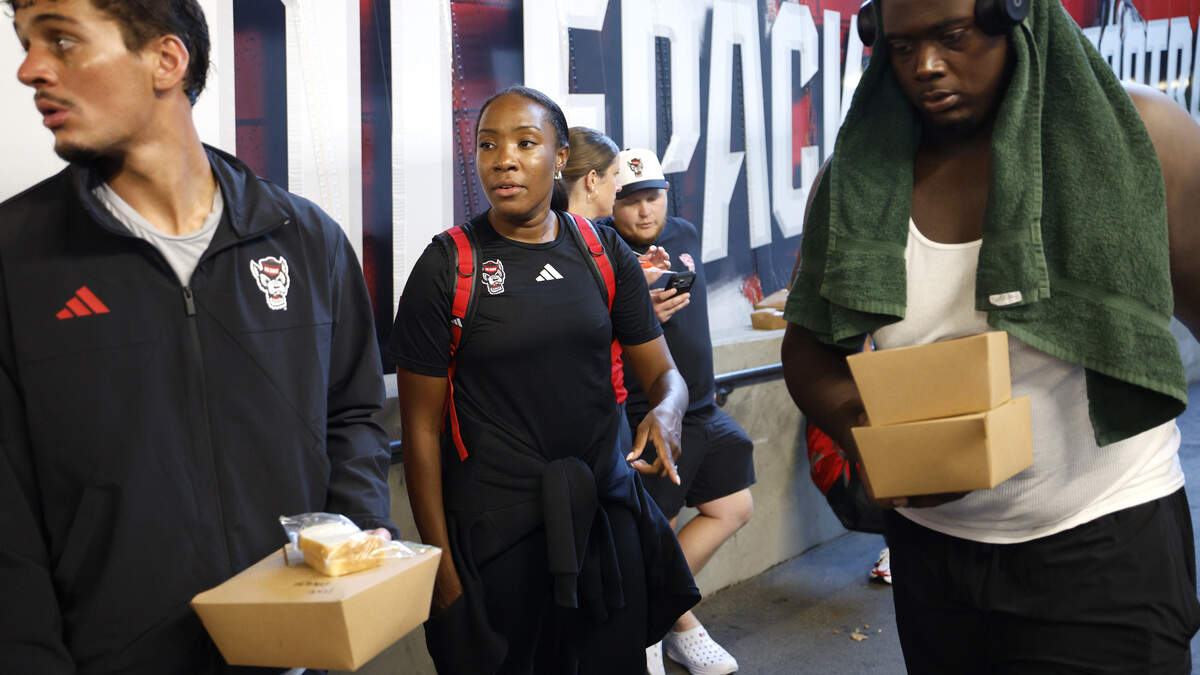
Shipman and her assistant nutrition director Erin Noble test each player’s hydration status when they come in each morning. A tool categorizes each player’s hydration by evaluating saliva osmolality: hydrated, mildly dehydrated, moderately dehydrated or severely dehydrated. The staff provides hydration recommendations, if necessary, and players eat breakfast. Hydration and snack stations are placed throughout the Murphy Center football facility for all-day access.
Before practice, players take hydration shots and eat carbohydrates and snacks.
During practice, the staff provides hydration products and more snacks, including pickles and fueling gummies.
Players receive the cherry juice drinks, which reduces inflammation and assists in recovery, along with protein products, carbohydrates, shakes and fruit at the conclusion of practice.
Each player takes daily vitamins and supplements, reviews their weight and eats lunch. Shipman said the staff is present in the dining hall to help players build their meals to ensure they are meeting their goals.
Shipman asks players to send photos of what they are eating when they are not at the Murphy Center.
“Basically, they want me to be proud of them for better or for worse,” Shipman said. “I’m getting all types of crazy texts, all types of things. ‘My stomach hurts. What’s wrong with me?’ I’m like, ‘I don’t know.’ Then I talk them through it.”
Read more When Was Jonathan Taylor Thomas Last Seen in Public? His Rare Appearances
Shipman’s staff also plans postgame “grab-and-go” meals, smoothies, plane-side meals (when applicable) and the dining hall menus. They typically plan at least two weeks in advance, with tentative in-season plans beginning when they get the game schedule.
Nutrition plans vary from player to player. Some have detailed, hourly instructions to keep track of their intake. Others are told what to eat at certain times, including quantities.
Shipman works with position coaches, strength coaches, and athletic training when devising player plans. She then educates the athletes on how they can meet their goals, while considering their psychological relationship with food.
The staff also helps players build their own meals and teaches how to replicate them at home. Shipman sometimes packs snack bags for players, so they have what they need when they’re outside the football facility.
“We are with them all day, you know, for most of their day, there’s so many touch points that we have. A lot of it is just walking hip and hip with them,” Shipman said. “I’m very much about having things accessible and doing things with them in tandem, so they know exactly what they’re doing, but also why they’re doing it.”
The staff makes most plan adjustments during the offseason. Once August arrives, the goal is about maintaining the finalized routine.
When asked how she keeps up with so many players, Shipman said they get used to it. She and Noble typically split the team in half, but, as the director, she has a general idea of what every player needs.
“We look at it all day long, and we’re with them so much that your brain just adapts,” Shipman said. “We learn how to keep up with all 125 of our children.”
The Wolfpack nutrition philosophy can be summarized in one word: Individualized.
It’s difficult to maintain that specificity, however, if the dining hall doesn’t have tools to support the work.
N.C. State upgraded the Murphy Center cafeteria this year. It now provides more options to appeal to each person’s needs and preferences. Instead of a buffet-style dining hall, it has stations to build salads, pastas, sandwiches and breakfast. Even the pickiest eaters can find something that works.
Additionally, a TV screen shows different reminders for building a balanced meal, education about various products, and provides visuals for an ideal plate. If a player is bulking up, it shows a photo of what his meal should include. If he is trying to lose weight, another photo appears.
“Our new dining hall is fantastic. If you haven’t been through it, you guys should walk down there. It’s amazing,” Doeren said in August. “It increases the quality of our food, which is a big deal. We talk about nutrition for your athletes and their health. For our team, health is a critical part of our success to have the season we want to have.”
Its impact doesn’t stop at the Murphy Center doors. Doeren said college football has always been in an arms race, even before paying players, where facilities played a big role. When schools are very similar in their recruiting pitches, the culture and financials, having great facilities often tip the scale.
“In our off season, that’s all these kids are doing now — touring the country,” Doeren said of recruits. “They’re looking at every school that’s offered them and comparing them, taking pictures everywhere they go. It matters.”
Prim used to ask his parents for $20 to buy Little Caesars pizza. He doesn’t have to do that anymore.
The defensive lineman transferred to N.C. State last season after playing two seasons at Pearl River Community College in Mississippi. Wide receiver Tyran Warren joined the Wolfpack this season. He played three seasons at FCS-level Alcorn State.
Both players have added muscle since moving to Raleigh, crediting the resources and support staff. The nutrition staff’s help, along with the resources available, Prim slimmed down and packed on muscle.
Doeren always says players who transfer up have a higher appreciation for everything the program provides. Prim and Warren are no different. They acknowledge the privilege it is to play for a Power Four program.
”At Alcorn, we don’t have as many resources,” Warren said. “They do what (they) can. Here, they have a lot of resources at your hands. They come to you. They make sure you’re healthy. They make sure you’re taking care of all your nutrition. Coach Thunder (director of strength and conditioning Dantonio Burnette) stays on you in the weight room and all that stuff. They make sure they’re on you about everything.”
Read more In 12 years, Triangle man missed only 1 health insurance payment. He lost coverage