
AI-generated summary reviewed by our newsroom.
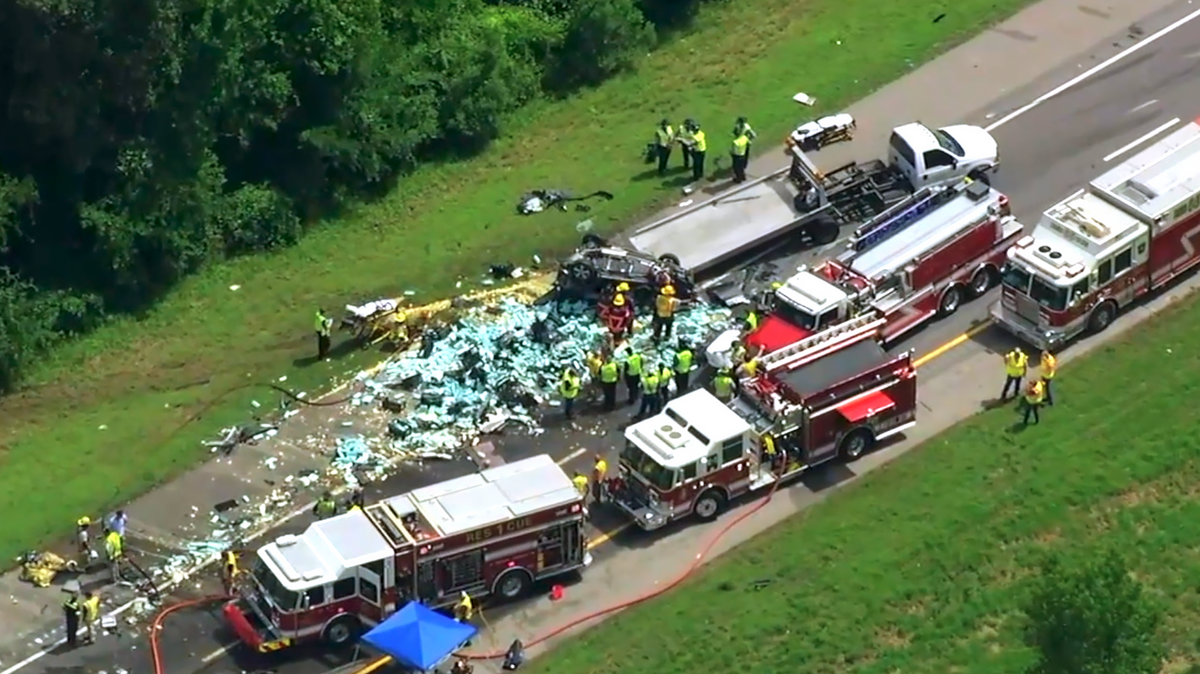
Federal investigators were unable to determine why a tractor-trailer truck driver plowed into the back of slowed traffic on Interstate 95 two years ago, setting off a chain-reaction crash that killed five people.
Read more ‘Locked in’: Inside UNC basketball coach Michael Malone’s recruiting reputation
The National Transportation Safety Board’s final report says the likely cause of the crash in Wilson County was the “driver’s inattention and failure to respond, for unknown reasons, to the visibly slow-moving vehicles” in front of him.
Charles Haskell of Las Vegas was going an estimated 70 mph when his truck loaded with orange juice hit the back of a Chevy Tahoe, the last in a line of cars and trucks that had slowed ahead of a work zone. NTSB investigators say the Tahoe was going just 7 mph, with its brake lights on, when Haskell’s Freightliner hit it from behind.
Haskell was charged with failure to reduce speed and five counts of misdemeanor death by vehicle. His case is still pending in Wilson County District Court.
Haskell, who was 51 at the time of the crash, refused to speak to NTSB investigators as they tried to determine what happened. They pieced together his activities before the crash using a variety of sources, including his truck’s electronic log and his cellphone records.
Those records showed that Haskell received a text message from an unknown number at 1:21 p.m. on July 24, 2024, as he drove north on I-95 near Kenly. Investigators were not able to determine whether he took his eyes off the road to read the message, but they noted that studies have found that cellphone notifications, “even when not viewed or responded to, can have a detrimental effect on performance for attention-demanding tasks such as driving.”
Less than a minute after receiving the text message, Haskell’s cellphone made a “real time text” or RTT phone call to an out-of-service number with a 252 area code, which covers northeastern North Carolina. Almost simultaneously, the phone called 911. Investigators say both calls were likely made after the crash as the result of an Apple feature that “automatically calls emergency personnel to report a detected crash.”
State Highway Patrol troopers told the NTSB that Haskell had two phones in the truck, including a prepaid cellphone. The prepaid phone was destroyed when the truck caught fire after the crash, according to the NTSB. Troopers did not keep Haskell’s primary phone or make any effort to download call or text data, the NTSB said.
Haskell was frequently on his phone, both during breaks and while driving; records gathered by the NTSB show he made and received hundreds of texts and voice calls in the days before the crash. But in the end investigators weren’t able to say if it was the phone that kept him from braking.
“Although the Freightliner driver’s lack of appropriate response to the traffic queue was consistent with being inattentive, the reason for his unsafe driving performance could not be determined from available information,” the investigators wrote. “Evidence was insufficient to establish that distraction from cell phone use was a factor in the crash.”
NTSB investigators did rule out other potential factors. The weather was clear, the roadway dry, and the crash occurred during daylight hours. The truck was in good shape and up to date on maintenance. Haskell had a valid license and medical certificate and was an experienced driver. All tests for drugs and alcohol came back negative.
It’s not clear whether fatigue was a factor. The NTSB identified what it describes as “sleep opportunity periods,” when Haskell was not working and not on his cellphone. Investigators say he parked his truck in Florence, South Carolina, the night before the crash, and, accounting for phone use, could have slept nearly 9 hours before getting back on the road at 10:14 the next morning on his way to Jersey City, New Jersey.
Investigators say, however, they don’t know if or for how long he actually slept.
Read more ‘Locked in’: Inside UNC basketball coach Michael Malone’s recruiting reputation
Haskell’s first stop was the Flying J Travel Center in Kenly, where he spent 35 minutes and bought 95 gallons of diesel fuel, according to records compiled by the NTSB. He was on the road again at 1:13 p.m.
Nine minutes later, Haskell hit the Tahoe, pushing it off the right side of the road. The SUV’s driver, William Carroll Tucker, 72, and his wife, Elizabeth Sharon Tucker, 66, of Hephzibah, Georgia, were killed.
Haskell then hit a Toyota RAV4, causing it to flip onto its roof. The driver, Edward Carroll Davis, 68, of Greenville, was killed, as were both of his passengers: his wife, Martha Warren Davis, 69, and her sister, Linda Warren Whitehurst, 80, of Robersonville.
Haskell then hit two other tractor-trailers, pushing one off the right side of the road. His own truck was on fire when it came to a stop 332 feet from where it had hit the Tahoe. Haskell was able to get out of his truck before it burned completely.
All three truck drivers, including Haskell, had minor injuries.
Traffic on northbound I-95 had slowed to a crawl ahead of a work zone, where N.C. Department of Transportation contractors were clearing trees and putting down mulch in the median. The left lane was closed about 1.7 miles from where the crash took place, and traffic had backed up.
Several signs warned of the lane closure, but Haskell encountered only one of them before the crash. About 2 miles from the start of the lane closure, about a quarter mile from the crash site, was an electronic sign that alternated messages “Left Lane Closed” and “Merge Right.”
NCDOT work zone rules now require that another electronic sign be installed about four miles before the first, with the alternating messages “Roadwork 6 Miles Ahead” and “Left Lane Closed.” But the one sign Haskell passed should have alerted him to “changing conditions ahead,” according to the NTSB report.
“Further, data indicated that the Chevrolet, the rearmost vehicle in the traffic queue, had its brake lights activated for at least 5 seconds before the crash, providing additional visual cues about the speed reduction that the Freightliner driver was encountering,” it says.
The NTSB says work zones are “high-risk areas” where changes in traffic patterns and sudden slowdowns make crashes more likely. The agency says dozens of fatal rear-end crashes involving trucks and buses take place at work zones each year.
In one recent crash, five people, including a family of four from Massachusetts, were killed when a bus going from New York to Charlotte slammed into cars that had slowed ahead of a work zone on I-95 in Virginia on May 29.
The NTSB concludes its report on the Kenly crash by emphasizing its support for new measures to prevent rear-end crashes. They include requiring collision warning systems in commercial vehicles and driver monitoring systems that “detect risky driving behavior, including but not limited to driver inattention, and that provide instantaneous feedback that communicates to the driver the need to bring attention back to the driving task.”
Read more A turtle’s best friend? How dogs are saving North Carolina’s tiniest turtle