
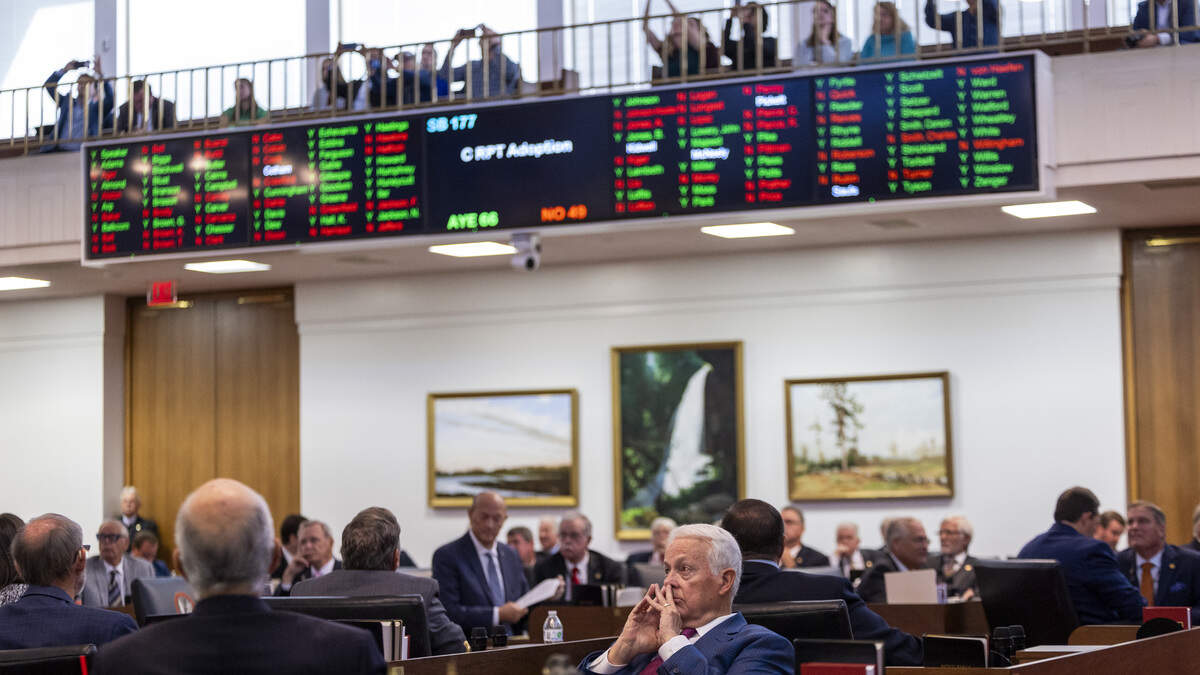
Legislators in Raleigh have long derided “the great state of Mecklenburg,” whose urban needs look different from much of the rest of North Carolina.
Read more Delta Air Line outage triggers national delays, including dozens at RDU
Getting the General Assembly behind Charlotte’s legislative agenda has been a tall task, fraught with suspicion, consternation and, at times, hostility.
There’s more at play than a partisan divide. But city leaders see Democrats’ sweeping gains in this month’s election as a rare window of opportunity, bolstered by Mecklenburg County delegates snagging key roles in state House leadership.
“Having a state government that understands who we are, understands our needs, and more importantly how to treat people will go a long way in terms of repairing that relationship between the city of Charlotte and the state government,” said City Councilman Malcolm Graham, who chairs the intergovernmental relations committee that develops legislative priorities. “I just look forward to working with people that I can have a conversation with and talking to them versus talking at them.”
Republicans controlled both chambers of the General Assembly for almost 16 years. Before the 2026 election, they maintained a veto-proof three-fifths supermajority in the Senate. In the House, they were one swing vote short of a supermajority. A supermajority allows the legislature to override Democratic Gov. Josh Stein’s veto.
Voters broke that grip on power earlier this month when they granted Democrats control of the House and reduced the Republican majority in the Senate to a slim 26-24 advantage.
“(Charlotte leaders) certainly have a hearing that they didn’t have before. They are welcome to come make their case in a way that they haven’t been previously. It doesn’t mean they’re going to get what they want. It doesn’t mean that it’s going to be easy to make progress,” said Eric Heberlig, a political science professor at the University of North Carolina Charlotte. “We’re starting with a ‘maybe’ rather than an ‘almost certainly not.’”
Charlotte landed in the General Assembly’s crosshairs on more than one occasion. There was the infamous 2013 attempt to wrangle control of the Charlotte Douglas International Airport from the city and give it to an independent authority, a threat the city still can’t seem to shake. Then there was 2016’s House Bill 2, which stripped Charlotte of certain local powers as punishment for passing a non-discrimination ordinance allowing transgender people to use public bathrooms that aligned with their gender identity. The bill was later repealed.
And just this year legislators intervened on the flashpoint Interstate 77 South toll lane project, which the council backed out of in May before reinstating support at the threat of a financial penalty.
Heberlig and council members attribute some of that tension to partisan politics. But there’s an underlying divide between urban and rural communities, they said.
“Even when you might think there’s a political affinity — that Democrats are in charge — Democrats from elsewhere in the state don’t warm up to Mecklenburg just because they’re also Democrats,” Heberlig said. “They’re representing very different constituencies with very different sets of priorities.”
The Democratic base has shifted from rural to urban since the party last held power, however, which Heberlig said is advantageous for Charlotte and gives it an unusual amount of power compared to years past.
Mecklenburg County representatives will occupy key positions in the House next term and can help nudge urban priorities forward.
Rep. Brandon Lofton will chair the House Rules Committee, which plays an essential role in determining what legislation moves forward in the House. And Rep. Terry Brown will serve as the House majority leader, one of the most powerful positions in the chamber.
Brown’s said his goal is to make the entire state more affordable for residents no matter where they live, he said. Affecting change in his district is an added bonus. He asked Mecklenburg County and city of Charlotte leaders to prepare a list of legislative priorities that they were previously unable to achieve or “afraid to ask for.”
“Charlotte is not asking for more than any other city. All we’re asking for is to make sure we’re getting our fair share and not being neglected,” said Brown, who represents western Mecklenburg County.
Democrats struggled to get a word in edgewise under Senate leader Phil Berger’s ironclad approach, according to Sen. Woodson Bradley, who represents south Mecklenburg County. She spent her first term trying to mend fences and keep her head above water despite an “unpleasant” tone from the supermajority. She hopes her efforts will pay off in 2027, and that her fellow Democrats will follow suit.
“I feel like some (Democrats) have been emboldened, and they’re like, ‘We’re gonna stop them at every turn.’ Well, that’s no different than the obstructionism we’ve been living with for 16 years,” Bradley said. “We have got to force a dialogue and negotiations.”
Brown said he also wants to reach across the aisle and work with anybody who is willing.
“We can’t be here a year from now, two years from now, not getting anything done for North Carolina,” Brown said.
Read more ‘All clear’ issued at NC Central University following nearby off-campus shooting
With each chamber under separate party control, the conditions are ripe for gridlock. Whether the parties can find a way to work together — and whether Charlotte’s agenda moves forward — could rest on one position: Berger’s replacement as the Senate president pro tempore. Berger lost his primary election.
The new leader’s attitude towards working with the House and governor will set the tone for the rest of the party, Heberlig said.
“There are some candidates I’m sure that are going to pitch more of the hard line, ‘We need to stick to conservative policies that work and push back against liberal attempts to change North Carolina.’ But there are also going to be those that run on a more accommodating pitch to say, ‘Hey, we got trounced in the last election for a reason. People want us to work together to solve problems that affect North Carolina,’” Heberlig said. “We don’t know whose pitch is going to resonate with the majority of senators.”
Heberlig thinks Republicans will “strike a hard bargain” as the last line of defense for conservative values. Democratic leadership will decide whether to push a liberal policy revolution or take a moderate approach predicated on good governance, he said.
Bradley foresees three possible scenarios for how everything plays out. The best case for Charlotte is the city develops a productive partnership with the House majority and also finds bipartisan support in the Senate for meaningful legislation.
The likeliest case is the relationship improves between the city and the disparate parties in the General Assembly, but major initiatives get delayed or watered down due to disagreement between chambers, Bradley said.
The worst case is a partisan divide continues, and Charlotte misses an opportunity to secure money and flexibility.
The Charlotte City Council is working on its 2027 legislative agenda now. An important early step will be inviting Mecklenburg County delegates to breakfast to talk about priorities, foster working relationships and set realistic expectations for how much the city should hope to accomplish, Mayor Pro Tem James Mitchell said.
Mitchell said the council should be selective so it can focus its energy on passing a few strong priorities rather than spreading itself thin across many.
Some of those priorities could involve money. Mitchell and at-large Councilwoman Dimple Ajmera said one of their biggest public safety concerns is inadequate funding for the Mecklenburg County District Attorney’s Office. They’d like the General Assembly to allocate money to hire more prosecutors, they said.
Ajmera and Councilwoman Kimberly Owens said they’re interested in changing the legislature’s funding structure for state road improvement money. The formula uses population size, but in 2021 the General Assembly capped the amount of money Charlotte can receive at about $13.7 million, which is millions of dollars less than it previously received.
Councilman Ed Driggs suggested the rural and urban dynamic could come into play on whether the funding cap gets lifted. Mecklenburg County voters approved a 1% sales tax increase last year, which will pump millions more dollars into road projects than the lost Powell Bill dollars.
“If you look at how poor many of the rural areas are in North Carolina, for Charlotte to go and ask for favors or ask for more money for anything, it’s probably not going to be well received by them,” Driggs said. “The outlook is more complicated than maybe some of my colleagues appreciate.”
Other priorities might not involve a price tag and deal instead with lifting restrictions on setting local policy.
Mitchell and Owens pointed to noise cameras as an example. Residents and hotel owners have complained excessive noise costs them sleep and money, but the city’s best enforcement tool — noise cameras — is not allowed under current state law.
And Charlotte is under a data center moratorium until October 2027 while the city works out a comprehensive plan. Charlotte is limited in what it can do, however, because the General Assembly recently outlawed downzoning unless the landowner consents. That means the city cannot ban data centers from areas they’re currently allowed.
Multiple council members flagged the downzoning rule as a top priority to overturn.
“I think we’re seeing the giant hand of the General Assembly descending down into every big and small and little town. No one knows what their community needs more than the county and the city elected officials that are there,” Bradley said. “Unintended consequences happened across the state with regard to that mindset coming from Raleigh.”
This story was originally published November 23, 2026 at 5:30 AM with the headline “Will NC legislature finally take crosshairs off Charlotte as Democrats gain power?.”
Read more Carolina Hurricanes use five-goal second period to shoot down Edmonton Oilers