
AI-generated summary reviewed by our newsroom.
At the first meeting of the Carolina North stakeholder advisory committee, one phrase prevailed: “We don’t know yet.”
Read more ‘Exceptional’ drought is back in Triangle. How much rain does NC need?
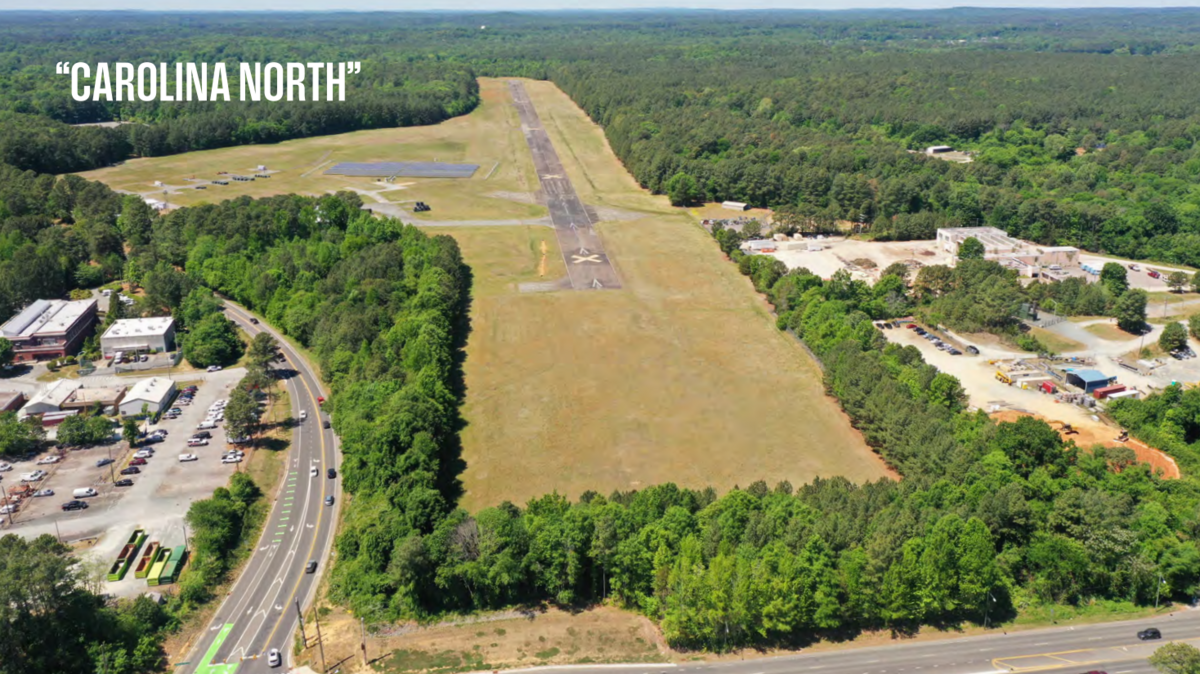
Carolina North is a 230-acre tract of land one-and-a-half miles north of the main campus, where UNC plans to build a satellite campus. It’s a project the school has been considering for decades, but under the leadership of Chancellor Lee Roberts, plans for development have come into focus — sort of.
Tiffany Lacey, UNC’s executive director of real estate development, explained to the committee that the university is not yet at “step one” of the project, and a lot of the specifics remain unclear.
Still, Roberts believes the university needs to start developing Carolina North as quickly as possible to address enrollment growth pressures, the need for new research facilities, and housing affordability challenges in Chapel Hill.
The school is already working with three outside companies to reach that first step. For its “place strategy,” it has contracts with Gehl, a design consultancy, and MVVA, a landscape architecture firm. For the work of master planning, the university is negotiating a contract with Ayers Saint Gross, a Baltimore-based design firm.
The committee’s charge is to provide feedback and guidance to Roberts as the university moves forward with Carolina North. The committee is chaired by trustee Brian Allen, UNC law professor Anita-Brown Graham, and Chapel Hill chamber of commerce president Aaron Nelson. It’s made up of professors, students, Chapel Hill residents, city planners, town officials, lawyers, real estate brokers, business leaders and more. Each member has a distinct interest in Carolina North’s responsible development.
Here are the top questions raised at its first meeting.
“How will this project be developed so that it doesn’t become a mini-campus … [where] most of the community does not feel invited?”
That was the question of Delores Bailey, executive director of EMPOWERment Inc., a Chapel Hill nonprofit focused on affordable housing. It’s a salient one for some Chapel Hill residents, who Bailey say feel “unwelcome” at UNC, despite their inextricable role in the university’s history.
“My interest is the community that already feels isolated from campus,” Bailey said.
Though a majority of acreage at Carolina North will be dedicated to the academic campus, Lacey told the committee that it is a “signature part of this project that we are looking for ways to bring the community in, and very much feel like this is a community space just as much as it is a university space.”
That goal centers on the 20% of Carolina North that will be more like a town-facing neighborhood, home to restaurants, retail, affordable workforce housing, green space, and more.
Lacey says she hopes to “blur the edges” between this public space and the academic campus, so that “they both feel inviting, and it doesn’t feel like there’s this clear delineation between the two.”
At the meeting, committee members were asked to help the university find the following kinds of people to sit for interviews with the place strategy firms:
The 230 acres UNC plans to develop is the site of the old Horace Williams Airport, and one main runway still stretches across it. The total area of the Carolina North site owned by the university is nearly 1,000 acres, but it plans to keep the most of the forest there undeveloped.
The jagged development footprint is a reflection of the history of the airport.
According to Lacey, when the airport was used as a Navy training facility during World War II, there were two other active runways that have now forested over, resulting in the property’s odd asterisk shape.
Read more Thailand’s Princess Bajrakitiyabha Dead at 47 After 3+ Years in Coma
Ted Zoller, a business professor at UNC and member of the committee, called the future Carolina North site Chapel Hill’s “Central Park.” That reputation is due in large part to the trail network that runs through the forest.
Lacey promised the committee that the trail network at Carolina North will remain intact, even the section of the Pumpkin Loop trail that swings out into the development area. The university would intervene with the trails only to improve their condition, build more trailheads, or provide more benches and bathrooms, Lacey said.
However, during the construction process, residents can expect to have their hiking routines disrupted. Lacey said that during construction, the typical ways to access to the trails will likely be cut off.
“One of the first things we’ll be looking at is where can we provide additional trail access off the existing street network and provide additional parking,” Lacey said. “When we get to that moment in time, that will be very much communicated with the community.”
Fred Black, a Chapel Hill resident on the committee, asked Lacey whether UNC Health plans to build a hospital at Carolina North. David Vollmer, UNC Health’s vice president of real estate, development and facilities, is also on the committee.
“I have not been made aware of any plans for hospital space,” Lacey responded. “Could there be a clinic? Yes, but it’s not been conveyed to me that there’s a hospital.”
The most controversial item in the planning of Carolina North is the debate around relocating the university’s legendary basketball arena. At one point, UNC had decided it was moving the Dean Smith Center to Carolina North. Then, the outrage from former coaches and players started rolling in, causing the university to backpedal.
Roberts now says conversations about whether to build a new basketball arena at Carolina North are on pause.
“Can we assume that we’re not talking about the basketball arena being in that property?” Black asked Lacey at the meeting. “Because that footprint for such a facility changes about everything you said.”
Lacey reiterated the university’s position that the decision-making process is on pause, then tried to address how a potential arena fits into plans.
“I don’t know if it would necessarily mean that footprint gets bigger, but yes, if there were to be an arena, that’s obviously a sizable development,” she responded.
A full copy of Lacey’s presentation to the board can be found online at carolinanorth.unc.edu. The committee accepts comments from the public at its meetings, the next of which is likely to occur on July 27.
This story was originally published June 11, 2026 at 9:35 AM.
CORRECTION: A previous version of this story misidentified one of the co-chairs of the committee.
Read more Why Raleigh may stop residents from watering their lawns completely