
AI-generated summary reviewed by our newsroom.
Robert Lyles has spent more than two decades raising children, but he says he is still learning what it means to be a father.
Read more ‘Scrubs’ Revival Loses Multiple Main Characters After Shocking Cast Exits
“I don’t know everything,” Lyles said.
With eight children ranging from 23 to 1-year-old, Lyles has learned that parenting looks different for every child. He joined Durham’s Nurturing Fathers Program to better meet his children’s individual needs and said it changed how he approaches fatherhood, including how he responds when his children misbehave.
“Instead of me just chastising my children, I’ve come to the point where I’m like, ‘All right, let’s talk about this a lot first,’” Lyles said. “We can figure out what’s going on in your mind, what’s going on in my mind, so we can figure out what’s the best course of action to take.”
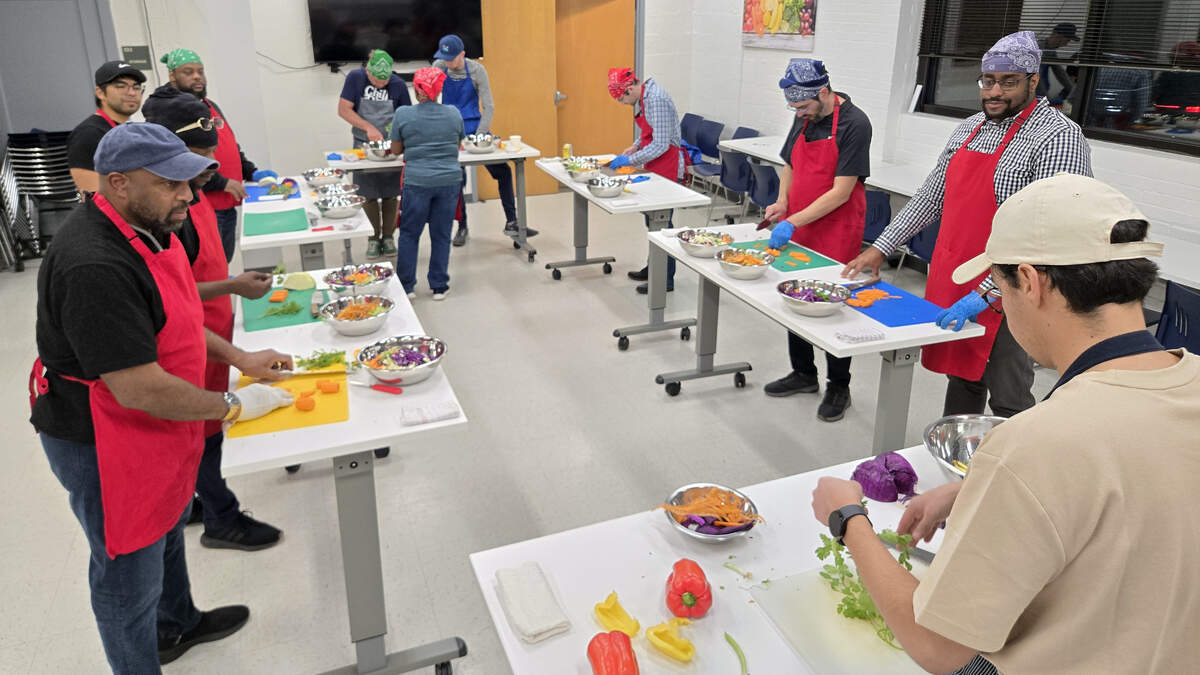
Lyles is one of 42 men who have completed the Nurturing Fathers Program since it launched in 2023. The program is part of Welcome Baby, a Durham County Cooperative Extension program that gives parents an educational curriculum and tools to strengthen their families.
Alfonso Blanco, a parent educator with the program, noticed that many of the parents attending Welcome Baby’s programs were mothers, while some fathers waited outside in their cars. He wanted to find ways to involve more fathers in the program’s services.
“We really want to bring the fathers to be part of the picture of a family,” said Axel Fonseca, another parent educator with the program. “For us to do that, we need to get them involved.”
Nurturing Fathers began in 2023 as a Spanish-language program. It now offers one Spanish and one English 13-week session each year, with classes on Thursday evenings.
Fathers work on communicating with their children and spouses, building confidence as a father, balancing work and family life and understanding how their own childhood experiences influence the way they parent.
For Omar Ghaznavi, who became a first-time father in January, the program gave him guidance as he learned to care for his now 4-month-old son while supporting his wife.
He saw how overwhelming it was for her as the family’s primary caregiver and learned to communicate with her more by using conversation starters he learned in class. The program also encouraged him to be more intentional with his time, making sure his wife had a chance to rest and recharge when he came home from work.
“I am more conscious of my time that I spend with my baby,” Ghaznavi said. “I try to make sure that once I finish work I am fully present.”
Read more Storms, with damaging wind and flooding, possible in Triangle area
The program also encourages fathers to learn from one another as they share challenges they face at home and strategies that have worked for their families.
Miles Crosskey, who has two children ages 6 and 9, was referred to the program by a social worker after separating from his wife. He learned from another father about the “Saturday Box.” The idea is that when children are not following expectations or leave their toys out, those items go into a box and they can’t play with them again until Saturday.
Crosskey said it helped him rethink how he sets expectations. He later sat down with his children and wrote out rules for how everyone in the household should treat each other.
Conversations with other fathers are one of the most valuable parts of the program, he said.
“In a lot of male-female relationships, the mom tends to bring a different approach and perspective to it than the dad does,” Crosskey said. “So to have this group where we can talk together about what we think dads are supposed to bring to the table … it helps us cement in our own head what our goals are supposed to be.”
He has completed the program several times, saying he learns something new each time and continues to find it helpful.
The program is meant to continue beyond the 13-week course. Graduates can stay connected through the Circle of Fathers, a monthly in-person, support group where fathers can share parenting challenges or simply spend time in community with one another.
Since launching, the program has completed six cohorts. The most recent English-language cohort had 10 fathers enroll, and all 10 completed the program — the largest graduating class since the program began.
The program is currently funded through a grant from The Duke Endowment and is in the third and final year of its grant cycle, which ends in June 2027. Team members said they are seeking additional funding to continue offering the program as interest grows.
Read more 700 NC residents lost more than $8.4 million in 2025 to this fraud. Here’s how