
AI-generated summary reviewed by our newsroom.
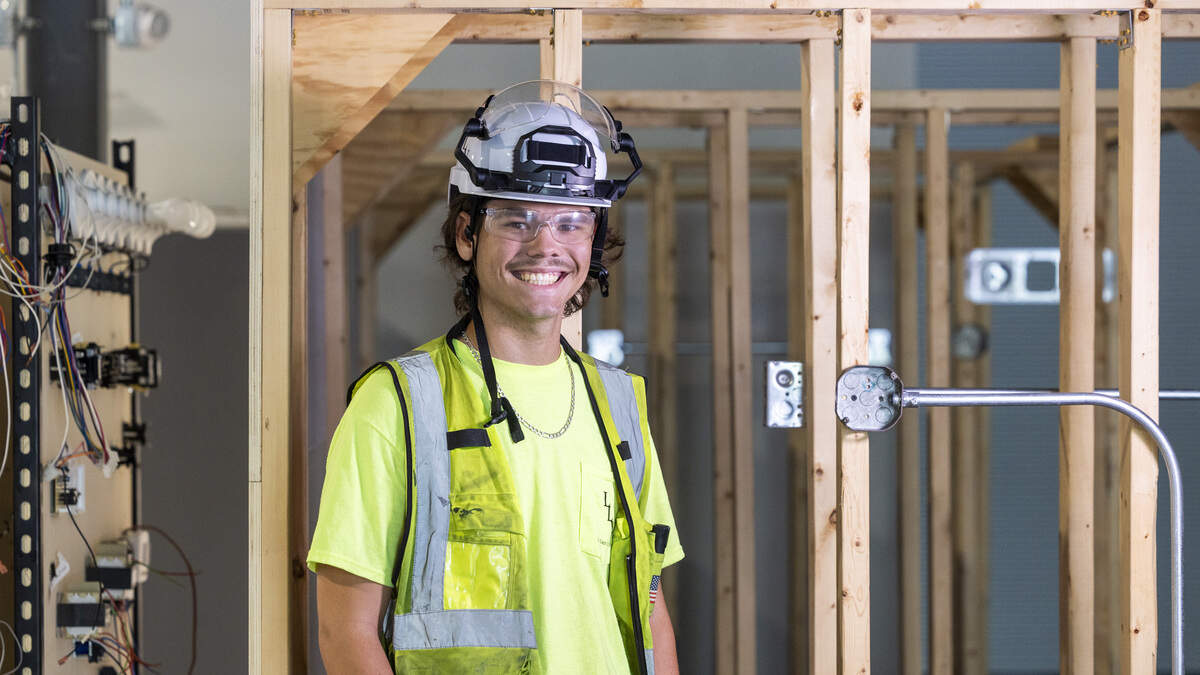
There’s nothing like the satisfaction of flicking on a light switch you wired yourself, says Conner Piotrowski.
Read more Triple-digit heat wave underway continues. The Triangle has ‘extreme’ heat risk.
At just 18 years old, the Raleigh native trained to become an electrician through a preapprenticeship.
Electrical work is deeply satisfying for Piotrowski: the open-ended problem-solving, the challenge of getting the wiring perfectly neat, the everyday visibility of the work, the diligence required. Even at his young age, Piotrowski found that his more experienced coworkers “will respect you if you just ask questions and show you’re willing to learn and do stuff directly.”
Piotrowski is part of a trend: The number of young North Carolinians in a preapprenticeship has increased 55% over the last three years, according to ApprenticeshipNC, the agency through which all apprenticeships in North Carolina are registered. The number of employers taking on those preapprentices has increased 35%. Regular apprenticeships too have gained momentum in the state. The skilled trades are having a moment.
Piotrowski thought he wanted to be an engineer like his dad — until the pandemic hit. He was only in middle school then.
“Sitting behind a desk on a computer all day — I just couldn’t do it,” Piotrowski said. “I needed to be up and moving, not just staring at a blank wall.”
Then, in sophomore year, he met Timothy Stile, a career and technical education teacher at Rolesville High School. Stile showed him what electrical work was like. Piotrowski loved it. That’s when he realized that “there’s more options than just a four-year college.”
Stile says he’s seen such an increased interest in electrical work at Rolesville High that he’s brought in two more trade programs to the school: heating and air conditioning and carpentry.
Piotrowski started a registered preapprenticeship with the electrical company L. L. Vann, which wires hospitals, college campus buildings, and even Raleigh’s tallest building, PNC Plaza. In North Carolina, a registered preapprenticeship introduces students — often while they’re still in high school — to an occupation through paid work with an employer, preparing them for a full apprenticeship and ultimately, a career.
Last school year, Piotrowski went to high school in the mornings, taking classes like English, HVAC, history, and electricity. Then, in the afternoons, he would head to L. L. Vann to work. There, he earned the nickname “Hollywood” from his colleagues — after he won ApprenticeshipNC’s Outstanding Registered Pre-Apprentice award.
“Not being at school the whole time felt a little weird, because that’s what my friends were doing,” Piotrowski said. “And I really knew the bare minimum before starting.
“But I didn’t want to have to go to college to waste money just to not know what I would do after four years, when you can do an apprenticeship, and in four years you’ll be able to get your electrical license. I show up early and work hard, and try to get the things done that I’m told.”
Piotrowski started his full apprenticeship with L.L. Vann in August. One day, he wants to own his own business. Maybe he’ll call it Hollywood’s.
Apprentices are employees whose wages increase as their skills do, completing structured training and coursework, often through a community college. At the end, they receive a journeyworker credential, which certifies mastery of the occupation — and are often brought on full-time by their employer. The model isn’t just for the skilled trades: There are registered apprentices in healthcare, education, technology and finance.
For Joshua Hadder, 24, the logic behind his apprenticeship in industrial maintenance is simple: “Good jobs are hard to come by.”
Hadder is in an apprenticeship program that he expects will help him land a job in the central utility building at the Pfizer plant in Lee County. He spends three days a week at the plant, and two days in a classroom at Central Carolina Community College in its Maintenance Technician Apprenticeship Accelerator program. He describes his apprenticeship as a “two-year job interview” to work for Pfizer. But this is a job interview he gets paid a salary for.
According to national data, there are 9,704 active apprentices in North Carolina managed by ApprenticeshipNC. That represents a 65% increase from 10 years ago. Nearly half of them are 24 or younger.
Enrollments in apprenticeships are up 55% from fiscal year 2023, according to ApprenticeshipNC. But not everyone who enrolls finishes: National data shows more than 1,209 cancelled apprenticeships in fiscal year 2026.
“My long-term goal is to have a good career in a facility that actually cares about you,” Hadder said, “versus just working a normal job to get your hours in.”
His classmates at Central Carolina Community College — who are largely also his coworkers — nodded in agreement at that.
“I just want to be a valuable person,” said Alejandra Cardenas, a 23-year-old in the same apprenticeship program as Hadder. “That would be my long-term goal.”
The consensus around what it means to have a successful, fulfilling career could be changing here in North Carolina.
“It wasn’t too long ago there was a big push for everyone to go to a four-year university, and it kind of left skilled trades out,” said Caleb Gilley, senior director of apprenticeships at Wake Tech. “There’s starting to be a shift now, back towards [the idea that] you don’t need a four-year degree to be financially successful in this world.”
Read more New on Pluto TV in September 2026 – All the Free Movies and Shows
School counselors are increasingly presenting the skilled trades to young people as a viable path, according to Jerry Jones, who heads Durham Tech’s Center for Workforce Engagement. That was certainly the case for Piotrowski.
Stile, the teacher who showed Piotrowski that a career in electricity was possible, says he thinks the trades are “the new millionaire show.” He thinks kids have been “sold too much on the college, and I don’t think every kid out there needs to go to college.
“Back in the day, if you got a degree, you got a good-paying job. Now, you get a degree, and you may or may not get a good-paying job,” Stile said. “But in the trades world, if you put in the work, the money will follow.”
He said he feels a cultural shift, tied partially to the rise of artificial intelligence.
“In another five years, a lot of these programmers and lawyers and people that went to college are going to be looking for some work, because AI is going to take their job,” Stile said.
Chris Harrington, director of ApprenticeshipNC, said he came of age in the 1970s and 80s, “when this ‘college for all’ mindset really started.”
“Only 25 to 30% of jobs in America actually require a four-year degree, but yet we’re beating into our youth’s heads since they start elementary school: go to college, go to college, go to college,” Harrington continued. “I think more people are really starting to question that.”
One reason that might be changing? Increasing levels of student debt.
That was one reason Collin Chapman, 33, an industrial maintenance apprentice and Pfizer employee working in Lee County, chose his path.
“When I graduated high school, I didn’t want to have $100,000 in debt, but I still wanted to make some money,” said Chapman. “A trade is definitely the way to go.”
Steven Allen, an economics professor at NC State, points out that while overall college enrollment has remained relatively stable over the last 10 years, fewer young men are going to college.
Plus, he says, blue-collar wages are rising slightly faster than white-collar wages.
That can make a career in the trades look attractive to someone who may have very little family or cultural connection to them.
Rowan County native Ashton Fairchild doesn’t come from a family of bricklayers.
But from the time a friend took her to watch the North Carolina state masonry competition as a high schooler, she was hooked. The masonry competition was part of SkillsUSA, where students participate in competitions in fields like welding, cosmetology, and firefighting.
Fairchild loved the challenge of attempting to lay bricks in accordance with the blueprint given by the contest judges, getting everything perfectly straight and of the highest quality. She became the first woman to win the national SkillsUSA masonry competition back-to-back in 2018 and 2019.
She ended up going to UNC Charlotte and majoring in construction management, a choice she says was partially based on the “false information” that everyone should have a college degree.
Now, Fairchild promotes masonry apprenticeships to high schoolers in North Carolina and runs the state and local SkillsUSA masonry contests. She’s said she’s slowly seen more girls get into the industry. But there’s still misconceptions about the trades she has to work hard to dispel.
“The misconception about masonry, and just the trades in general, is that it is a lot of grunt work for people that aren’t necessarily on the right path,” Fairchild said. “Some people just have a bad outlook of the trades. [They see them as] dirty jobs, only for lower-income people.”
Chapman says he’s heard that too. People think someone in the trades is a “guy who’s flushing toilets and fixing light switches,” he said. “But some of these guys are pretty smart.”
When she’s selling high schoolers on the prospect of becoming an apprentice in the skilled trades, Fairchild tells them it’s a way to get paid while you learn, a rare opportunity you can chase even with zero experience and knowledge.
“If you’re wanting to learn and you’re wanting to grow in your career, this is a great place to be, and you can make a great living in the trades and in masonry,” she said. “You can move up through the company by being a foreman, superintendent, project manager, estimator, owner — anything that you want to be.”
There’s just one requirement, she says: a work ethic.
This narrative — that the trades are a smart choice rather than a last resort — is one that more people are coming around to, according to Lisa Chapman, president of Central Carolina Community College, who bears no relation to Collin. She visited Sanford Contractors to see the work of Mason Setzer, a preapprentice in construction who takes classes at CCCC.
“We are seeing a shift,” Chapman said. “People are understanding the value of the work and how important it is. That makes it easier for the students who always wanted to do it to pursue it. What you heard Mason say is he chose it.
Read more Colin Kaepernick Accuses the NFL of ‘Blackballing’ Him After Anthem Protest
“He didn’t default to it. He chose it.”