
AI-generated summary reviewed by our newsroom.
A woman walking on the boardwalk at Fort Macon State Park stopped when she saw Laura Taylor wearing long-sleeves and a cargo vest sagging under the weight of myriad gadgets despite the 95 degree heat.
Read more Debt-wary and job-hungry, more NC youth look to skilled trades
“Have you had any luck?” she asked. She added, “Thanks for doing what you’re doing.”
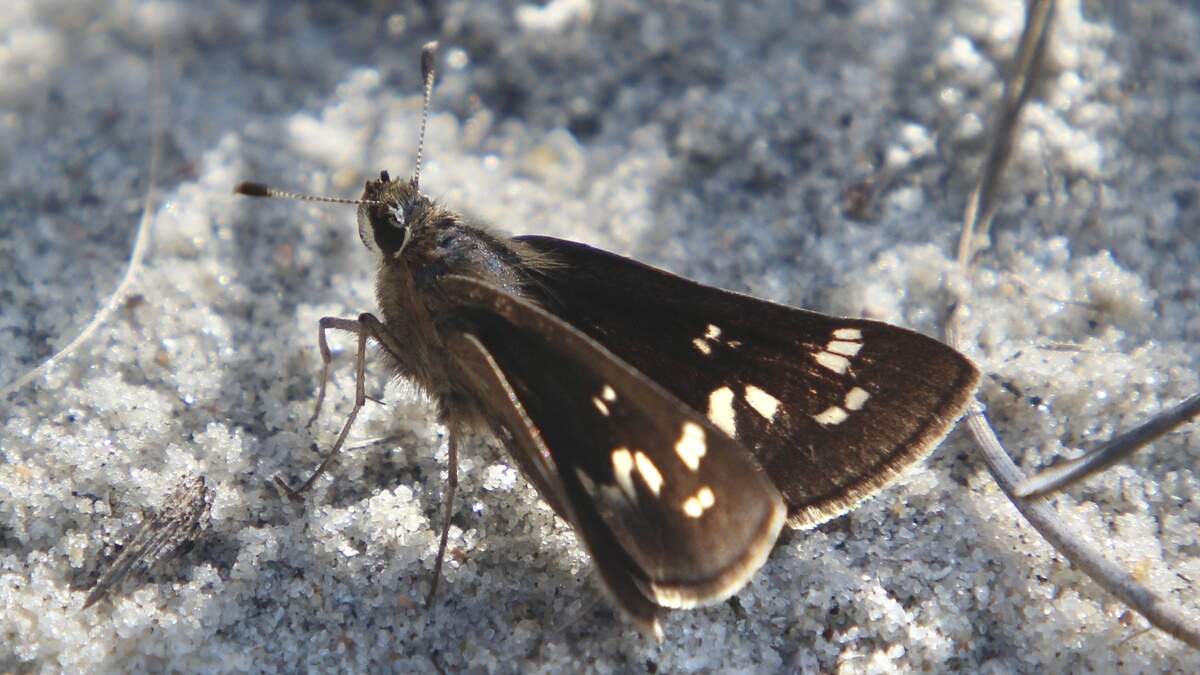
Taylor, a PhD student at NC State University, said moments like that happen more than people might expect. Strangers already know about the crystal skipper, a small brown butterfly found only along a 30-mile stretch of North Carolina’s barrier islands along the Crystal Coast.
That affection has helped keep the crystal skipper’s conservation effort alive for nearly three decades. But the people running it are leaving, and it isn’t clear who will take their place.
Elsa Youngsteadt, an NC State entomologist who has overseen much of the butterfly’s recent research, stepped away in August for a new job. Carol Price, research coordinator for the North Carolina Aquariums, began overseeing research on the crystal skipper a decade ago but never intended for her work to be permanent.
“I was a temporary caretaker of this butterfly to make sure that people continued to care about it,” Price said. “Call me a foster mom.”
Price picked up the work from Allison Leidner, whose original surveys first mapped where the skipper lived and how it moved throughout the landscape. Now Price is stepping back, too.
“I am sad, but at the same time, I’m incredibly happy that I was able to continue Allison’s important work and maintain this interest and awareness for this butterfly,” Price said. “All of this work has just built this community.”
Brianna Hoffman manages the crystal skipper project at the aquarium, but her contract ends in October with no funding lined up beyond it. Price and Taylor hope to obtain a new grant to fund genetic research and outreach, but nothing is settled.
For now, the weight of the crystal skipper falls largely on Taylor.
“Laura knows more about that butterfly now than probably anybody in the world,” Price said.
Although she stressed her dedication to the conservation of the species, Taylor is uncertain about whether she will shoulder the burden after graduation.
“I don’t know if I would be able to find the funding for it, and if I would want to stay in Raleigh, or in North Carolina, afterwards,” Taylor said. “I want to help out the butterfly for sure, but I just don’t know where exactly I will be.”
Read more Triple-digit heat wave underway continues. The Triangle has ‘extreme’ heat risk.
The crystal skipper was described as its own species in 2015, living in the dunes between Bear Island and Fort Macon State Park. It also depends almost entirely on seaside little bluestem, where females lay eggs and caterpillars take their first bites.
That narrow range is also the source of its vulnerability. Much of the skipper’s habitat overlaps with vacation homes and rental properties, complicating survey access.
Hurricanes pose an even bigger threat. Caterpillars spend the winter at the bottom of the bluestem, exactly where storm surges, flooding and wind hit hardest. After Hurricane Florence, researchers found a sharp drop in the population.
Whether these threats add up to an immediate risk of extinction is unknown, Price said.
“I don’t think that we know whether it is at risk of extinction or not,” Price said. “We know that it is rare. We know that it is endemic. Could it blink out? Sure, it could, especially if there was a perfect storm of horrible things.”
That uncertainty is what makes Taylor’s fieldwork important. Her data will help researchers understand just how much climate change threatens the crystal skipper and how planting beneficial plants might offset some of those effects.
That research isn’t finished, and Taylor is doing it in harsh conditions. During her first field season, she experienced heat exhaustion twice, her vision blurring as she counted butterflies in the scorching dunes.
When one site with an abundance of morning glories, the skippers’ favorite nectar plant, turned up nothing recently, Taylor jokingly shrugged off the disappointment despite sweat beading on her face.
“If you cry, maybe they’ll come out,” she said. “Nah, just kidding. They don’t care.”
At another site, Taylor explained why the work is so important to her.
“I really care about the butterfly, and I think a lot of people don’t think about nonhumans having equal worth as us,” Taylor said. “If I can speak for something that can’t communicate with humans, then I should speak for it. These butterflies deserve someone who is able to speak for them and say, ‘Hey, they’re not doing all right, we need to help them.’”
Read more New on Pluto TV in September 2026 – All the Free Movies and Shows
This story was originally published September 2, 2026 at 7:30 AM.