
AI-generated summary reviewed by our newsroom.
UNC-Chapel Hill is pouring millions of dollars into developing a satellite campus two miles north of campus, a 230-acre tract of land now dubbed Carolina North.
Read more What’s in the deal? Community members still demand answers on WakeMed-Atrium merger
But there are some old and unusual strings attached to the development, thanks to a former professor’s will that’s over 85 years old.
Before it was known as Carolina North, it was the estate of UNC philosophy professor Henry Horace Williams, a man who grew up near the Great Dismal Swamp in the aftermath of the Civil War. Later in life, he became a learned logician at UNC and a real estate tycoon in Chapel Hill.
When Williams died in 1940, he willed his estate to the university with the purpose of funding fellowships for the philosophy department. Williams’ will was a short document that covered nearly 1,000 acres of land. He was laser-focused on benefitting the philosophy department.
“I give to the University of North Carolina all my property of every description and all of it,” his will reads. “This property is to be held in trust forever.”
And crucially: “The income from this property is to be used for Fellowships in Philosophy.”
In the 1990s, some 50 years after Williams’ death, members of the philosophy department raised questions about whether the university was honoring his final wishes and properly funding the department with the land.
For a long time, the property functioned partially as Horace Williams Airport, a World War II-era airfield where presidents like Gerald Ford and George H.W. Bush practiced flight. Other parts were used as a town landfill and dumping ground for hazardous waste from the chemistry department.
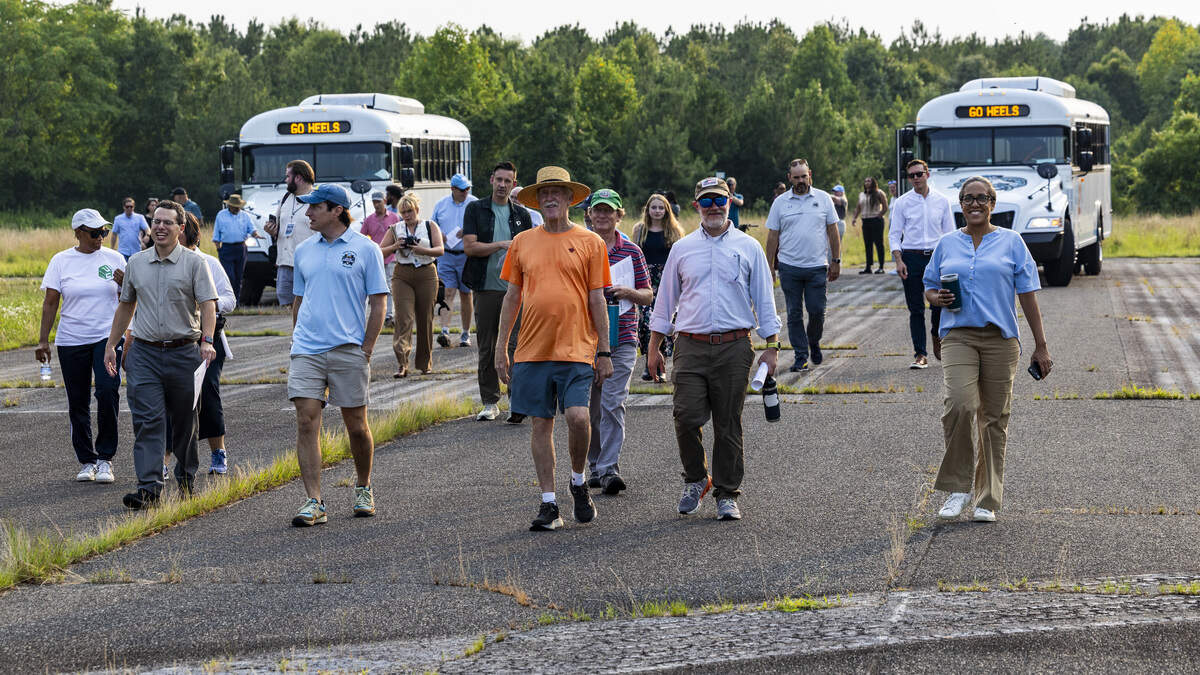
It’s now mostly a green space, with miles of trails snaking through forest. The landing strip is overgrown, and the buildings that once serviced it stand empty.
All these years later, the university is planning to build out Carolina North on the land, but many questions remain about what that could look like — and whether it will be home to a new basketball arena.
The university has plans for an ambitious development that will include student and workforce housing, academic classrooms, research facilities, retail and entertainment options, restaurants, health services and a hotel. A basketball arena isn’t out of consideration yet — much to the dismay of certain UNC fans who have been vocal in their opposition.
Read more New subpoenas target Nolan Wells’ social media, location-tracking accounts
On Monday evening, the Carolina North stakeholder advisory committee, made up of interested people from both the community and university, visited the property by bus and on foot. As the orange sun set over the weedy airfield, committee co-chair Anita Brown-Graham told reporters she was overcome by the “sense of opportunity” that the property presents to both the town of Chapel Hill and to UNC.
But the issue of complying with Williams’ will remains. Earlier this month, the university announced that as it moves forward with its master plan for the land, “additional legal process may be necessary” to ensure Williams’ original wishes are being met. The university said it would seek approval in the coming months for a legal plan that “confirms the University’s commitment to supporting graduate study in line with Horace Williams’ wishes.”
A 1999 agreement was intended to “buy peace” between the university and “The Philosophers,” as the group of professors is referred to throughout the agreement. It settled how the philosophy fellowships Williams requested in his will would be funded.
“While there’s no question that funding is going towards graduate study in philosophy, we want to ensure that all our paperwork is in order and that we’re both honoring the 1999 agreement and carrying out the donor’s intent,” wrote Paul Newton, vice chancellor and general counsel, in a statement on the university’s website.
That could include “seek[ing] court approval to modify the terms of the bequest, while at the same achieving results consistent with the donor’s original purposes,” a university spokesperson said.
According to the 1999 agreement, the university was to make an immediate $1 million payment to fellowship trusts. Then, over the next 10 years, the university was to put an additional $4 million into the trusts — with 5% interest annually on any unpaid balance. Finally, the university was to list a 60-acre plot of land for sale “as soon as possible” and deposit the proceeds into the fellowship trusts.
“The Philosophers further acknowledge that in virtue of this Agreement they have no claim to any income or principal represented by, associated with, or derived from any property passing to the University under the Will and Codicils of Henry Horace Williams,” the 1999 agreement obtained by The News & Observer reads.
The university never did sell the land, but in 2002, the university deposited a flat sum of $1.3 million into the trusts, “in full and complete satisfaction of the University’s obligations” to The Philosophers regarding the land. The university said it contributed $6.3 million to the fellowships all in all.
Now, though, it’s going back to court to make sure everything is in order.
“The University is evaluating plans to undertake a court-approved modification to ensure there is permanent financial certainty for the fellowship program in the Department of Philosophy and also clarity regarding the future development of Carolina North for the benefit of the University, the community and the State,” a spokesperson for the university said.
The university has already brought on firms to provide advice on the place strategy and master planning for Carolina North. Next, it will select a development partner.
Read more NC woman missing in Grenada, legislative power shift: Tuesday’s top stories
Conversations about moving the basketball arena are still officially on pause.
This story was originally published July 28, 2026 at 2:36 PM.