
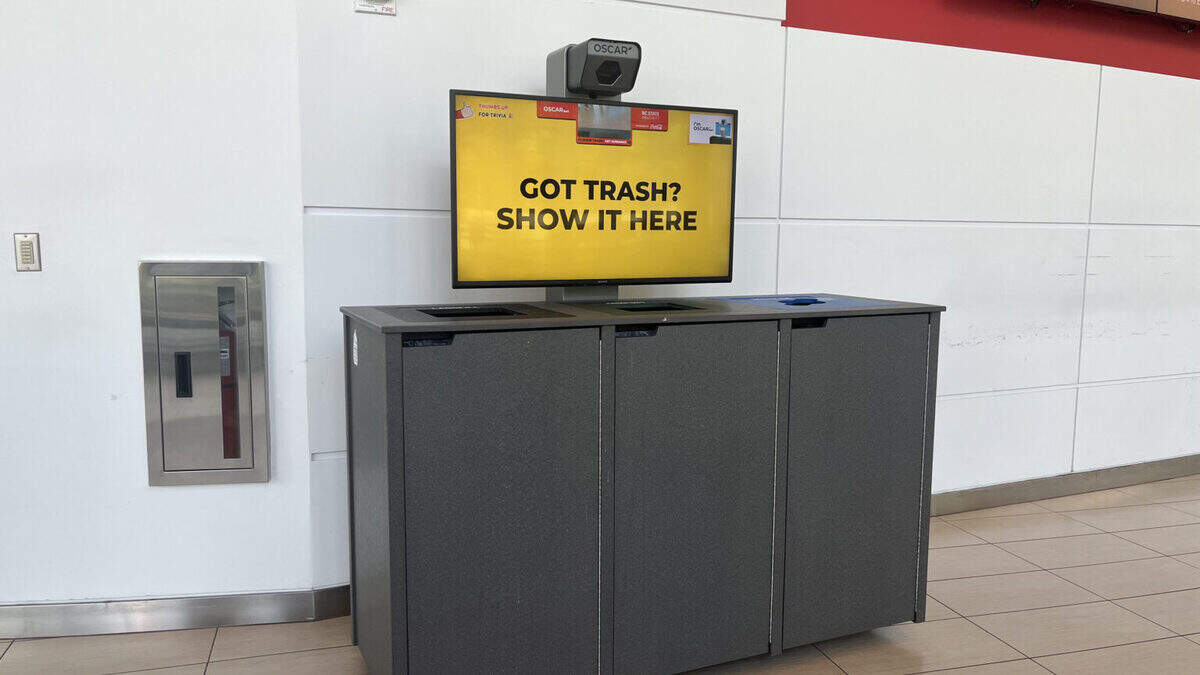
NC State University installed two new AI-powered trash cans in Talley Student Union this summer. They were poised to welcome students back and aid in their responsible waste-sorting endeavors.
Read more Made fresh to order: Five Guys signs lease for a new store in Triangle town
But before students ever came back to campus, the school had to remove the high-tech trash cans — known as Oscar Sorters — due to consistent errors in the cans’ sorting recommendations.
Now, the two cans are in back rooms away from the public. NC State staff is working with the company behind the Oscar Sorter to recalibrate the machines and hopes to put them back into use in the coming weeks, according to Jennifer Gilmore, director of marketing and communication for NC State’s retail and hospitality division. There’s no specific target date for their reintroduction, she said.
According to NC State, 63% of material sent to the landfill from Talley Student Union could’ve instead been recycled or composted. That’s where Oscar comes in. The can is “trained on NC State’s trash” so it can easily recognize common waste items at Talley and advise students on where to throw what.
Or at least that’s the idea.
The machine was having trouble fulfilling its mission. It couldn’t parse compostable spoons from recyclable spoons, Gilmore said, and it failed to identify different kinds of coffee cups. It offered confusing advice.
“We have to figure out what exact information we need to put in there so that when a student walks up, we’re absolutely certain that it’s telling them to put it in the right bin and not toggling back and forth,” Gilmore said. “We want this to be friction-free. Until then, we’re going to keep it back here and work on it ourselves, waving a lot of trash in front of it.”
The Oscar Sorters were purchased for NC State by The Coca-Cola Company, with which the school has a “beverage pouring rights agreement.”
Read more Dolly Parton Shares Update After Navigating ‘Hard Times With My Health’
“With our agreement, Coca-Cola gives us funds for different types of initiatives,” Gilmore told The News & Observer. In the past, Coca-Cola has funded other work at NC State connected to sustainability, Gilmore said, including Earth Week activities.
An NC State administrator saw Oscar in action at another university and was impressed, Gilmore said, so “we asked Coca-Cola if they would fund a pilot program using Oscar, and they said sure.” The cans — the hardware, set-up costs, and the two-year “AI subscription” — cost Coca-Cola a total of $20,600, Gilmore said. That comes to $429 per can per month, she said.
While they use artificial intelligence, Gilmore said the cans are “not tapping a data center” or “guzzling water“ or “reaching to the cloud every time someone puts something in.” She compares it to the technology on a McDonald’s self-ordering kiosk or a phone reading a QR code.
“The company tells us that each machine consumes less power than a hair dryer,” she said.
The cameras on the cans are pointed down to capture users’ hands, she said, and if it were to catch a person’s face, it would blur it out. Talley sees more than 15,000 visitors a day during the school year, Gilmore said, and those visitors generate a “large and diverse waste stream.”
The cans will return analytics and metrics to NC State about their usage — once they are actually back in use.
Read more ‘Reading Rainbow’ Host Mychal Threets Shares Update Amid Hospitalization
This story was originally published August 21, 2026 at 1:30 PM.