
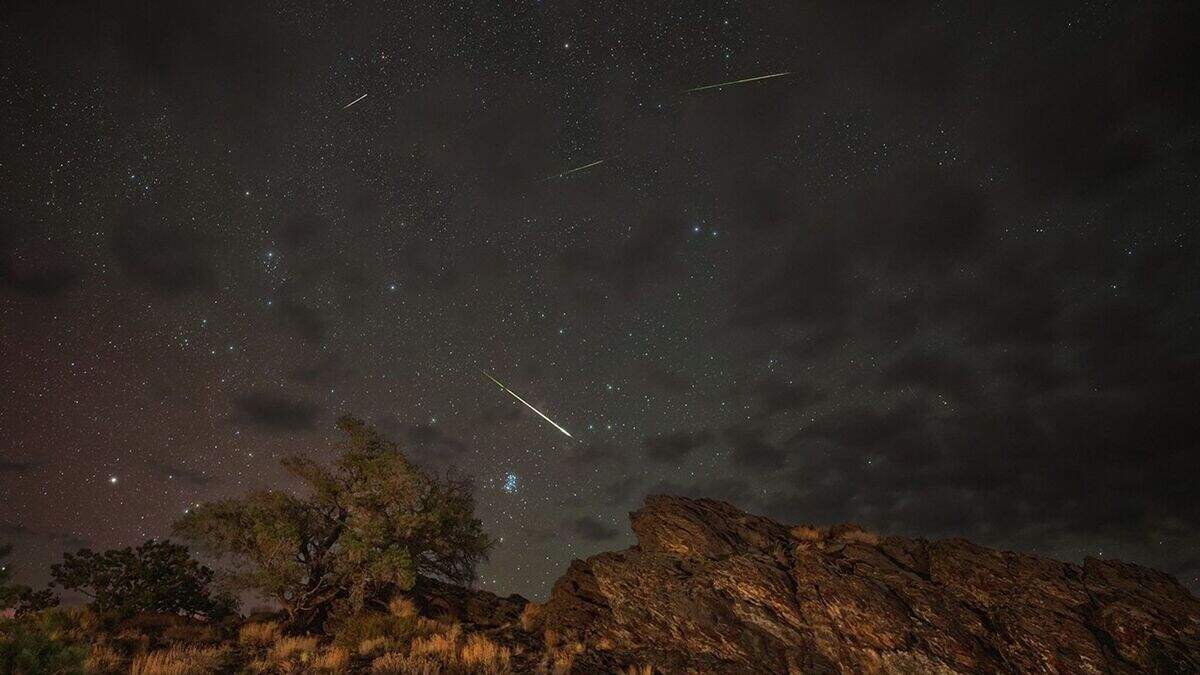
The Perseids meteor shower will soon peak offering stargazers, dreamers and others willing to search inky night skies a chance to see one of the best and brightest celestial shows of the year.
Read more New store opening in North Hills this summer, marking first Triangle location
Every summer the Earth slams into the cosmic trash and debris left from the Comet Swift-Tuttle, causing bright, fiery smears of color and light.
The meteor showers are underway now, but are set to peak next week. Here’s what you need to know.
Comet Swift-Tuttle orbits the sun every 133 years, leaving behind bits of ice and dust, some as small as grains of sand.
“It will interact in our atmosphere and create these beautiful streaks of light across the sky,” said Amy Sayle, science education specialist at the Morehead Planetarium and Science Center.
Swift-Tuttle, discovered in 1862, is almost twice as big as the object hypothesized to have led to the extinction of the dinosaurs, according to NASA.
The meteors appear to originate from the nearby constellation Perseus, giving the shower its name of Perseids.
Meteors can happen any night, but there are times of the year when you have a better shot to see them, Sayle said.
“Generally, we’re running into debris that’s been left over by a comet, and so we’ll run into that debris at generally the same point in our orbit every year,” she said. “That’s why meteor showers tend to peak around the same dates every year.”
The Perseids meteor showers are active from July 17 until Aug. 24 and are expected to peak on the night of Aug. 12 and into the early morning of Aug. 13, according to the American Meteor Society.
The best time to see most meteors will likely be between midnight and 5 a.m., Sayle said.
This year’s meteor shower peak coincides with a new moon, allowing for darker skies without interfering moon light. A new moon is when the moon sits between the Earth and sun, and it is invisible in the night sky.
There are at least two local events to see the Perseids meteor showers:
People should try to avoid urban areas with lots of light pollution, and many parks are closed to visitors at night. People may be able to rent a campsite at Jordan Lake or Falls Lake to stargaze.
Read more NC GOP Rep. Chuck Edwards ends reelection campaign after sexual harassment report
Always confirm the hours before planning an overnight stay.
The International Dark Sky Places programs certify locations around the world that protect and preserve dark skies, including two parks in North Carolina and one just over the Virginia border:
Visit North Carolina also recommends:
The meteors can be seen by the naked eye, so folks can leave binoculars and telescopes at home. Bring a blanket or chair, a hot drink and snacks, bug spray and anything else to make you comfortable looking into the night sky for at least 30 minutes.
“You’re gonna need time for your eyes to adjust to the dark,” Sayle said. “It does take a while so you’re going to want to be comfortable.”
That means staying off your phone.
“You don’t want to create your own light pollution,” Sayle said. You want to make it easier for your eyes to adjust to the dark and to be able to see the dimmer meteors. So you’re going to want to stay away from your phone screens, white flashlights, headlights, things like that.”
Even though August might not be considered a chilly month, Dana Bostic, co-chair of the Raleigh Astronomy Club, stressed it’s best to wear layers to avoid having to leave early.
“I’m not kidding about the bug spray,” Bostic said. “This is North Carolina. You want to make sure you can lay there and enjoy the night and look at the stars, and you’ll see meteors fire by.”
You’ll also need a bit of cooperation from mother nature.
“This is all going to require reasonable clear skies,” Sayle said. “You don’t want to bother going out during a rainstorm or totally overcast skies. Check the weather before you commit to losing a bunch of sleep.”
You can visit weather.gov/forecastpoints, type in your location and look at the percentage of sky cover for the time you want to try and watch the showers.
There is also a total solar eclipse on Aug. 12 that’s visible in its totality in parts of Spain, Greenland and Iceland. Parts of the eclipse will be viewable in the United States, including in some areas of North Carolina.
“I’m in Chapel Hill, and it’s not visible at all,” Sayle said. “But in Raleigh, there is the tiniest, tiniest, tiniest partial eclipse. I would say it is pretty much a non-event, but I was very entertained to see that a tiny, tiny, tiny fraction of the sun will be covered up between 1:52 p.m. and 2 p.m. Wednesday.”
Despite the eclipse’s brief appearance in the Triangle, people should still wear eclipse glasses and should not look directly at the sun.
A large partial lunar eclipse can also be seen this month on Thursday, Aug. 27, starting at 10:33 p.m. and lasting hours, Sayle said. Weather permitting, the Morehead Planetarium will host a sky watching party.
Read more NC GOP Rep. Chuck Edwards ends reelection campaign after sexual harassment report
About 96% of the moon’s face will be covered.