
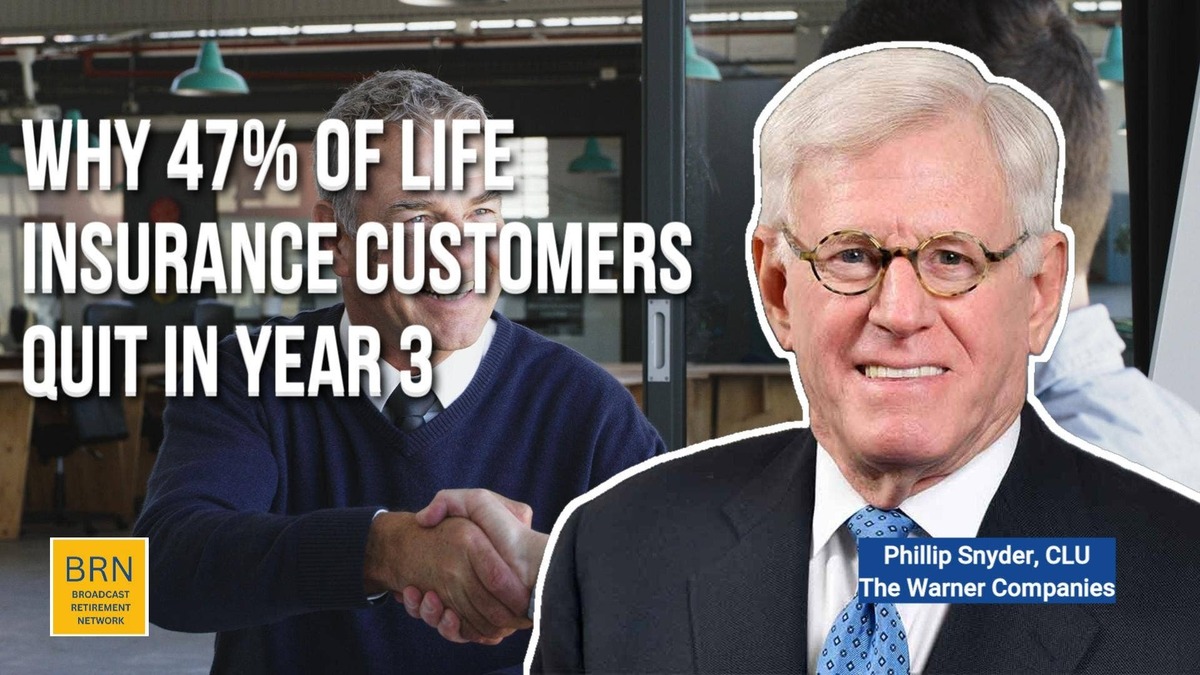
Phillip Snyder, CLU, The Warner Companies, addresses a critical challenge facing the life insurance industry: client retention. According to recent LIMRA research, 40% of policyholders rarely or never hear from their insurer after purchase.
Read more First round of tenants announced for new Wake County shopping center
Transcript:
Phillip Snyder, CLU, The Warner Companies
Okay.
Jeffrey Snyder, Broadcast Retirement Network
Well, dad, it’s always great to see you. Thanks for popping by the program this morning.
Phillip Snyder, CLU, The Warner Companies
Good morning, Jeff.
Always nice to be with you.
Jeffrey Snyder, Broadcast Retirement Network
Do you recollect what year this is for you in the life insurance and executive benefit industry?
Phillip Snyder, CLU, The Warner Companies
Lord, probably 45 to 50 years in that range.
Jeffrey Snyder, Broadcast Retirement Network
Okay, well, you’re an expert when it comes to a lot of these financial issues. It’s someone that I go to personally about not only life insurance, but financial. So I appreciate you coming on the program.
Dad, I wanted to, the reason why I reached out to you outside of just talking to you in general, because I love you, is there was a survey recently through LIMRA, which is a major life insurance association, lobbying group, whatever. They put out the World Life Insurance Report. And in the findings, it said that life insurers are losing clients at an alarming rate.
And I wanna get your reaction to that because I wanted to drill down into that. So let’s get your top line. When you read that article and you saw the survey, what did you think?
Phillip Snyder, CLU, The Warner Companies
Well, some of that is not surprising. I think they’re referencing younger buyers. Yes.
Who, for whatever reason, at their point in life, and I think most of them are under the age of 40, now are interested in buying life insurance, but they’re also disillusioned because they’re not really getting the care and treatment and follow-up that they need. And they don’t really know enough about what they bought or what they hope to buy to make an informed decision or to feel comfortable keeping what they did buy. So those are the issues.
Jeffrey Snyder, Broadcast Retirement Network
So does that track, look, you just said you’ve been in the life insurance and executive benefit industry, which uses a lot of life insurance products for the last 40, 50 years. Is that kind of track with your experience and expertise in dealing with younger people? Because to me, it just makes sense.
Phillip Snyder, CLU, The Warner Companies
Well, the answer is, of course, obviously my clientele is not younger people today and it’s more business oriented. But sure, I go back to my early days in the business and I think what I learned to do early on is that you need to educate people. You need to educate them as to why you think at least, and hopefully they will concur that they should buy life insurance.
What’s the purpose of it? How does it function? How do the various products actually work?
What are the options available to them? What flexibility is built into that in case things change? I mean, if you spend the time upfront creating relationships with clients, that’s gonna serve everybody’s best interest in the longer term.
Jeffrey Snyder, Broadcast Retirement Network
Okay, so, well, hold that thought. I wanna get your reaction to this. Because according to the report, 40% of policyholders, that’s a pretty significant number, almost 50%, say they rarely or never hear from their insurer after buying a policy.
So that tells me the customer service part, and that’s primarily probably done by the advisor, that’s not being done. Maybe there’s an opportunity here for people like yourself that are advisors, hey, touch your customer a little bit more, retain your customer.
Phillip Snyder, CLU, The Warner Companies
That has been a problem since day one when I came into the industry.
Jeffrey Snyder, Broadcast Retirement Network
Okay.
Phillip Snyder, CLU, The Warner Companies
The follow-up is really pretty bad in a general sense. That’s clearly there are those people within the industry, salespeople and companies that identify the fact that we’ve got to maintain relationships with people. These are not short term, buy something and move on to the next one.
These are relationships you’re trying to cultivate and maintain. And it just requires effort and commitment to do that. And really a general interest and a professionalism in what you’re doing.
And if you do those things, then you’ll be able to maintain your… Almost, you’re not gonna retain all your client relationships. And candidly, you probably don’t wanna retain some of them over time.
But at the same time, you really need to make the effort and realize that you’re helping people, not in the short term, but in the long term.
Jeffrey Snyder, Broadcast Retirement Network
It’s interesting to hear you say that from day one, that when you were in a business… So this is before, no offense, Deb, but this is before computers or mainstream computers. This is before probably the calculator, well, at least the digital calculator and before technology.
So it seems like it’s always been an issue. Technology today allows anybody, any advisor, to reach out directly to their client through email, through text, through telephone. Yeah, the good old telephone, right?
So I feel like the technology exists. All it takes is the effort. Or like shows like you coming on BRN, this is an opportunity for you to interact with your clients in a way that maybe they haven’t always seen you.
I mean, they’ve seen you in person, but they’ve never seen you on air.
Phillip Snyder, CLU, The Warner Companies
So that… Over the years, I’m sorry. Look, I still have client relationships now going on 40 or more years.
We’ve worked through their business interests, through their personal interests, through their children, now grandchildren in some cases we’re helping. But there are some that I haven’t maintained relationships with over the years for a variety of reasons, some of which maybe the fault may lie with me to some degree, but for the most part, you sort of, you’ve got to make a commitment. That’s what it’s all about.
And you can’t be successful at this business if you don’t do that.
Jeffrey Snyder, Broadcast Retirement Network
Is it more that it’s a focus on the sale? So most people, I don’t want to lump people in categories, but my experience has been that people in our line of work, they focus on the acquisition phase of the relationship because that’s the one that typically pays and it’s so hard to upsell products. So maybe it’s the focus of the advisor, the insurance company that it’s about acquisition and less about customer service.
Again, I don’t want to pay with this broad brush, but that’s just been my experience. Let’s go out and get the client and keep doing that.
Phillip Snyder, CLU, The Warner Companies
Yeah, I agree. Well, at the company level, I think there are clearly companies that take the time to train and really support their producers, we’ll call them, their marketing teams, and that gives them the wherewithal to maintain relationships. They cultivate the materials to target their clientele and they know more about their clientele than many of the other companies would otherwise know about their clientele.
But the way that business is oriented, the sale of individual life insurance products, for the most part, are high front-end commission products. And I think that’s a contributing factor and still remains a contributing factor because a salesperson who’s really not into it, that this is just a job, it’s not a career, and I’m doing this to make money, they’re going to run out and they’re going to sell as much as they can to people and move on to the next one because that’s where they make their quick money. But the reality is much of what we do in our practice here is revenue is generated over a long period of time, meaningful revenue.
So we’re interested in cultivating real relationships that not only benefit the client, but also benefit us. You need revenue to support the business you sell.
Read more 3 Great Netflix Movies to Watch Before They Leave Next Week (September 2026)
Jeffrey Snyder, Broadcast Retirement Network
Yeah, but the upfront costs of onboarding a client. So getting that client, you get a new, it could be an individual, you get a new insurance client. You’ve got to go through the process of getting them enrolled.
They usually have to take a medical exam unless it’s a guaranteed issue, right? There’s a big upfront cost. So wouldn’t it make sense, you want to keep that client for a long period of time in order to pay that revenue and also earn back that upfront cost.
It just doesn’t make sense to me. Maybe I’m missing it.
Phillip Snyder, CLU, The Warner Companies
Well, you’re 100% right, but that’s not the way everybody sees it, unfortunately. We spent a lot of time upfront with people long before we even begin to make a sale, we’ll call it. We’re trying to learn about the people, learn what they have, learn what they think, learn about their family, learn as much as you can as to what makes them tick and what their motivations are and what they want to accomplish.
And that takes time. That takes a lot of time before you even make a proposal to people. You’ve got to learn about the people.
Jeffrey Snyder, Broadcast Retirement Network
Dad, I want to ask you about, I know you’re not a huge user of AI, but I’m sure people in your firm use it. Customers more and more can get information from, they can just put a query in into one of these large language models and say, compare three products for me. Does that change?
I don’t even know if that information, by the way, is accurate. I have some questions, personal questions about the accuracy of some of these large language models, because if they’re built by humans, they’re going to have the same fallacies as humans. But let’s set that aside for a second.
People are using this as a tool, that is a tool. Does that change the relationship? I can just go out and look up insurance products and do a comparison through AI, and therefore I’m gone in three years or two years or one year.
Phillip Snyder, CLU, The Warner Companies
Yeah, well, clearly it has an impact. And you see that because you see it, if you look on TV, you’ll see all the ads running for $27 a month, you can get $8 million of insurance or whatever, some ridiculous ads like that. But those are just quick in and outs.
Really undermine what most of the real pros, the really good people in the insurance industry are trying to do is create relationships. I mean, I still have relationships with clients. I’ve sold something for 30 or more years ago.
And frankly, people haven’t bought anything from me in a long time, and I’m generating no revenue, but we’re still meeting with them, we’re still talking, we’re still delivering service to them. It’s not ideal for us, but that’s the commitment we made. Okay, and that’s what we wanna honor.
Jeffrey Snyder, Broadcast Retirement Network
What motivates you? So maybe the motivation, let’s talk about motivations of the advisor community, because obviously you, what motivates you to stay in the business that has changed dramatically over, especially over the last decade? What has motivated you as an individual?
I mean, obviously I know you, the audience doesn’t know you. So what has motivated you to stay in the business? What makes you get up every morning at your maturity and come to work every day and on Saturdays to do your job?
Phillip Snyder, CLU, The Warner Companies
No two people that I call are alike. Everything is different. Everything is a new opportunity and a new challenge.
And I learn new things every day, and it’s fun. It’s not fun every minute of every day. There are challenges.
There are things that don’t go my way or whatever the case may be, but it’s still fun to get out and talk with people and meet people of all different types. And we’ve been successful doing that over the years, business people, everyday people, government workers, whatever, high-end, middle-income people. They’re all just people, and they’re interesting to talk to.
And it’s a lot of fun to be helpful to those people. It’s very fulfilling to do that.
Jeffrey Snyder, Broadcast Retirement Network
So you’re more of a professional problem solver on a personal level than you are just a churner. So maybe that’s the difference. And do you see that?
I mean, you have people of all ages in your practice. So do you see, I don’t want you to call anybody out, but do you see differences between generationally from the younger brokers or advisors to someone like yourself?
Phillip Snyder, CLU, The Warner Companies
No, we don’t. Well, first of all, in this practice here, we don’t have too many young producers, as it were. We do have a couple of new people who are relatively new to the industry, but they’re catching on to what the real MO is and what we’re trying to do here.
But everybody else here, for the most part, is very professional. They really are interested in doing it the right way, helping people, helping them understand what their need may be, how to fulfill the need, understand the products, understand the pricing, the options, the flexibility, and the changes that occur over time. People’s lives change.
And the reason they may have bought something five or 10 years ago may no longer exist. So you’ve got to review everything, their ownership, their beneficiaries, their assets, things of that nature. You’ve got to do all that.
If you want to be a true pro.
Jeffrey Snyder, Broadcast Retirement Network
Yeah, I think that’s part of it. I think that you’re fighting this endless battle against information consumption, where people get it, how they get it, the frequency they wish they get it. And so you’re one of many touch points.
Not you in particular, but the advisor, the product producer. That’s kind of what you’re fighting against day in and day out, because people are getting it on their little device. Dad, I’m going to have to leave it there.
Really interesting conversation. Always great to see you. And thanks for joining us.
And I look forward to having you back on the program again very soon.
Phillip Snyder, CLU, The Warner Companies
Always my pleasure, Jeff. I wish you the best. And we’ll talk a little later today.
Have a good day.
Jeffrey Snyder, Broadcast Retirement Network
You too. Thanks, Dad.
Phillip Snyder, CLU, The Warner Companies
Bye-bye. Okay.
The Arena Media Brands, LLC THESTREET is a registered trademark of TheStreet, Inc.
Read more Lindsey Vonn Hard Launches Relationship With French Skier Matthieu Bailet
This story was originally published September 24, 2026 at 7:30 AM.