
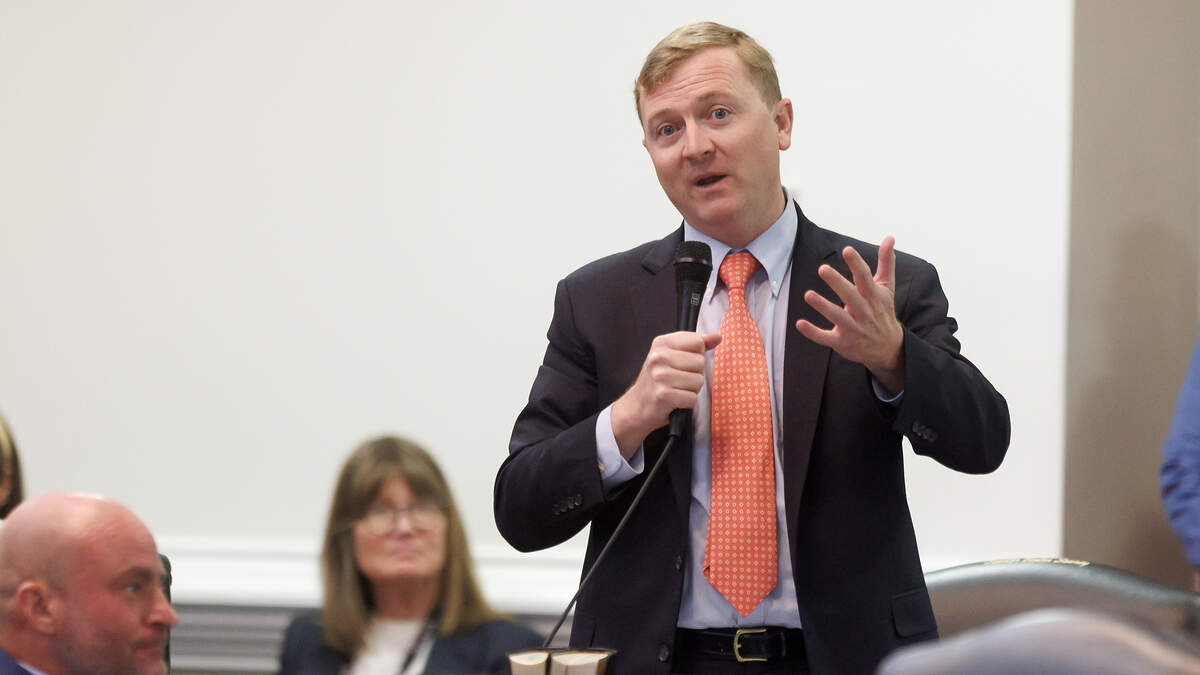
North Carolina lawmakers kicked off debate on the long-awaited $34 billion budget Wednesday.
Read more RDU Airport resumes flights after truck, corporate jet collide
The bill passed the Senate on a bipartisan 37-12 vote with several Democrats in favor, but two Republicans against it.
Debate has also begun in the House, with final legislative votes from both Republican-majority chambers expected Thursday.
The budget “reflects the need to rein in spending while prioritizing our state’s most pressing needs,” said Sen. Brent Jackson, a top budget writer, in opening remarks from Republicans.
“Republicans have been good stewards of taxpayer funds, and we’re not going to change that course now,” he said, noting that while the bill includes tax cuts, it still represents a 7% increase in spending over the last enacted budget.
The bill was released on Tuesday morning, posted to the General Assembly website. House Speaker Destin Hall and Senate leader Phil Berger announced a deal on major items in May, but were still negotiating the final legislation for more than a month. The bill revealed this week was not heard in committees, and is the product of negotiations between Republican Senate and House leaders. It cannot be amended on the floor.
Senate Democratic Leader Sydney Batch of Apex said the proposed budget “only gets us halfway there, and halfway does not deserve full credit.”
She said the budget doesn’t come close to “meeting this critical moment” of rising costs for North Carolinians.
“Some of my Democratic colleagues will vote for this budget today. Some will not, and that is because we understand every day of a delay only adds to someone’s pain,” Batch said. “And after 366 days of pain, we are not going to needlessly extend it one more day.”
Sen. Bobby Hanig, a Republican from Powells Point, voted against the bill.
His opposition stemmed from a provision in the budget that creates a new toll for using ferry routes in Eastern North Carolina, which he also opposed in the 2025 Senate budget proposal.
Hanig, who ran unsuccessfully for Congress and won’t be back next year, drew attention last year for opposing a GOP-backed bill in an episode some dub “shrimpgate.” On Wednesday, he said the toll could be called a “fee, but it is a tax.”
“No North Carolina citizen should have to pay a toll to ride on a ferry,” he said.
“I made a promise to my constituents a long time ago that I would not vote for ferry tolls,” and ”so for that reason, I have to be no on this budget,” he said.
Hanig and Sen. Norman Sanderson were the only two Republican senators to vote against the budget.
Sanderson, similar to Hanig, asked his Senate colleagues to reconsider the ferry tolls. He said a complete audit of the ferry system could find savings elsewhere.
Sanderson, of Pamlico County on the coast, said the ferry is “a part of our life. It really is. We don’t even think about using it anymore.”
“This is very important to the ones that live in coastal Eastern North Carolina,” he said. “It’s an intricate part of our transportation system, and it’s not something that I feel like that we should double charge our people to use.”
Once passed by both chambers, the bill will head to Democratic Gov. Josh Stein, who has 10 days to act. He has not yet indicated whether he will sign the measure, veto it or allow it to become law without his signature.
The budget was due last July but was delayed because of disagreements between the Senate and House on several issues, primarily the rate of tax cuts and amount of raises for teachers and state employees. Legislative leaders announced their budget agreement in mid-May, ending months of gridlock.
If Stein vetoes the bill, Republicans have enough votes in the Senate to override him but remain one vote short in the House, meaning they would need support from at least one Democrat or independent. A majority of House Democrats voted in favor of the GOP-written budget in 2025.
The final budget spans more than 600 pages and includes raises for thousands of teachers and state employees and funding for the new fiscal year that began on Wednesday for several state agencies and programs.
Read more NC budget bill ends one incentive for data centers, keeps other tax breaks
It is not retroactive, meaning new funding for the fiscal year that just ended is not included. The state runs on a two-year budget cycle, and the lack of a 2025 budget meant the state operated under spending levels approved under the 2023 budget. Lawmakers also passed a few small spending bills in late 2025 and authorized some step-increase raises.
Teachers will receive an average 8% raise, although the increases vary based on years of experience, with many veteran teachers receiving smaller raises because of salary plateaus. Most state employees will receive a 3% across-the-board raise, while law enforcement officers will receive increases ranging from 10.1% to 27.5%. Retirees will receive a 2.5% bonus this year if the budget becomes law.
Sen. Kevin Corbin, a Republican education budget writer, said the budget invests in advanced teaching role salary supplements, improving student results in mathematics and instruction on the use of artificial intelligence.
The budget also includes dropping the individual income tax rate to 3.49% in 2027, and eliminates some vacant state positions, freeing up money to be used by Republicans for other priorities. It also puts $450 million in the state’s rainy day fund and hundreds of millions more in other savings funds.
The Office of Health Equity, within the state’s health and human services department, which works to improve health access and eliminate health disparities, would be closed and its functions transferred to the Division of Public Health. Also eliminated is the Office for Historically Underutilized Businesses in the Department of Administration and funding for a program that aims to increase the progression and completion rates of minority male students.
Beyond raises and cuts, the budget includes several big-ticket items such as over $700 million more for Helene recovery needs, over $1 billion for Medicaid and $208 million for a pediatric hospital being built by Duke Health and UNC Health.
“While we’re glad we’re funding the Medicaid rebase requirements. I think this continues to be a cautionary tale of our increased healthcare costs received across the state of North Carolina,” said Sen. Benton Sawrey, a Johnston County Republican and healthcare budget writer.
“It continues to be one of the largest parts of our budget and eat off costs for things that we do,” he said, adding that the budget also includes funding to maintain “program integrity.” That includes $2.5 million in one-time funds to the state auditor’s office for an investigation of waste and abuse within the Medicaid’s program.
Also in the healthcare realm is $9 million in funding for North Carolina’s Healthy Opportunities Pilots, an experimental initiative that uses Medicaid funds to cover nonmedical services like food, housing and transportation. While showing positive results, it did not receive funding in 2025, and the program suspended operations. There is also funding for the Supplemental Nutrition Assistance Program, or food stamps, and SUN Bucks, which provides summer food assistance to eligible children while school is out.
Other provisions include ending a sales tax exemption for data centers for electricity used on site (though it keeps several others), increasing the tax rate from 18% to 23% on what the state taxes sports gambling operators, consumer protections for ticket resale websites and prohibiting those under 21 from entering vape shops.
Sen. Julie Mayfield, an Asheville Democrat, said “this budget giveth and it taketh away.”
She highlighted pieces she liked, such as funding for HOP and indigent defense services. But it cuts money going to legal aid organizations providing services for low-income people.
She contrasted the budget increasing taxes on gambling with also allowing gamblers to deduct their losses as an itemized deduction on their income taxes. She also pointed to the budget cutting hundreds of positions to fund other areas, such as the average 3% raise for state employees, which she said do not meet inflation increases.
“Despite all the new money that is in this budget, it feels to me like this is a budget born of a scarcity mindset rather than one of abundance, and it could be and should be different,” she said.
Yet she said despite all that, she would vote for it because a budget was needed promptly.
Notably not in the bill is funding for a Major League Baseball stadium in Raleigh or a clawback of funding for NCInnovation, a nonprofit awarded $500 million to help UNC System researchers convert promising concepts into revenue-generating businesses.
Another provision also calls for an end to physical motor vehicle registration cards and renewal stickers, replacing them with an electronic system.
Debate began in the House just before 2 p.m., with Hall saying the budget invests in the people of the state.
He said the long debate this past year “was ultimately worth it.” Hall praised the budget for cutting taxes as well as putting $1 billion in savings.
Read more Downtown Raleigh’s ‘crane lot’ is finally moving forward. Here’s what to know