
AI-generated summary reviewed by our newsroom.
If there’s always money in your checking account, you don’t have to worry about overdraft fees.
Read more Want squiggly, yellow center lines on a Raleigh street restriped? Make a TikTok about it.
But some North Carolinians struggle to keep funds in their account or to keep track of how much they have. And when that happens, they’re in danger of facing even more financial challenges.
The Consumer Financial Protection Bureau reported in 2024 that about 23 million U.S. households pay overdraft fees each year.
Overdraft fees, which banks charge customers when they withdraw more money than is in their account, are a revenue stream for banks. According to the CFPB, in 2023, reporting banks collected more than $5.8 billion in overdraft and non-sufficient funds fees — which result from a transaction being refused.
That amount, which had been dropping for years, is perhaps even more eye-popping when you consider that the typical overdraft fee is $35.
Decades ago, banks allowed their customers to overdraft their accounts as a courtesy, Pete Smith, a senior researcher for the Durham-based Center for Responsible Lending, told The News & Observer in a phone interview. Banking wasn’t as digital as it is today, and customers couldn’t simply open an app to see whether a check had cleared.
But later, banks started charging fees to cover overdrafts. And then in the 2000s, Smith said, banks realized they could capitalize on the service.
“They gradually built themselves a revenue stream by increasing the amount of the fee, even in situations where they could refuse to honor the transaction,” Smith said.
The situation for consumers eventually began to improve, Smith said. In the mid- to late-2010s, institutions such as the CFPB, Federal Reserve and Federal Deposit Insurance Corp. began requiring banks to let their customers opt in to overdraft coverage with debit card and ATM transactions. Some banks limited overdraft fees or eliminated non-sufficient funds fees.
But according to the Center for Responsible Lending, these actions aren’t enough.
“These big bank institutions could change these policies again at the drop of a hat,” Smith said. “Unfortunately, without a supportive regulatory environment, without supportive rules from the CFPB at this point, this change is tentative at best.”
In 2024, the CFPB supported a rule expected to save households that pay overdraft fees $225 per year. Through that rule, banks with more than $10 billion in assets could: cap overdraft fees at $5; cap their fee at an amount that covers costs and losses; or disclose the terms of their overdraft loan just like other loans.
The rule was supposed to take effect last October, but Congress overturned it.
That means North Carolinians, and consumers across the country, are still subject to the policies of individual banks, with no federal regulation.
“The fees that are charged on top of people’s income insufficiency is insult to injury,” Smith said.
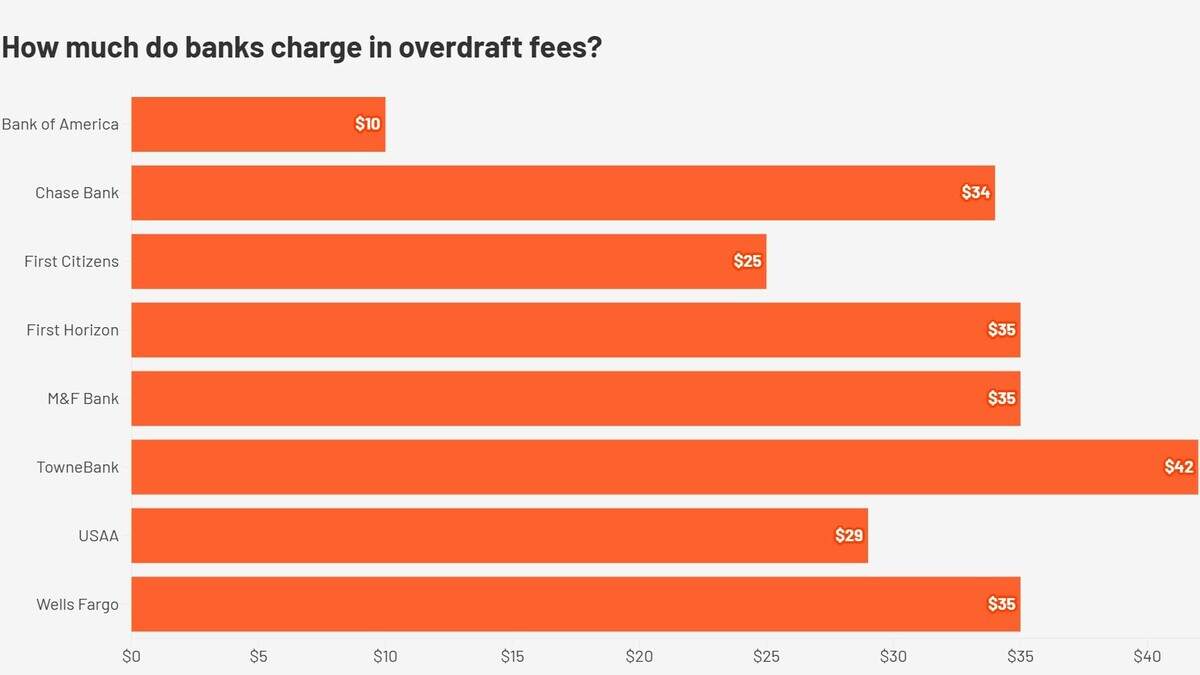
Here’s how some of the country’s biggest banks, plus some regional banks or those with North Carolina headquarters, handle overdrafts.
Read more Cozell McQueen, a member of NC State’s ‘Cardiac Pack’ in 1983, has died
Durham-based M&F Bank, which limits fees to no more than four items per day, and Tennessee-based First Horizon charge $35 per overdraft item.
TowneBank, headquartered in Virginia, charges $42 per overdraft. For personal accounts, overdraft fees don’t apply until the final daily balance is overdrawn by more than $50, and overdraft fees are capped at five items per day.
Raleigh’s First Citizens Bank, the 18th largest in the country, charges $25 per overdraft item. But it won’t charge that fee for transactions of $5 or less, and it won’t charge more than three overdraft fees per day.
Charlotte-based Bank of America, the second-largest commercial bank in the country, charges $10 per overdraft item, no more than twice per day. The bank won’t charge the fee for any item that is $1 or less or for a transaction that overdraws the account by $1 or less.
Chase Bank, the country’s largest, charges $34 in overdraft fees per transaction, with a maximum of three fees per business day. No overdraft fees are charged for transactions that are $5 or less, or when the account balance is overdrawn by $50 or less at the end of the business day.
Wells Fargo, the fourth-largest bank in the country, charges $35 for items paid into overdraft, with no more than three overdraft fees per business day for personal accounts. The bank won’t charge the fee on items that are $10 or less, or if the account’s ending daily balance and available balance are overdrawn by $10 or less after all transactions have been processed.
USAA, which serves the military community and veterans, charges a $29 overdraft fee per day, per account. The fee won’t be charged if, by the time all transactions are processed for the day, the account is overdrawn by $100 or less. USAA also won’t charge the fee for transactions of $5 or less.
Here’s how much revenue these banks reported from overdraft fees in 2025, based on consolidated reports of condition and income, aka call reports:
The simplest way to protect yourself against overdraft and non-sufficient funds fees is by not spending more than you have in your account.
And when you look at your account, don’t forget about outstanding transactions, including checks you’ve written or upcoming automatic payments.
Also, learn your bank’s policies.
Some banks, such as Chase, offer a grace period, which means you have a little bit of time to deposit funds into your account before you’ll be charged. USAA will refund an overdraft fee if you deposit funds into your account within a certain window of time.
Your bank may also allow you to link your savings account or a credit card to a checking account, so that if you overdraft your checking account, money will be automatically transferred to it. There may be a fee for this service. And if you use a credit card, it will be treated as a cash advance, which typically carries a much higher interest rate than purchases.
You can also ask your bank to decline or return transactions. This may help prevent most, but not necessarily all, overdraft fees, and you may also be charged a non-sufficient funds fee.
Read more More backyard cottages allowed under legislature’s move to add housing supply