
AI-generated summary reviewed by our newsroom.
The battle to stop a pipeline in Chatham County has only heated up.
Enbridge Gas North Carolina has proposed a 28-mile natural gas pipeline, 12 inches in diameter, from Moncure to Siler City. The company, which is a Canadian energy infrastructure company with subsidiaries across North Carolina, previously told The News & Observer it will help residential demand in Chatham and Lee counties, which has increased 2.7% over the past year.
Read more Banks collect billions in overdraft fees. Which in NC charge the most?
Enbridge said it has surveyed 200 people in the area and have assigned each a land agent to communicate any concerns they have with the study corridor map Enbridge has presented.
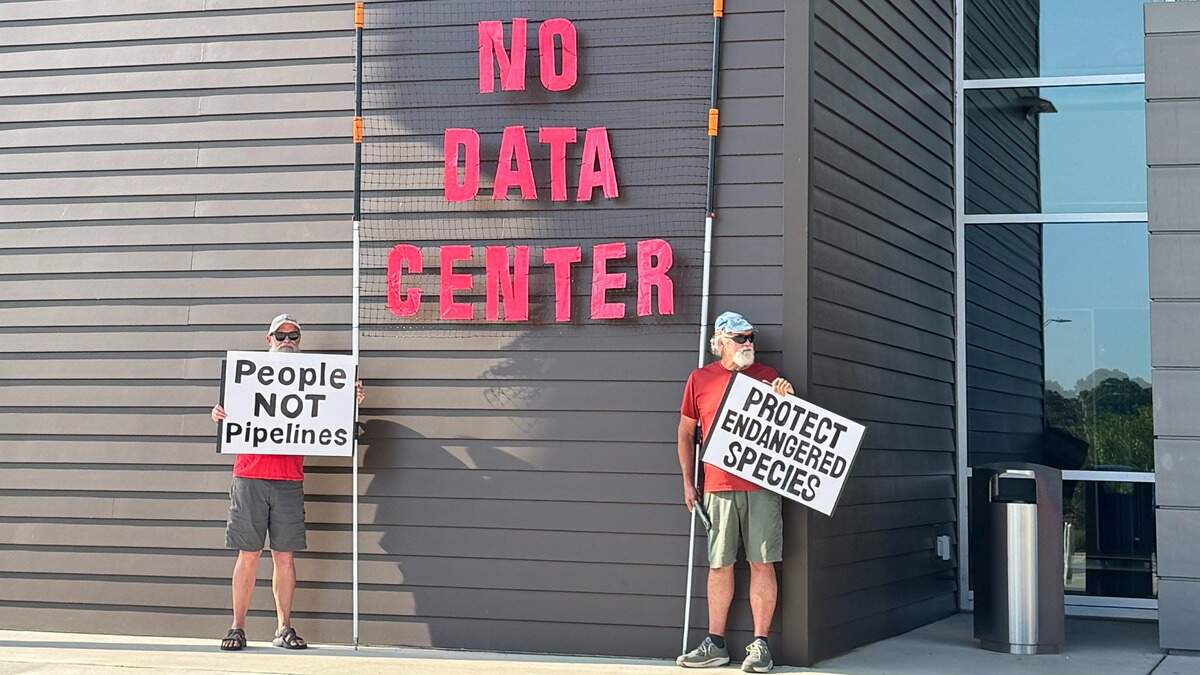
But residents have only mobilized further against the project. On Wednesday evening, more than 320 residents packed the Chatham County Agriculture & Conference Center in a meeting held by the Chatham County Board of Commissioners. Inside, farmers, scientists, professors, veterans, business owners and landowners lined up for more than two hours to oppose the proposal, each with unique testimony.
“I’m coming up here for my family and all my neighbors. But as a Marine, and so many veterans here — we’re always ready for a fight,” resident John Ladner said.
The commissioners took no action related to the project before moving into a closed session.
Robin Holmes and her husband never made more than $30,000 each per year. For over 20 years, they’ve paid $200 a month for 16 acres they bought. “That’s our family legacy,” she told the board members.
“I’ve only lived here 45 years, a fraction of the time that these old trees and the old growth forest and the farms have lived here,” she said. “There’s not a third-grader in this county that doesn’t know how important the environment is to their future, and we adults need to start acting like it.”
At both a July 17 community meeting hosted by Haw River Assembly, an environmental advocacy group, and a July 28 open house hosted by Enbridge, residents in the area have made clear three major issues: property, potential leaks and the environment.
James Gunipero, who spoke at the Wednesday meeting, and his wife Eileen, previously told The N&O that Enbridge has downplayed the long-term restrictions that easements could have on farm owners who would no longer be able to grow or build near the pipeline. The easement, which is expected to be 50 feet wide, is a legal right that allows Enbridge to use residents’ land for the pipeline, but not take direct ownership of property.
Governments can use eminent domain to acquire private property for projects that are deemed to benefit the public. They must pay the landowners for their property. Private utility companies can also use eminent domain for purposes such as pipelines.
Politicians, such as the Democratic congressional candidate for the 9th district, Richard Ojeda, and Democratic state Sen. Natalie Murdock of Durham, also came to show support for the residents.
NC State University instructor and biologist Aaron Bell said the proposed corridor could cross tributaries supporting endangered aquatic species, including habitat connected to one of the largest known populations of the federally endangered Cape Fear shiner. Even one chemical release could threaten the species, he said.
Enbridge has a controversial history in Wisconsin. The Bad River Band of Lake Superior Chippewa sued the company over its 41-mile oil pipeline after it crossed into tribal land. A federal judge ruled in 2023 the company has trespassed on the reservation since 2013 and ordered it to reroute.
Read more Want squiggly, yellow center lines on a Raleigh street restriped? Make a TikTok about it.
Separately, in 2024, Enbridge detected a crude oil spill of 70,000 gallons in a small town in Wisconsin, prompting cleanup efforts that cost $1.1 million. And in 2019, Wisconsin regulators accused the company of violating state law by waiting more than 15 months to report a pipeline leak near Fort Atkinson that released 1,200 gallons of petroleum into groundwater.
Enbridge has operated safely in Chatham County since 1955, the company has said.
At the meeting, resident Whitney Schmidt asked the Chatham County Board of Commissioners to pass a resolution of opposition to the project.
“We must demand a local witness hearing from the North Carolina Utilities Commission. NC law provides for and encourages this, and the NCUC can and will come to Chatham County to hear local intervening testimony. The county should refuse to sign any voluntary easement request from Enbridge, where the pipeline would cross land for the project,” she said.
Residents also urged commissioners to require Enbridge to obtain a special-use permit which would force the project to undergo the same local review process as other major developments.
In a statement handed to members of the press, Amanda Robertson, chair of the Board of Commissioners, said they have limited authority over the approval process and ultimate outcome of the project, but that it is important the board is informed by “the voices of our community,” for authority they have available.
In asking commissioners to oppose the pipeline, critics cited a lack of public need for more natural gas and the potential for environmental harm.
“When mature trees are cut down we lose carbon sequestration and ecosystem health that take centuries to replace. I don’t know how many trees are in the pipeline’s path … I imagine it’s thousands,” Joanna Hendrick told the board. “Please throw sand in the gears in whatever way you can.”
Enbridge cannot apply for environmental permits until a route is finalized. At the open house July 28, Enbridge spokesperson Persida Montanez told The N&O the company is collecting as much information as possible based on residents’ concerns before finalizing the route.
Many residents are urging the North Carolina Department of Environmental Quality to require individual permits for each stream and wetland crossing instead of issuing one general permit. Once Enbridge does apply for permits, DEQ has 15 days to review an application, followed by 15 days for Chatham and Lee residents to provide feedback.
“Look around this room. Most of the people here are the residents of Chatham County that you were elected to serve,” county resident Donald Paul Lyerly told the board Wednesday evening.
There is no future county board agenda item scheduled to discuss the pipeline further, according to the statement.
Read more Cozell McQueen, a member of NC State’s ‘Cardiac Pack’ in 1983, has died